
Timesheet fraud isn’t just padding hours here and there. It’s costing construction companies thousands per worker annually – and most don’t even know it’s happening.
Here’s the truth: If you’re relying solely on manual timesheets or trusting foremen to track every worker’s hours, you’re exposed. Buddy punching, inflated hours, and falsified time entries add up fast. One employee clocking in for absent coworkers can cost you $4,285+ per year. Multiply that across your crew.
This isn’t about catching bad actors. It’s about eliminating the opportunity for time fraud in the first place. Because when workers know they can’t cheat the system, the honest ones stay motivated – and the ones looking for shortcuts find somewhere else to work.
This risk compounds on public projects, where certified payroll audits rely on accurate classifications and verifiable hours.
Wage compliance on those projects depends on a data trail that starts at the time clock, not in the payroll office.
Let’s break down what timesheet fraud actually looks like, why it matters, and how to prevent time card fraud permanently.
What is Timesheet Fraud?
Timesheet fraud happens when employees manipulate attendance data to get paid for hours they didn’t work.
In construction, this typically means workers clocking in for absent colleagues (buddy punching), inflating work hours on paper timesheets, taking unauthorized breaks without clocking out, or employees caught falsifying timesheets to boost overtime pay.
Most companies using manual submission processes or paper-based time records create the perfect environment for time fraud. When there’s no verification system – just a foreman signing off on a crew’s hours – it’s too easy to game.
The American Payroll Association reports the average employee steals 4.5 hours per week. That’s six weeks of wages paid for work that never happened. Per worker. Per year.
For a 200-person construction company, that’s 54,000 hours of lost productivity annually. Do the math on your average hourly rate.
Is Timesheet Fraud a Crime?
Yes. Timesheet fraud is theft.
Depending on the amount stolen and your state’s labor laws, employees caught falsifying timesheets can face immediate termination per most employment contracts, civil lawsuits for recovery of stolen wages, criminal charges for fraud or theft (especially if amounts exceed state thresholds), and federal prosecution on government contracts like prevailing wage jobs or Davis-Bacon work.
For employers, the legal consequences extend beyond stolen wages. Non-compliance with accurate time records creates Department of Labor violations, wage and hour lawsuits, workers’ comp fraud exposure, and tax reporting issues.
But here’s what most companies miss: The bigger risk isn’t the legal action. It’s the systematic bleeding of profit margins while you assume your time tracking works.
6 Common Types of Timesheet Fraud
1. Buddy Punching
The classic. One employee clocks in for another who’s late, absent, or left early. Without biometric attendance systems, there’s nothing stopping John from clocking in for Sarah every Monday morning when she’s running late.
The cost: If Sarah is 30 minutes late twice a week at $25/hour, that’s $25/week × 52 weeks = $1,300 annually. Per buddy-punching pair, that’s a lot of financial losses.
2. Time Rounding Abuse
Workers can game your rounding rules. If you round to the nearest 15 minutes, they clock in at 7:08 (rounds to 7:00) and out at 4:52 (rounds to 5:00).
The theft: 15 extra minutes per day = 1.25 hours/week = 65 hours/year = $1,625 at $25/hour. Per worker.
3. Extended Breaks and Unauthorized Time Off
Workers take long breaks or handle personal tasks on company time without clocking out. That “quick 30-minute lunch” stretches to 90 minutes, but the timesheet still shows a 30-minute deduction.
The impact: An extra hour daily of unauthorized breaks = 260 hours/year = $6,500 per worker.
4. Timesheet Inflation
Padding daily hours on manual timesheets. Recording 8 hours when they only spent working 7. Claiming 10-hour days that were actually 9. Over time, this inflation of work hours becomes normalized.
The damage: One hour of inflated hours worked daily = 260 hours/year = $6,500+ per worker, plus overtime thresholds getting triggered unnecessarily.
5. Incorrect Arrival and Departure Times
Workers arrive late but record arriving on time. Leave early but mark their departure as end-of-shift. Without GPS tracking or facial recognition verification at the jobsite, there’s no proof of actual arrival times.
Example: Arriving 20 minutes late and leaving 15 minutes early daily = 145 hours/year = $3,625 stolen per worker.
6. Unauthorized Overtime Claims
Claiming overtime hours that weren’t worked or weren’t approved. This is particularly common on T&M jobs where overtime thresholds get fuzzy and manual submission makes verification difficult.
The multiplier effect: Overtime at 1.5× turns that $25/hour into $37.50. Small overtime fraud has massive cost inflation.
Timesheet Fraud Consequences
Timesheet fraud doesn’t just inflate costs – it destroys company culture and exposes you to compliance risks most contractors don’t see coming.
1. Massive Labor Cost Overruns
Paying employees for work they didn’t do hits your bottom line directly. With construction operating on 2-5% net margins, even small time theft can push profitable jobs into the red. A 100-person crew with just 3% time fraud equals 12,000 stolen hours annually – that’s $300,000+ in lost profit at $25/hour.
2. Destroyed Employee Morale
Honest workers see colleagues stealing time without disciplinary action. The message is clear: working hard doesn’t matter. This creates a culture where the dishonest thrive and the reliable workers start looking for companies that actually reward employees who show up and do the work. The cycle is predictable: low morale leads to higher turnover, increased recruiting costs, more inexperienced workers, and more opportunity for time theft.
3. Your Company’s Reputation Takes a Hit
Word spreads fast in construction. If you’re known as a company where workers can game the system, you’ll attract the wrong employees and struggle to hire quality crews. Clients notice too – especially on cost-plus or T&M work where inflated labor hours directly impact their budgets.
4. Internal Trust Breakdown
When one employee realizes others are clocking in late and still getting paid for 8 hours, teamwork erodes. Foremen lose credibility when they can’t enforce accountability. Project managers start questioning every timesheet. Open communication breaks down. Projects suffer.
5. Compliance Nightmares
Inaccurate timekeeping creates exposure you can’t afford. Wage and hour violations under FLSA. Incorrect overtime calculations triggering Department of Labor audits. Workers’ comp premium fraud, where overstating hours inflates your premiums. Prevailing wage non-compliance on government work. Tax reporting errors when paid hours don’t match worked hours. Each one opens the door to legal action and fines.
6. Increased Oversight Costs
Once time fraud becomes obvious, you’re forced into damage control: manual audits, additional supervisors, time-consuming verification processes. Every dollar spent on oversight is a dollar not spent growing the business.
The real cost isn’t just the stolen wages. It’s the systematic profit erosion while you assume your current process works.
Effective Strategies to Prevent Timesheet Fraud
Preventing timesheet fraud starts with eliminating the opportunity – not trusting everyone will do the right thing. Here’s how to instill strict policies that actually work in field conditions.
1. Deploy Biometric Attendance Systems
Face it: If workers can clock in for each other, they will. Biometric facial verification ensures the person checking in is actually on-site. No more buddy punching. No more one employee covering for the crew.
Why facial recognition beats everything else: It works with gloves (unlike fingerprint scanners), works with dirty hands and welded fingerprints, requires no fobs to share or lose, can’t be fooled by photos thanks to AI verification, and requires zero training.
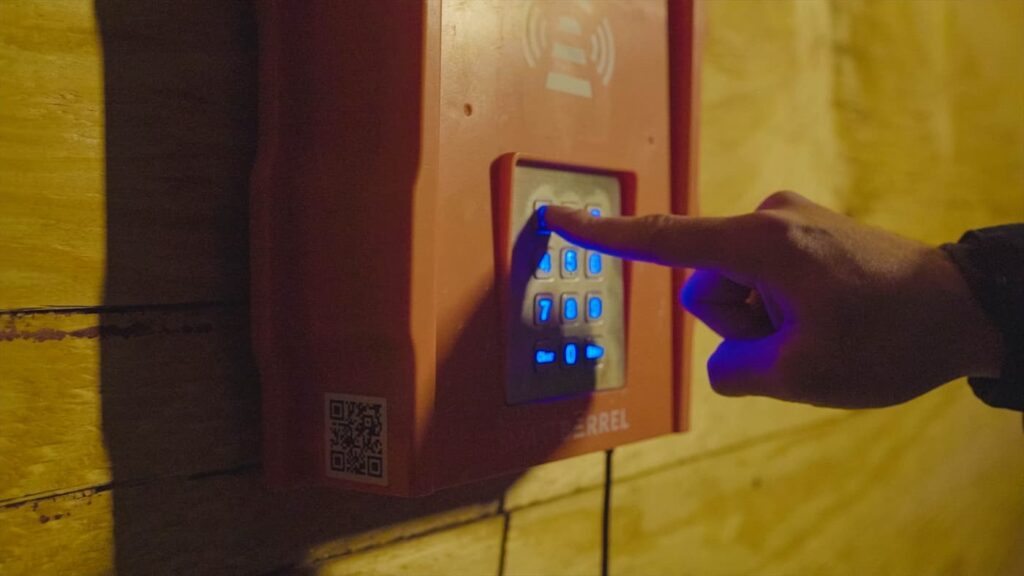
SmartBarrel’s approach is simple. Workers scan their face in under 3 seconds. The system self-learns – no photoshoot required. Works in any condition. Built-in LTE means no WiFi dependency.
It also means the rugged check-in hardware can go straight onto a fresh jobsite, with no network closet or IT visit required.
2. Implement Real-Time Time Tracking
Manual timesheets entered at the end of the week are fiction. You need accurate time records captured the moment workers clock in and out – not hours or days later.
The requirement: Live data that shows you who’s on which jobsite right now, exact check-in and check-out times, automatic lunch break deductions, and GPS verification of location.
Why it matters: Real-time visibility means you can address timesheet discrepancies immediately, not during payroll review when it’s too late to fix.
Managing multiple jobsites? Our analysis of the best time tracking software for construction companies focuses on solutions that actually scale beyond 50 workers.
3. Establish Clear Time Theft Policies
If workers don’t know time fraud is a big deal, they’ll treat it like borrowed staplers. Your employment contract and employee handbook need explicit language on what constitutes time theft, why accurate time promptly matters, consequences for employees caught falsifying timesheets (up to and including job loss), and how you’ll detect and investigate time entries.
To successfully prevent timesheet fraud, make your company policy visible. Post your time theft policy at every check-in location. Discuss it during onboarding. Reference it in toolbox talks. The goal isn’t to threaten – it’s to eliminate any confusion about expectations.
4. Remove Foremen from Timekeeping Duty
Your foremen should be leading crews and keeping projects on track – not playing timekeeper and enforcer. When foremen are responsible for time records, they’re stuck in an impossible position: motivate the crew while also docking pay for tardiness.
The fix: Let technology handle verification. Workers clock themselves in and out with facial recognition. Foremen get pre-populated timesheets to review – not create from scratch. This removes the burden and eliminates the temptation to “help out” workers with questionable hours.
5. Eliminate Manual Submission Processes
Paper timesheets and Excel spreadsheets create too many opportunities for manipulation. Every manual touchpoint is a chance for time entries to be padded, lunch breaks to disappear, or overtime to mysteriously appear.
Replace manual systems with automated timekeeping systems that capture data at the source, apply your business rules automatically (rounding, breaks, overtime thresholds), and flow directly to payroll. Zero manual intervention means zero opportunity for inflation of work hours.
Construction time tracking software handles that capture automatically, recording each punch with a timestamp the worker cannot edit after the fact.
Automated labor verification adds another layer by learning each worker’s biometric profile over time, so the system catches discrepancies the moment they happen rather than during end-of-week review.
6. Use Automated Reporting and Audits
Relying on spot-checks and manual reviews won’t catch systematic time fraud. You need reporting that flags anomalies automatically: workers consistently clocking in before the jobsite opens, unusual patterns like always exactly 8.0 hours, spending excessive time on personal tasks during work hours, and overtime claims that don’t match project schedules. The goal is identifying key areas of risk before they become systemic problems.
7. Train Everyone on Labor Laws and Consequences
Most workers don’t commit timesheet fraud because they’re criminals. They do it because they don’t understand the seriousness (legal action, criminal charges), they see others doing it without consequence, they think “everyone rounds up” or “borrowing a few minutes” isn’t a big deal, or they don’t realize it violates their employment contract.
Fix this through education. Regular training on why accurate reporting matters, what time theft actually costs the company, and how it hurts their honest coworkers. Make the consequences real and visible.
8. Reward Employees Who Do It Right
When you only punish time fraud, you create a culture of fear. Balance enforcement with recognition. Acknowledge crews that consistently submit accurate time records. Call out workers who check in properly despite bad weather, equipment issues, or inconvenience. The message: We value integrity. We notice who shows up and does it right.
Using SmartBarrel’s Solution for Eliminating Timesheet Fraud
SmartBarrel doesn’t just track time – we eliminate the opportunity for time fraud to exist in the first place. 20% of companies can reduce payroll costs by implementing effective time tracking solutions.
Typical mobile time tracking apps require workers to have phones, download software, and remember to clock in. Fob systems get shared. PIN codes get passed around. Fingerprint scanners fail with gloves or welded hands. Paper timesheets are fiction.
Every solution leaves a loophole. Every loophole costs you money.
How SmartBarrel Works
Biometric Facial Verification
Workers walk up to the device, type their phone number, and scan their face. That’s it. Under 3 seconds. The system uses AI to verify it’s actually them – not a photo, not their buddy, not last week’s picture. Green circle = verified and clocked in. Red circle = something’s wrong, review needed.
No photoshoot required. The system self-learns workers automatically. First check-in takes 60 seconds. Every check-in after takes 3 seconds. No phone needed either – workers can use self-registered fobs if they want. Works for anyone, anywhere. Zero excuses.
90% of organizations using biometric systems have reported a decrease in timesheet fraud incidents.
Real-Time Data Flow
The second a worker checks in, that data hits your dashboard. You see live headcount across all jobsites, who’s on-site right now (who’s late, who left early), exact timestamps instead of rounded estimates, automatic lunch break deductions based on your rules, and GPS verification that the device and worker are at the right location.
No waiting for end-of-week submissions. No chasing foremen for timesheets. No manual entry errors.
Accurate Time Records, Automatically
SmartBarrel captures 70+ data points on every check-in: biometric verification status, GPS coordinates, exact time (not rounded), weather conditions, project and cost code assignment, crew assignment, and photo documentation.
Your foremen get pre-populated timesheets. They review, assign cost codes, approve. Done. The data integrity is built in – they can’t change the check-in time, delete verifications, or pad hours.
A review-only workflow for foremen, where the hours arrive already captured, is what keeps the final numbers clean.
Eliminates Every Fraud Vector
Buddy punching? Impossible. Facial verification ensures only the actual worker can clock in. Manual timesheet padding? Gone. Workers can’t edit their own time. Foremen can’t create hours that didn’t happen. Long breaks and unauthorized time? Visible immediately. You see when they checked out and back in – no hiding a 2-hour lunch break. Fake arrivals? GPS tracking proves they’re on-site. Device placement verification confirms the time clock is where it should be. Time rounding games? Your rules apply automatically and consistently. No worker manipulation.
Works in Real Construction Conditions
No WiFi required – built-in LTE connectivity works in parking structures, basements, remote sites, anywhere. No power infrastructure needed – solar-powered or battery-powered with magnetic mount on any trailer or container. Set up in under 5 minutes. No training required – workers figure it out in 10 seconds. Works with gloves, dirty faces, and welded hands, unlike fingerprint scanners or most mobile solutions.
The ROI Is Immediate
Time theft eliminated: $4,285+ saved per worker annually (based on 4.5 hours stolen weekly at $25/hour). Manual entry eliminated: 800+ hours saved annually on timesheet entry and corrections. Payroll processing happens in hours instead of days – pre-populated, verified data flows directly to your ERP. Most contractors recover their SmartBarrel investment in 30 days from time theft prevention alone.
Integration That Actually Works
SmartBarrel plays nice with your existing tech stack:
- Procore: Timesheets, timecards, daily logs
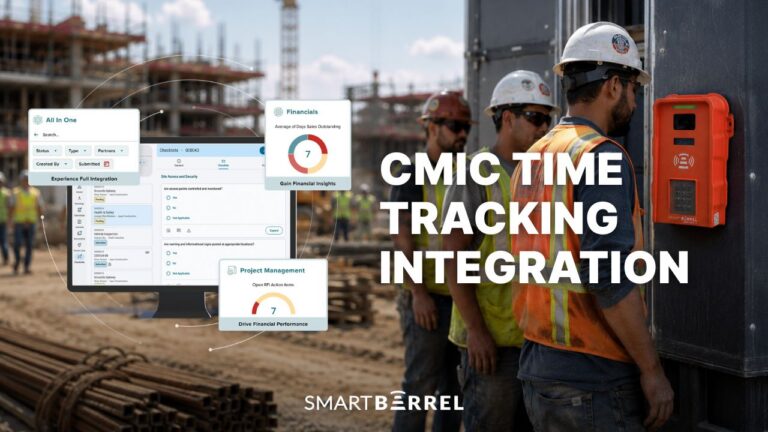
- Foundation, Vista, CMiC: Direct timesheet integration
- PowerBI, Tableau: Real-time labor analytics
- Your payroll provider: Clean data export
Zero-touch data flow: Field → SmartBarrel → ERP → Payroll. No manual re-entry. No transcription errors. No gaps where time fraud can hide.
Built for Scale
Whether you’re running 3 jobsites or 30, SmartBarrel scales without breaking. Unlimited devices across unlimited projects. Multi-state operations with automatic compliance rules. Support for self-perform GCs, specialty contractors, and complex workforce structures including direct employees, temp labor, and hourly subs. Real-time visibility across your entire operation.
Simple for your crew. Built for your complexity.
Get Control of Your Time Tracking
FAQ About Timesheet Fraud
How to deal with timesheet fraud?
Start by documenting everything – time records, GPS data, witness statements, project logs. Anything that proves the actual hours worked versus claimed. Investigate quickly by interviewing the employee privately and reviewing patterns. Is this a one-time error or systematic theft? Check for other employees involved.
Enforce your time theft policy consistently. If your policy says termination for falsifying timesheets, follow through. Inconsistent enforcement destroys credibility and signals to other employees that time fraud isn’t actually a priority.
For significant amounts or repeated fraud, consider legal action. Consult with employment counsel about demanding restitution for stolen wages, criminal charges (depending on state laws and dollar amounts), or civil lawsuits for fraud.
Most importantly, fix the system that allowed it. If manual submission or lack of verification created the opportunity, close that loophole immediately. Deploy biometric attendance systems that eliminate the chance for future fraud.
How serious is timecard fraud?
Extremely serious – for both employees and employers.
For employees caught falsifying timesheets, it means immediate job loss in most cases, difficulty finding future employment through reference checks and background checks, civil liability for restitution, potential criminal charges depending on amount stolen and state laws, and even federal prosecution on government contracts.
For employers who don’t address it, the consequences compound. Systematic profit loss over time. Department of Labor violations for inaccurate time records. Increased workers’ comp premiums because fraudulent hours inflate your experience mod. Compliance risks on prevailing wage work. Destroyed company culture and employee morale. Reputation damage that makes hiring quality workers harder.
The hidden cost goes beyond the stolen wages. Time fraud signals to honest employees that integrity doesn’t matter. This drives away your best workers and attracts more fraud.
Why do employees commit timesheet fraud?
Most time theft isn’t malicious – it starts because the opportunity exists and consequences seem distant.
They see others doing it. If one employee clocks in for another without consequence, the behavior spreads. Peer normalization makes fraud feel acceptable. They don’t think it’s a big deal. “Borrowing 15 minutes” or “rounding up to the next hour” doesn’t feel like theft. They rationalize it as deserved or minor.
Weak verification systems invite fraud. When manual timesheets or honor-system time clocks are the only controls, there’s no real barrier. If the system can’t catch them, why not try? Financial pressure plays a role too. Workers struggling with bills may pad hours to make ends meet, not thinking about long-term consequences.
Poor relationships with employers also contribute. Employees who feel undervalued or underpaid sometimes justify time theft as “evening the score.” This is especially common when workers see profits but don’t feel fairly compensated. And if foremen cover for late arrivals, managers ignore inflated timesheets, or leadership doesn’t care about accurate reporting, workers learn that time theft is acceptable.
The solution: Remove the opportunity to enter time manually. When workers know they literally can’t cheat the system – biometric verification, GPS tracking, real-time data – timesheet fraud stops before it starts.
How to detect timesheet fraud?
Watch for pattern anomalies
Workers always recording exactly 8.0 hours (too perfect). Consistently rounding to the next hour or quarter-hour. Overtime claims that don’t align with project schedules. Time entries submitted days after the fact. Workers always clocking in just before the next hour for rounding benefits.
Look for inconsistent documentation
Timesheet hours that don’t match the foreman’s daily reports. Workers recording hours on jobsites they weren’t assigned to. Time claimed on days when the jobsite was shut down for weather or inspections. GPS tracking showing they weren’t on-site during claimed hours.
Behavioral signals matter too
Workers who arrive late but always record on-time arrival. Extended lunch breaks without corresponding time deductions. Leaving early but recording full shifts. Resistance to new time tracking systems with comments like “the old way worked fine.”
Financial indicators tell the story
Labor costs exceeding budget despite production staying on track. Overtime expenses spiking without corresponding productivity gains. Payroll hours not matching project progress reports.
Use automated auditing through software that flags unusual patterns
SmartBarrel’s reporting dashboard shows timesheet discrepancies automatically, alerts when time entries deviate from normal patterns, and compares recorded time against project milestones. Combine this with random manual audits – spot-check timesheets against security camera footage if available, project manager logs and daily reports, GPS data from vehicles or equipment, and delivery records and material sign-offs.
The most effective detection is prevention
Deploy biometric attendance systems. When workers must verify their identity with facial recognition at check-in, fraud becomes impossible – not just detectable. Real-time visibility is your best tool. If you can see who’s on-site right now, track check-in times as they happen, and verify identities biometrically, time fraud can’t hide.
Stop Timesheet Fraud
Time theft isn’t going away on its own. Every day without a verified time tracking system is another day of systematic profit erosion contributing to significant financial losses.
The companies that eliminate timesheet fraud permanently have three things in common: They make buddy punching physically impossible with biometric facial verification. They capture accurate time at the source with real-time data – not end-of-week guesses. They remove foremen from the timekeeper role and let automation handle verification.
SmartBarrel handles all three. Out of the box. First worker clocked in within 60 seconds of setup.
No WiFi required. No phones required. No training required. No excuses.
Want to see how much time theft is actually costing you? Book a demo and we’ll calculate your current losses based on your crew size. Most contractors are shocked by the number – and relieved by how fast the ROI hits.
Because timecard fraud isn’t a technology problem. It’s an opportunity problem. Ensure compliance, eliminate the fraud.