


Most specialty contractors don’t get to choose between union and non-union labor – they manage both because that’s what projects require.
The difference between union and non-union workers goes far beyond pay rates. It’s about compliance structures that don’t align, accountability systems that work differently, and operational complexity that multiplies when both workforces occupy the same jobsite.
For most trade contractors running multiple jobsites, the question isn’t which workforce type to choose. It’s how to manage both effectively without overloading your operations team.
Union members come with guaranteed hours, union contracts, and strict reporting requirements. Non-union workers offer scheduling flexibility but demand tighter documentation. When you’re running both on the same project – union electricians alongside non-union workers, your own employees mixed with union members- you’re essentially operating two parallel systems on one jobsite.
This guide breaks down the operational differences, compliance challenges, and time tracking requirements for contractors managing both workforce types.
Key Differences: Union vs. Non-Union Construction Workers and Job Security
The differences between union and non-union workers shape everything from construction payroll processing to project scheduling. Understanding these key differences is crucial for employers managing mixed workforces.
Here’s a quick table showing the differences:
Aspect | Union Workers | Non-Union Workers |
Pay Structure | Guaranteed hours (5/8s or 4/10s) | Actual hours worked |
Wages | $33.86/hour average | $28.95/hour average |
$56.12/hour (with benefits) | $40.27/hour (with benefits) | |
Benefits | Standardized (96% health coverage, pension, paid leave) | Variable by employer (69% health coverage) |
Hiring Process | Union hall dispatch based on seniority | Direct hire by contractor |
Job Security | Strong protections through union contracts | At-will employment, less formal protection |
Termination Rules | Can’t terminate for hours issues; can terminate for chronic attendance patterns | More flexibility; requires documentation |
Representation | Union representatives advocate collectively | Individual negotiation |
Pay Rates and Working Conditions
Union workers operate under guaranteed hours – typically 5/8s (five eight-hour days) or 4/10s (four ten-hour days). Employers pay these guaranteed hours regardless of exact clock-in times.
Non-union workers get paid for actual hours worked. Clock in at 7:05 AM, clock out at 3:30 PM – that’s what gets paid. This difference in wage rates and pay scale differences affects how contractors approach job costing and budget constraints.
Wages and Benefits
Union members receive standardized wages and benefits negotiated through collective bargaining agreements (CBAs): health insurance, retirement contributions, fringe benefits, and specific health and welfare funds allocations. These benefits are uniform across members performing similar work. Union contractors make regular contributions to benefit funds as part of labor contracts and union agreements.
Non-union workers negotiate benefits individually or receive whatever the contractor offers – often fewer benefits. Coverage varies dramatically – some contractors provide comprehensive packages, others offer minimal or no benefits. There’s no standardization, no collective bargaining agreements backing, and no union representatives for disputes.
Hiring and Job Security
Union contractors source workers through union halls based on dispatch lists. When a project needs five journeyman carpenters, the contractor calls the construction union local, and the union sends workers based on seniority and their system. Employers don’t control who shows up.
Non-union contractors hire directly – interviews, references, trial periods. They build their crews over time and maintain relationships with specific workers, giving them more freedom in hiring decisions.
The job security and termination rules differ significantly. Union workers have stronger job security protections through labor contracts and union agreements. Union contractors can’t fire workers for minor time discrepancies or deduct hours from guaranteed pay. But they can terminate for chronic attendance issues – repeated late arrivals, early departures, or no-shows. The key is pattern, not incident.
Non-union employers have more freedom but less protection. They can adjust or terminate based on performance, but they also shoulder more documentation burden to prove compliance with labor regulations.
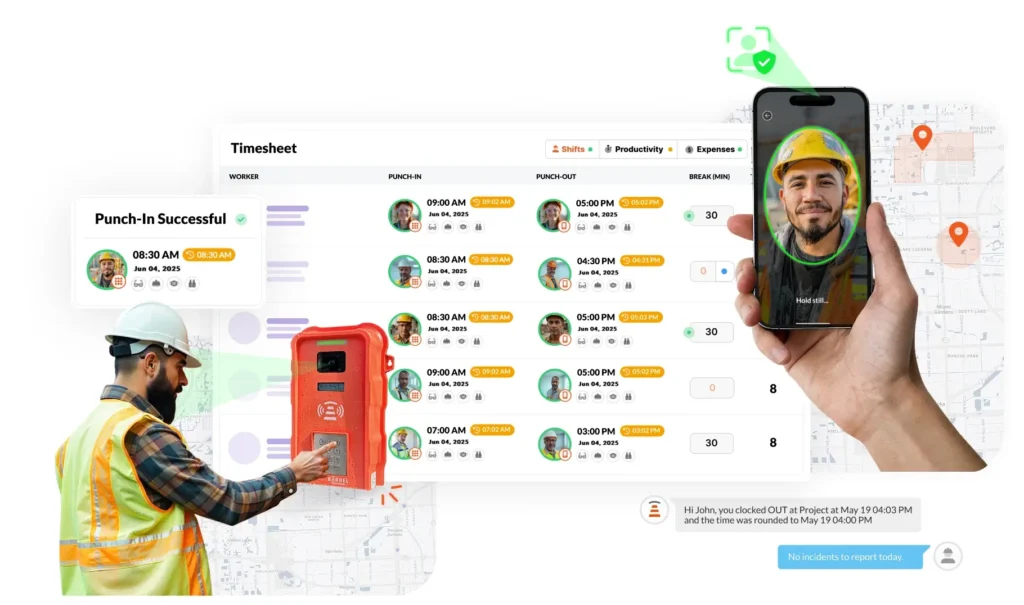
SmartBarrel handles both workforce structures on one platform – no workarounds, no separate systems. Union members get presence verification tied to guaranteed hours. Non-union workers get minute-by-minute actual hours. The system knows the difference automatically based on how you’ve tagged each worker.
Same facial verification. Same LTE-connected device. Different outputs where they need to be different.
The 5/8s and 4/10s Guarantee: Why Union Time Tracking Is Different
guaranteed hours fundamentally changes what matters in time tracking for union jobs.
Union contractors aren’t concerned with 15-minute rounding errors. If they’re paying for eight hours regardless, whether a worker clocked in at 6:58 AM or 7:03 AM doesn’t affect the paycheck. What matters is presence verification and ensuring fair wages are paid according to negotiated agreements.
This shifts the focus from precision timekeeping to verification. Union contractors need proof that workers were present because that’s the only leverage point for addressing chronic issues. Can’t deduct hours, but can document patterns of tardiness or early departures that justify termination.
The 5/8s and 4/10s structure also affects job costing and budget planning. Project managers budget labor based on guaranteed hours, not actual hours. If the project requires five union workers for three weeks, that’s 600 guaranteed hours (5 workers × 40 hours × 3 weeks) regardless of actual time on tools.
This makes having real-time work hours crucial. If workers aren’t showing up but you’re paying guaranteed hours, that’s pure cost with no production. Unlike non-union crews where employers can adjust hours based on actual work, union labor costs and fringe benefits are locked in through negotiated contracts.
SmartBarrel’s facial verification addresses this exact challenge. The system verifies presence at the jobsite, creates a timestamped record, and gives workers their own verification text.
When there’s a dispute about whether someone was on site, there’s photographic proof tied to a specific time and location.
Compliance Complexity: Different Rules for Different Workforces
Managing union payroll alongside non-union workers means navigating completely different compliance frameworks simultaneously, from labor union regulations and union requirements to standard labor laws. The main differences in compliance requirements create significant administrative challenges.
Union Reporting in Construction: What’s Required
Union contracts dictate specific reporting obligations. Union contractors must track and report hours to multiple entities: the union local for union dues calculations, welfare funds and health and welfare funds for contribution purposes, and pension administrators for retirement contributions. Each may have different reporting formats and deadlines. Contractors must maintain accurate records for each entity separately.
Non-Union Documentation Needs
Non-union workers require tighter actual-hours documentation. Every minute matters because there are no guaranteed hours to fall back on. Overtime pay calculations must be precise. Meal break deductions need documentation. Any dispute about hours worked requires detailed records as proof.
Multi-State Complexity
Union contracts vary by location. The same trade might have different guaranteed hours requirements, different benefit contribution rates, and different overtime rules depending on the state or even local counties. An electrical contractor working in Texas, Oklahoma, and Louisiana manages three different negotiated agreements for essentially the same work.
Certified Payroll for Both
Federal projects require certified payroll under Davis-Bacon. State projects may have their own prevailing wage laws. Both union and non-union contractors must document job classifications, wages paid, fringe benefits provided, and hours worked. Contractors must submit certified payroll reports weekly to government agencies and regulatory agencies, and errors trigger audits.
The challenge multiplies when managing both workforce types. Union members already have standardized classifications and benefit tracking. Non-union workers need individual documentation for each classification and benefit component. Processing certified payroll for a mixed crew means maintaining two separate tracking systems that both feed into the same certified payroll reports.
External resources like the U.S. Department of Labor’s Davis-Bacon compliance guide provide detailed requirements, but understanding the requirements doesn’t simplify the execution.
Multi-Company Structures: Managing Own Employees, Union Workers and Temp Labor
The complexity intensifies when contractors manage multiple workforce sources on the same project – a common reality for construction companies managing multiple workforce sources.
Why Contractors Use Mixed Structures
Project requirements often dictate workforce composition. A large electrical job might require union workers per the GC’s negotiated agreement, but the contractor supplements with their own non-union and temp labor for material handling.
Labor availability creates mixed crews. When union halls can’t provide enough workers quickly enough, employers fill gaps with non-union labor or temp agencies. When specialized skills aren’t available through union dispatch, contractors bring in non-union specialists with essential technical expertise.
The Employment Relationship Dynamic
The accountability structures differ significantly between direct employees and union hall workers – not due to skill or reliability, but because of the employment relationship itself.
Direct employees build ongoing relationships with the contractor. Over time, the contractor becomes familiar with individual work patterns, capabilities, and performance tendencies. This familiarity streamlines project planning and crew assignments.
Union hall workers are dispatched through the local’s assignment system based on availability and seniority. While many are highly skilled professionals, the contractor has limited visibility into individual work histories prior to dispatch. The assignment process follows union protocols rather than the contractor’s direct hiring criteria. This creates a different dynamic for workforce planning and project continuity, particularly on long-term projects where familiarity with site-specific requirements matters.
Hourly subs and temp labor create a similar challenge. These workers are employed by staffing agencies, creating a layer of separation between the contractor and the individual performing the work. The contractor manages the output while the agency manages the employment relationship.
Different Rules, Same Jobsite
A typical mixed-crew scenario: 20 union electricians on guaranteed 5/8s, 10 non-union helpers on actual hours, and 5 temp labor workers from an agency. Three different employers. Three different pay structures. Three different compliance requirements. One jobsite. One foreman trying to manage all of it.
The foreman needs to know which workers get guaranteed hours, which get actual hours, which company each worker belongs to, and which rules apply to whom. Then track everyone’s time differently while maintaining crew cohesion and project progress.
Time Tracking Requirements for Union vs. Non-Union Workers
The tracking requirements differ based on workforce structure – another key difference employers must navigate.
Union Worker Time Tracking
Worker verification – was this person on the jobsite or not – matters more than precision for union jobs. The system needs to confirm:
- Worker arrived at jobsite
- Worker was present during guaranteed hours
- Worker checked out at end of shift
- Pattern of attendance over time
What matters is creating an accountable record that documents presence and can identify chronic issues affecting working conditions.
Union reporting also requires specific data: hours worked per day, classification codes, benefit fund allocation, and job assignments. This data feeds into multiple systems – union locals for dues, benefit funds for contributions, and internal systems for job costing.
Non-Union Worker Time Tracking
Actual hours demand precision. The system needs to capture:
- Exact clock-in time (to the minute)
- Exact clock-out time (to the minute)
- Meal breaks (documented and deducted)
- Overtime calculations (accurate to avoid costly errors)
- Project and cost code assignments
For T&M billing, non-union hours need bulletproof documentation. Clients will challenge vague time entries. “Worker on site 8 hours” won’t satisfy a skeptical GC. “Clocked in 7:02 AM, clocked out 3:34 PM, verified with facial biometrics and GPS coordinates” is defensible.
This table clearly distinguishes what needs to be tracked for each workforce type:
Tracking Priority | Union Workers | Non-Union Workers |
Primary Focus | Presence verification | Minute-by-minute precision |
Clock-in Accuracy | Approximate (within guaranteed hours) | Exact time to the minute |
What Matters Most | Worker was on jobsite during shift | Actual hours worked for pay calculation |
Key Data Points | • Daily presence • Attendance patterns • Classification codes • Benefit fund allocation | • Exact clock-in/out times • Meal break deductions • Overtime calculations • Cost code assignments |
Reporting Purpose | Union dues, benefit funds, compliance | Payroll accuracy, T&M billing, job costing |
Consequence of Errors | Union grievances, fund contribution penalties | Payroll disputes, client billing challenges |
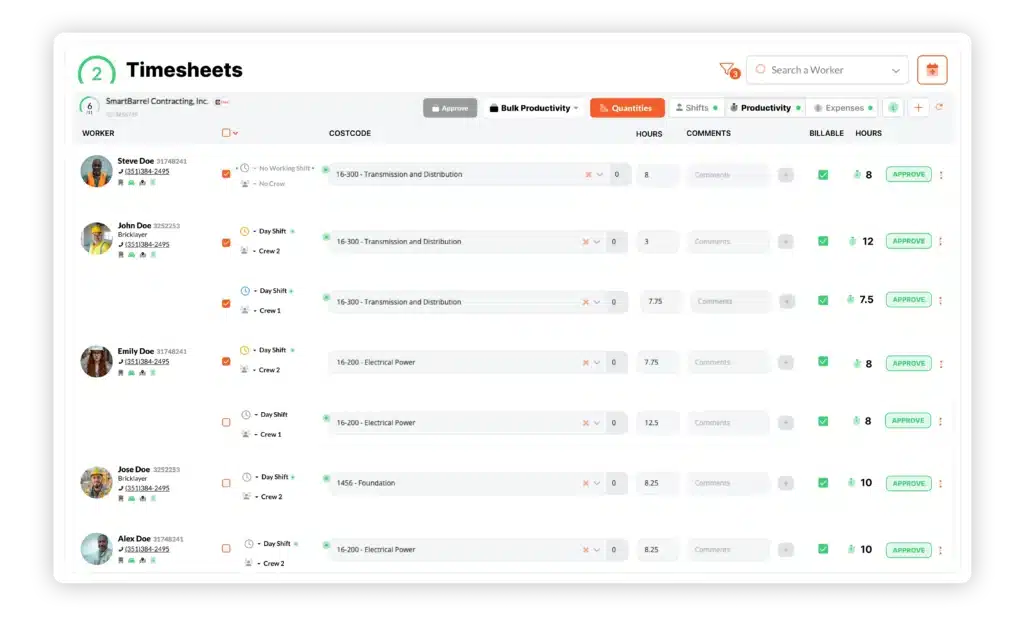
How SmartBarrel handles union and non-union time tracking on the same jobsite
Most time tracking systems were built for one workforce type. They handle actual hours or guaranteed hours – not both. When you run mixed crews, you end up with workarounds, manual adjustments, and payroll errors that cost you time every single pay period.
SmartBarrel was built specifically for this. The multi-company capabilitylets you tag workers by company and union status from setup. Union members clock in to verify attendance; the system logs their guaranteed hours automatically. Non-union workers clock in and get tracked to the minute. Both happen on the same TimeClock 4.0 device, same facial verification, same real-time LTE connection.
The result feeds directly into your existing ERP or payroll system. Union payroll and non-union payroll get clean, separated payroll data – no manual reconciliation. Project managers see a unified view of who’s on site, what company they’re with, and their hours – all in real-time. Procore, Vista, CMiC, Foundation – the data flows without manual re-entry.
The Challenges In Managing Both Union and Non-Union Workers on the Same Project
The theoretical differences become operational chaos when both workforce types occupy the same jobsite. Understanding the difference between union and non-union management approaches becomes essential.
Dual Systems, Single Jobsite
Running two parallel time tracking approaches can create confusion . For instance, a foreman managing 30 workers needs to remember: 20 union members get eight guaranteed hours regardless of actual time, 10 non-union workers get paid for the exact hours worked.
The worker shows up late? If union, document it, but pay guaranteed hours. If non-union, adjust actual hours and explain the deduction. Worker leaves early? Same split decision based on workforce type and employment terms.
Union payroll processing mirrors this complexity on the back end. The payroll team processes guaranteed hours for union members while calculating exact hours for non-union workers – in the same pay period, for the same project, sometimes for workers performing similar tasks with different skills and experience levels.
Compliance Complexity Multiplied
Union reporting requirements + prevailing wage laws + standard labor regulations = compliance nightmare. Each layer adds rules, deadlines, and documentation requirements across multiple aspects of workforce management.
Two workers perform similar electrical work on the same project. One is a union member, one is non-union. The union worker triggers benefit fund contributions, union dues reporting, and collective bargaining agreement compliance. The non-union worker requires individual overtime calculations, benefit tracking if offered, and prevailing wage documentation if applicable.
Communication and Coordination Challenges
Union work jurisdictions limit task assignments. Union electricians can’t perform plumbing work even if they’re capable – it’s outside their trade classification and negotiated work standards. Non-union workers often have more freedom in task assignments, providing access to greater flexibility.
Trust and Accountability Disparities
The incentive structures don’t align. Union workers dispatched to jobs want consistent work through the local union. Non-union employees want to prove value for continued employment and job security. Hourly subs from temp agencies want to maximize billable hours. The contractor wants efficient labor utilization and cost control.
Managing a mixed crew with different employers, rules, and incentives is a challenge even for experienced foremen. Some workers can be fired for performance issues, while others require union grievance processes. Some workers receive standardized wages and benefits negotiated collectively, others negotiate individually – a key difference that affects morale.
SmartBarrel was built specifically for this operational reality in construction. Contractors can keep union and non-union workers separated for payroll compliance while providing unified visibility for project management. Guaranteed hours and actual hours both flow through the same system. Facial verification works for both workforce types.
One dashboard shows everything: who’s on site, what company they’re with, union versus non-union status, all in real-time.
Why Excuse-Free Verification Matters for Mixed Workforces
Biometric facial verification solves accountability challenges for both workforce types without creating new burdens – a crucial aspect of modern workforce management.
Union Accountability Without Deducting Pay
Union contractors can’t adjust pay for minor time discrepancies, but they can address chronic attendance issues affecting working conditions and safety. Facial verification creates the documentation trail needed to identify patterns.
Worker consistently arrives 20 minutes late? The verification data shows it. Worker leaves early three times per week? There’s photographic proof with timestamps. This documentation supports termination decisions when patterns justify action under union contracts while ensuring fair wages are maintained.
Non-Union Flexibility With Documentation
Non-union workers need exact hour documentation for accurate pay and T&M billing defense. Facial verification provides audit-ready proof: this worker, this time, this location, verified biometrically. When clients dispute hours on T&M projects, contractors respond with verifiable data. The verification removes arguments and negotiations.
Benefits for Workers
Workers get protection regardless of union status – a key difference from traditional time tracking. The verification proves they were where they claimed to be when they claimed to be there. Payroll disputes get resolved with data, not arguments or negotiations. Workers also receive their own records – text confirmations of clock-in and clock-out times that can be used if company systems fail or discrepancies arise.
Making It Work: Systems That Handle Workforce Complexity
Contractors managing both union and non-union workers need specific capabilities in their time tracking systems – essential tools for modern construction management.
Requirements for Mixed Workforce Management
Union worker payroll and non-union payroll have different rules – your system has to handle both without exceptions. The system must handle guaranteed hours AND actual hours without treating them as exceptions. Union members clock in to verify attendance while the system logs guaranteed hours. Non-union workers clock in for actual hour tracking with minute-by-minute accuracy. Both happen simultaneously on the same platform.
Union workers need separation from non-union workers for payroll processing. Temp labor workers require their own company designation. The system must track everyone separately for compliance while providing unified visibility for project management and safety oversight.
Excuse-free verification eliminates the common time tracking failures: dead phone batteries, “forgot to clock in,” “no service,” and gloves preventing fingerprint scans. The system has to work regardless of conditions, without requiring workers to download apps or use personal devices – providing more freedom from technology constraints.
Why SmartBarrel Was Built for This
SmartBarrel’s simple facial verification works for both union and non-union workers without different processes. No specialized payroll software workarounds. Processing union payroll and non-union payroll calculations happens automatically. Workers enter their phone number and take a photo. The AI verifies their face against previous photos.
The multi-company structure keeps workforce types separated. Union members get tagged to their local union, Non-union workers get tagged to the contractor’s company. Temp workers get tagged to their agency. Your payroll system processes each company separately, while project managers see unified data showing all workers across all companies on their projects.
Built-in LTE means the system doesn’t depend on WiFi. Remote jobsites, areas with poor coverage, inside structures – the data flows in real-time regardless. Solar and electric power options eliminate charging hassles and provide more freedom from infrastructure constraints.
Integration with existing systems ensures SmartBarrel feeds clean data to whatever ERP or project management platform contractors already use.
The result: less administrative burden, better compliance with union payroll requirements and state labor laws across both workforce types, and accurate compensation without forcing foremen to become timekeeping specialists. Average time savings exceed 800 hours annually on payroll management and manual entry work.
Frequently Asked Questions
Why do construction workers choose to join unions?
Construction workers join unions primarily for higher wages, guaranteed benefits, job security protections, and collective bargaining power negotiated through union representatives. Unions provide professional negotiators who establish pay rates, benefit packages, and working conditions through union contracts.
Workers also gain access to apprenticeship programs, legal representation, comprehensive benefits, and other employee benefit programs in workplace disputes, and retirement security through union pension funds. Women and minority workers often see particularly strong wage gains through union membership. The tradeoff includes paying union dues and potentially less freedom in individual negotiations, but the majority find the wage premium and benefit standardization worth these costs.
How do prevailing wage laws affect non-union construction workers?
Prevailing wage laws require non-union workers to be paid union-equivalent wages on public projects, effectively eliminating the wage gap for government-funded work and helping to ensure fair wages across the industry. The Davis-Bacon Act and state-level prevailing wage laws establish minimum wages for construction workers on public projects based on locally prevailing union rates negotiated to ensure fair wages.
This means non-union workers receive significantly higher average pay on public projects compared to private work. However, employers must track and document prevailing wage compliance carefully, maintaining certified payroll reports submitted to government agencies that prove workers received proper wages and fringe benefits. Non-compliance triggers Department of Labor audits and potential penalties.
What's the impact of collective bargaining on construction project timelines?
Collective bargaining agreements can impact project timelines through guaranteed work hours, overtime restrictions, and specific scheduling requirements negotiated to protect working conditions but reduce flexibility compared to non-union crews. The guaranteed 5/8s or 4/10s structure means employers pay for specific hours regardless of project needs, which can create inefficiencies during slower project phases or weather delays.
However, these negotiated agreements also provide predictability that enables better planning. Union contracts may specify break times, overtime rules, and work jurisdiction limitations that affect scheduling coordination. With proper planning and systems that accommodate these requirements, contractors can mitigate timeline impacts while maintaining compliance and safety standards across all jobs.
Managing Union and Non-Union Workers: Choosing the Right System
The union versus non-union debate misses the operational reality most specialty contractors face in the construction industry. They don’t choose one or the other – they manage both because that’s what projects require. Union members bring standardized wages and benefits and collective bargaining protections negotiated to ensure fair wages and job security. Non-union workers offer scheduling flexibility and direct employment relationships with more freedom in hiring and negotiations. Both have value. Both create complexity.
The challenge isn’t which workforce type is better. The challenge is managing different pay scale differences, union payroll requirements, labor contracts, and accountability systems on the same jobsites without drowning in administrative burden – understanding the difference between union and non-union management approaches and the key differences in employment terms, working conditions, and work standards.
Workforce management systems should remove complexity from foremen and project managers, not add to it. Workers should check themselves in, systems should verify them, payroll data should flow automatically, and foremen should focus on building projects, ensuring safety, and managing skills development instead of chasing timesheets. Both union and non-union workers deserve accurate pay for their time, essential training programs, and safe working conditions. Employers across the industry deserve compliance without excessive overhead and access to real-time data for better decision-making.
See SmartBarrel in action on a mixed workforce
If you’re managing union and non-union workers on the same projects, you already know the administrative weight that comes with it. Two compliance frameworks. Two pay structures. One foreman trying to keep it all straight.
SmartBarrel removes that burden from the field and puts accurate, audit-ready data into the hands of the people who need it. Workers scan their face. The system does the rest.
One site or 50 sites. Union crews or non-union or both. Same accuracy.
Book a demo to see how SmartBarrel handles your specific workforce structure.


