


Union payroll isn’t regular payroll with union dues added on. It’s a parallel workflow where construction companies must track straight time separately from overtime pay, calculate fringe benefits by job classifications, maintain detailed records for multiple locals with different remittance calendars, and produce audit-ready certified payroll reports that satisfy both federal and state labor laws.
Most contractors approach union payroll processing as an enhanced version of their non-union payroll process. That assumption creates a structural problem that compounds across hundreds of union employees and multiple job sites.
The consequence shows up months later: regulatory agencies revealing fringe benefit discrepancies, manual remediation consuming hundreds of hours, and union reporting in construction becoming a bottleneck that delays project closeouts.
When time records contain variance – 15 minutes here, rounded hours there, construction workers checking in for absent colleagues – those errors flow directly into union reports. Even a 5% variance in recorded hours can represent a material portion of labor costs when multiplied across a 200-worker operation.
Union payroll processing fails because construction companies build their payroll systems around payroll processing, not compliance-grade data capture.
What Is Union Worker Payroll? (And Why It’s Not Just Enhanced Payroll)
Union worker payroll refers to the documentation and financial disclosure requirements that construction companies must maintain when employing union workers. This includes tracking hours worked by job classifications, calculating and remitting fringe benefits to health and welfare funds, maintaining payroll data that supports labor unions’ financial disclosures, and meeting both federal and state labor laws obligations.
Standard payroll systems treat time as a single input: hours worked multiplied by hourly wage rates equals the worker’s gross earnings.
Union worker payroll requires maintaining source data that feeds trust fund calculations and may be relied upon by unions in their federally required financial disclosures. This isn’t enhanced payroll – it’s a compliance-grade data workflow where the time capture system must produce audit-ready certified payroll by default.
The challenge intensifies when contractors work under multiple union locals. Local 3 may require remittance by the 15th of each month. Local 134 may operate on a different calendar. Manual systems that work for single-local operations fail when scaled across five or ten different labor unions.
How to Process Union Payroll: Step-by-Step Workflow for Construction Companies
Processing union payroll requires executing a structured workflow that maintains compliance with collective bargaining agreements (CBAs) while ensuring accurate compensation for union employees. The process differs significantly from non-union payroll due to the additional payroll fields and verification requirements.
Step 1: Capture Time Data with Job Classifications
Union worker payroll processing begins with capturing hours worked by specific job classifications. A worker classified as a journeyman electrician on Monday may work as a foreman on Tuesday. Each classification carries different wage rates and fringe benefits calculations. Construction time tracking systems like SmartBarrel capture verified time and location at the source, then ties time to the project setup where union classification is defined and imported to the ERP or payroll software, reducing mistakes in classification, manual coding, and rework during payroll.
Step 2: Separate Straight Time from Overtime Pay
Collective bargaining agreements (CBAs) typically require different treatment for overtime hours. Some union agreements cap fringe benefits at 40 straight-time hours per week. Others require full union benefits on all hours worked, including overtime. The payroll system must track and calculate these distinctions automatically based on the specific labor union’s agreement.
Step 3: Calculate Fringe Benefits by Union Local
Each labor union maintains separate fringe benefit rates for health and welfare funds, retirement contributions, apprenticeship programs, and other employee benefit programs. Managing union payroll across multiple locals means applying different rates to different groups of union workers. Construction payroll software should store CBA-specific rates and apply them automatically based on worker assignment.
Step 4: Deduct Union Dues and Process Remittances
Union dues represent a percentage of gross wages or a flat hourly amount specified in collective bargaining agreements. The payroll system deducts union dues from worker paychecks and prepares remittance reports for each union local. Different locals operate on different calendars – some require remittance by the 15th, others by month-end.
Step 5: Generate Certified Payroll Reports
Construction companies working on prevailing wage projects must submit certified payroll reports weekly. These reports document wage rates, hours worked, job classifications, and fringe benefits paid. The certified payroll format differs from standard payroll reports and requires additional verification signatures.
Step 6: Maintain Audit-Ready Records
Labor laws require preserving payroll data for three to five years. Processing union payroll generates multiple documentation streams: timecards, certified payroll submissions, union remittance reports, fringe benefit calculations, and CBA compliance records. Integrated payroll systems that maintain these records in an audit-ready format eliminate manual filing and retrieval when regulatory agencies request documentation.
The processing burden compounds when construction contractors employ union employees across multiple states with varying working conditions and labor laws. Contractors managing 200+ union workers typically spend 10-15 hours weekly on manual union payroll processing using spreadsheet-based systems.
Union vs. Non-Union Payroll: Key Differences for Construction Contractors
Construction contractors managing both union and non-union workers face fundamentally different payroll workflows. Understanding these distinctions prevents compliance failures and processing inefficiencies.
| Payroll Element | Non-Union Payroll | Union Worker Payroll |
| Wage Determination | Set by employer based on market rates | Determined by collective bargaining agreements (CBAs); varies by job classification and union local |
| Fringe Benefits | Employer-managed; typically included in total compensation | Calculated separately per union agreement; remitted to trust funds managed by labor unions |
| Overtime Calculations | Standard FLSA rules: 1.5x after 40 hours | Varies by CBA; may include double-time, different triggers, and fringe benefit caps |
| Payroll Deductions | Standard taxes and benefits | Standard deductions plus union dues, initiation fees, and assessments |
| Reporting Requirements | Standard W-2, quarterly tax filings | Certified payroll reports, union remittance reports, LM-2/LM-3 support documentation, prevailing wage reporting |
| Record Retention | 3 years (FLSA standard) | 3-5 years (varies by jurisdiction and labor laws) |
| Job Classifications Tracking | Optional for job costing | Mandatory; determines wage rates and fringe benefits |
| Multi-Jurisdiction Complexity | Moderate (tax differences) | High (different CBAs, union locals, prevailing wage requirements per state) |
The critical distinction: Non-union payroll processes time as a single input (hours × rate = pay). Union worker payroll requires tracking time as structured data that feeds multiple compliance outputs: trust fund contributions, certified payroll reports, union local remittances, and labor union financial disclosures.
Construction contractors who treat union payroll as “enhanced non-union payroll” encounter structural problems when scaling across multiple union locals. The workflow isn’t more complex – it’s fundamentally different. SmartBarrel’s time tracking captures the additional payroll fields union payroll requires at the source, eliminating manual data manipulation during processing.
Key Components of Union Payroll in Construction
Union worker payroll comprises five interconnected components that construction contractors must manage simultaneously. Failure in any single component cascades through the entire system.
1. Base Wage Rates by Job Classifications
Collective bargaining agreements (CBAs) establish specific wage rates for each job classification: apprentice levels 1-4, journeyman, foreman, and general foreman. A worker may hold different classifications on different days or even different shifts. Time tracking systems must capture which classification applied to each hour worked, as this determines both the wage rate and the corresponding fringe benefits calculation.
2. Fringe Benefits Management
Fringe benefits represent employer contributions to health and welfare funds, pension plans, apprenticeship programs, and training funds. Unlike non-union benefits included in paychecks, union fringe benefits are remitted separately to trust funds managed by labor unions. Each union local maintains different fringe benefit rates, and some CBAs cap fringe contributions at 40 straight-time hours regardless of total hours worked.
3. Union Dues and Assessments
Union dues – deducted from worker paychecks – differ from fringe benefits paid by contractors. Most CBAs specify union dues as a percentage of gross wages or a flat hourly amount. Construction contractors must track and remit these deductions to the appropriate union local according to varying remittance calendars.
4. Certified Payroll Reporting
Construction companies working on prevailing wage projects must submit weekly certified payroll reports documenting wage rates, hours worked, job classifications, and fringe benefits paid. These reports require additional verification signatures and follow specific formats that differ from standard payroll reports. The same time data feeds both union remittances and certified payroll submissions.
5. Multi-Jurisdiction Compliance Tracking
Union workers frequently cross state lines mid-week, triggering different prevailing wage requirements, labor laws, and union local obligations. A plumber working Monday-Wednesday in Nevada and Thursday-Saturday in California generates time data that must support two separate compliance frameworks. Construction payroll software must track work location at the hour level, not just the project level.
The integration challenge: These five components don’t operate independently. Accurate fringe benefits depend on correct job classifications. Certified payroll accuracy requires precise work location tracking. Union dues calculations rely on gross wage accuracy. When construction contractors capture time data without the required structure, downstream processing requires manual intervention at every component – consuming 10-15 hours weekly for contractors managing 200+ union employees.
SmartBarrel addresses this integration challenge by capturing all five components at the source: workers check in with job classification, geo-verification confirms location, and the system automatically structures data for all downstream union payroll requirements.
The Landrum-Griffin Act: Federal Baseline for Union Payroll Requirements
The Labor-Management Reporting and Disclosure Act of 1959, commonly known as the Landrum-Griffin Act, establishes the federal baseline for labor unions’ financial disclosure and reporting. For construction companies, the Act creates specific obligations around record-keeping and data accuracy. While construction contractors do not file LM-2 or LM-3 forms themselves, the payroll and contribution data they provide to unions and trust funds is relied upon to meet these federal reporting obligations.
As a result, contractors must maintain accurate, defensible payroll and contribution records under collective bargaining agreements and trust fund participation agreements. Inaccurate or retroactively adjusted time data can create downstream discrepancies that surface during union audits or trust fund reviews.
The practical impact: Time records should be audit-defensible from the moment of capture. When compliance is addressed after the fact through retroactive corrections or manual adjustments, contractors face expanded audit scope, increased scrutiny, and higher administrative burden.
LM-2 and LM-3 Forms: What Construction Payroll Must Support
Labor unions with total annual receipts of $250,000 or more must file Form LM-2. Smaller unions file the simplified Form LM-3. For construction contractors, the relevance lies in understanding how their payroll data feeds these union filings.
Construction companies provide the source data for trust fund contribution reporting. When a contractor reports hours and corresponding fringe benefit contributions for journeyman electricians at Local 134, that information is aggregated by trust funds and unions and reflected in their federally required financial disclosures. If those hours are inaccurate, rounded, estimated, or transcribed incorrectly, they increase the risk of discrepancies that may surface during trust fund or union audits.
SmartBarrel’s biometric time tracking eliminates rounding and transcription errors by capturing exact check-in/check-out times with facial verification, ensuring the hours reported to union locals match actual time worked.
The compliance chain works like this: Field time capture → Construction payroll → Union local remittance → Welfare funds deposits → LM-2 financial reporting. Manual transcription introduces variance at every transition point.
Contractors do not file these forms directly, but they are responsible under collective bargaining agreements and trust fund participation agreements for providing accurate payroll and contribution data. A labor union facing an LM-2 audit will trace disputed contributions back to contractor time records.
Federal vs. State Union Reporting in Construction: Navigating Labor Laws Across Multiple Jurisdictions
The Landrum-Griffin Act establishes federal financial disclosure requirements for labor unions, while state labor laws create additional payroll and reporting obligations for construction contractors operating across multiple jurisdictions. California, New York, Illinois, and other states maintain separate prevailing wage systems and union payroll requirements that extend beyond federal baselines.
California’s prevailing wage law requires contractors to submit certified payroll reports weekly on public works projects. When a contractor employs union workers on California prevailing wage projects, it must comply with both the requirements of the collective bargaining agreement and California’s state-specific certified payroll obligations. The same time data feeds both payroll systems, but the format, timing, and verification requirements differ.
A national electrical contractor might operate under Local 3 in New York, Local 134 in Chicago, and Local 11 in Los Angeles. Each local operates under its collective bargaining agreement (CBA) with potentially different fringe benefits calculation methods, remittance deadlines, apprenticeship programs ratios, and overtime rules structures.
What Construction Contractors Must Track for Managing Union Payroll Compliance
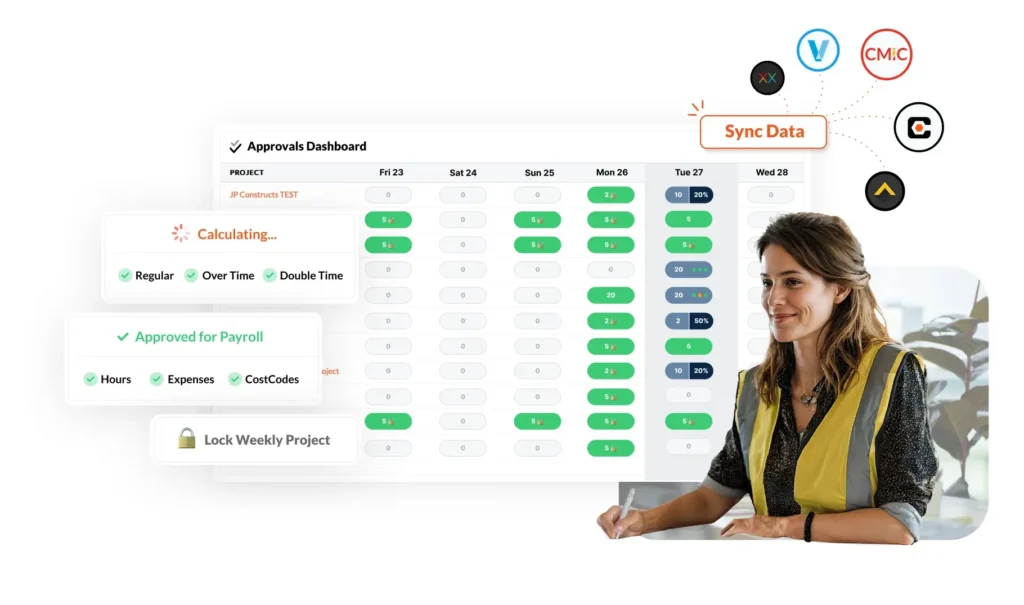
Union reporting in construction requires tracking multiple payroll fields at the point of time capture to ensure union worker payroll processing compliance.
| What to track | Why It’s Required | Compliance Risk if Missing |
| Straight time vs. overtime pay | Fringe benefits calculations differ; some CBAs cap benefits at 40 hours | Misreported trust fund contributions; audit findings |
| Job classifications by worker and shift | Determines wage rates and fringe benefits | Underpayment/overpayment; classification audit violations |
| Work location by state/local jurisdiction | Union contracts and prevailing wage vary by location | Multi-state compliance failures; incorrect wage determinations |
| Union local designation | Ensures contributions flow to correct trust funds | Misallocated funds; delayed benefits for workers |
| Fringe benefits tracked separately | Required for accurate trust fund reporting | LM-2 reporting errors; trust fund audit exposure |
| Remittance-ready formats | Eliminates manual report preparation | Processing delays; increased administrative burden |
Straight time vs. overtime pay: Fringe benefits calculations often differ based on whether hours are straight time or overtime. Some collective bargaining agreements (CBAs) require fringe contributions on all hours worked. Others cap union benefits at 40 hours per week.
Job classifications by worker and shift: A journeyman electrician on Monday morning may work as a foreman on Tuesday afternoon. Classification determines both the wage rates and the fringe benefits calculation.
Work location by state and local jurisdiction: Union contracts and prevailing wage requirements vary by location. When union workers travel between job sites, time records must capture where each hour was worked.
Union local designation: Multi-union contractors may employ union employees from Local 3, Local 11, and Local 134 on the same project. Payroll data must include local designation to ensure contributions flow to the correct trust funds.
Fringe benefits management tracked separately: Track fringe hours as a separate line element from the moment of time capture, not during payroll processing.
Remittance-ready formats: Contractors using expense and time tracking systems that export data in union-required formats eliminate manual payroll reports preparation.
The Hidden Cost of Inaccurate Time Data and Managing Union Payroll Challenges
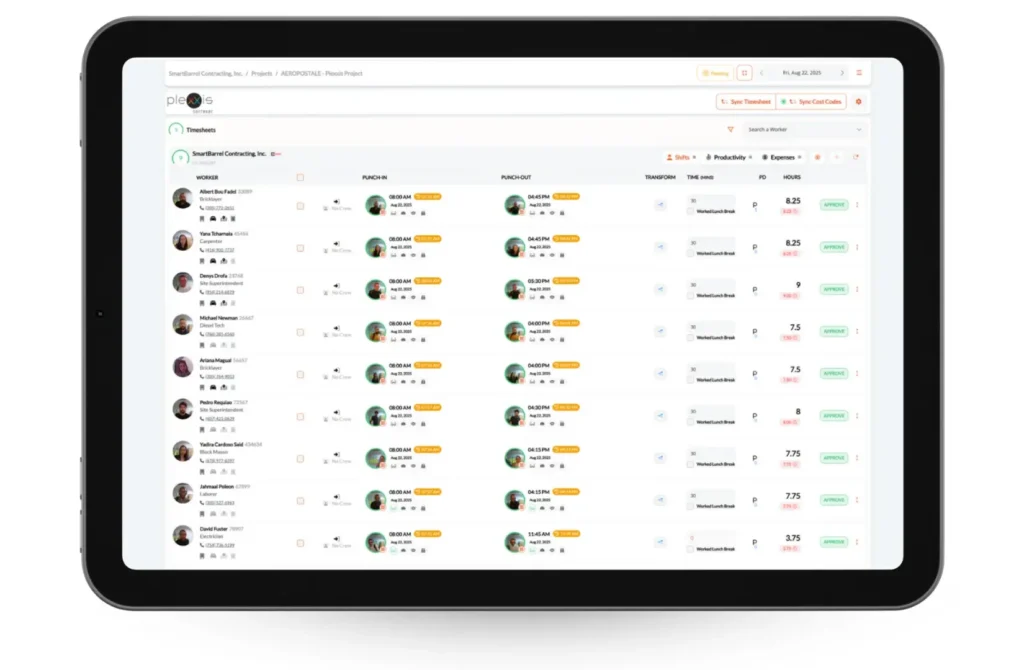
Time data variance compounds across large workforces. Consider a trade contractor employing 200 union electricians across multiple projects. Payroll systems that rely on manual entry often contain measurable variance from actual time worked due to rounding, delayed reporting, and transcription errors
For example, a hypothetical 5% variance across 200 union workers working 2,000 hours annually equals 20,000 hours of discrepancy. When fringe benefits average $12-15 per hour, that variance represents $240,000-300,000 in potentially misreported trust fund contributions.
Prism Electric documented the operational impact before implementing biometric time tracking. Their previous payroll system resulted in double payments and inconsistent data across the board.
Common structural challenges in processing union payroll include:
Manual transcription between systems: Union workers record hours on paper → Foreman transcribes to spreadsheet → Office staff enters into construction payroll → Accountant prepares union reports. Each step introduces potential variance. 200 workers × 52 weeks × 4 transcription steps = 41,600 opportunities for errors annually.
Multiple union locals with different calendars: Manual calendar management fails at scale when construction contractors work under multiple locals with separate remittance deadlines and union reporting requirements.
Tracking fringe hours separately from wage hours: Accurate fringe reporting requires tracking fringe-eligible hours to be tracked separately from the moment of time capture. Manual payroll systems rarely capture this distinction.
Retroactive adjustments: A single-hour correction for one construction worker might require amended payroll, recalculated fringe benefits, corrected union remittance, updated certified payroll, adjusted cost codes, and modified job costing reports.
Penalties for Non-Compliance with Union Payroll Rules and Labor Laws in Construction
Non-compliance carries consequences at federal, state, and union levels:
Federal penalties: Government agencies can pursue civil actions against construction companies that provide false information to union locals or fail to maintain accurate records supporting union agreements.
State-specific penalties: California’s prevailing wage law assesses penalties, restitution, and debarment for prevailing wage violations. Multi-state contractors face multiplicative exposure with separate penalties assessed by regulatory agencies in each state.
Union-imposed consequences: Late payment fees (10-18% annually), audit costs ($150-$300 per hour), enhanced reporting requirements, and removal from approved contractor lists maintained by union halls (Specific ranges vary widely by trust fund and CBA).
Project debarment: Construction contractors with documented prevailing wage or public works violations may face temporary or permanent debarment from bidding on public projects administered by government agencies.The real cost – administrative burden of manual remediation: A mid-size specialty contractor facing a trust fund audit covering three years might incur $100,000-$200,000 in total exposure: internal staff time (200-400 hours), external consultant fees ($15,000-$30,000), legal counsel ($10,000-$25,000), and audit fees ($20,000-$50,000).
Union Reporting Compliance Tips and Payroll Software Solutions for Construction Contractors
Achieving consistent union payroll compliance requires treating time capture as a data architecture problem:
Eliminate manual entry at the source
Zero manual entry architecture means union employees check in using biometric verification, mobile applications with geo-fencing, or time clocks that record verified time and location, while job classifications are imported from the ERP or construction management system and applied automatically during payroll processing.
Separate fringe tracking from wages at the source
Automated time tracking solutions that capture fringe-eligible hours as a separate line item eliminate payroll calculation complexity during payroll processing.
Standardize data capture across all projects
When time data flows from all sites in the same format, preparing union remittances becomes a data export operation rather than manual compilation of certified payroll reports.
Build for audit-readiness by default
Capture all required payroll fields at time entry: worker name, job classification code, union local, work location, and hour type. The time record itself serves as audit documentation.
Integrate with specialized payroll software providers
Time data flows directly from the capture system to the payroll software provider without manual entry.

How Accurate Time Data Solves Managing Union Payroll Complexity
Union payroll complexity doesn’t stem from complicated forms. The structural challenge lies in producing audit-grade data from manual time capture systems. Solving managing union payroll requires addressing time data quality.
Biometric verification eliminates buddy punching and establishes worker presence with audit-defensible accuracy. The time record serves as source documentation for all downstream certified payroll reports without additional verification steps.
Real-time job classifications capture ensures fringe benefits are calculated correctly from the source, preventing journeyman hours miscoded as apprentice hours. Geo-verification provides location documentation for multi-state operations with latitude/longitude data that satisfies state-specific prevailing wage requirements.
Integration enables single-entry, multiple-output workflows. Time data captured once with proper structure can feed payroll processing, ERP systems, union remittance reports, and certified payroll submissions without manual reformatting.
SmartBarrel’s approach centers on this principle: accurate source data eliminates downstream compliance work. Construction contractors report significant reductions in time spent on union reports preparation and improved relationships with trust fund administrators.
FAQs About Union Worker Payroll Processing in Construction
How often must contractors submit certified payroll reports for union labor?
Most union locals require monthly remittances, with payroll reports due by a specified date (often the 15th or last business day). Some locals require weekly reporting for certain job classifications. Multi-union contractors must track separate calendars for each local, as submission deadlines rarely align.
What's the difference between union dues and fringe benefits?
Union dues represent membership fees deducted from workers’ paychecks. Fringe benefits represent employer contributions to health and welfare funds (health insurance, pension, training) calculated based on hours worked and paid by the contractor in addition to base wage rates.
Can contractors use the same payroll system for managing union and non-union payroll?
Modern payroll software designed for the construction industry can handle both union payroll and non-union workers within a single platform. The system must capture union-specific payroll fields without requiring these fields for non-union payroll processing.
What happens if time records don't match union remittance payroll reports?
Discrepancies trigger trust fund audits, labor union challenges, and compliance violations. If construction contractors can’t produce source time records supporting their payroll reports, they face expanded audits, presumption of underpayment, penalties and interest, and enhanced reporting requirements under collective bargaining agreements (CBAs).
Take Control of Union Payroll Processing Complexity
Union payroll in the construction industry fails at the time capture level, not during payroll processing. The solution requires recognizing that managing union payroll depends on structured, audit-grade time data captured at the source. Manual processes that rely on foreman memory, paper timecards, or rounded hours will never produce the payroll data quality needed for consistent union compliance with labor contracts.
SmartBarrel’s approach centers on this principle: capture time data once, accurately, with all the payroll fields needed for processing union payroll compliance. Biometric verification eliminates buddy punching. Real-time job classifications capture ensures correct payroll calculations. Geo-verification provides location documentation for prevailing wage compliance. Automated workflows generate union-ready certified payroll without manual reformatting.
Union payroll doesn’t have to consume 10+ hours per week in manual preparation. SmartBarrel’s biometric time-tracking provides audit-ready data by default.
Book your demo to see how trade contractors managing 500+ union workers across multiple locals simplified union compliance while cutting payroll processing time in half.