


Construction worker overtime pay is one of the most litigated areas of labor law in the construction industry, and violations aren’t usually what contractors expect. It’s rarely about not knowing the rules. The Fair Labor Standards Act threshold of 40 hours per week is common knowledge on any jobsite.
The real problem runs deeper: the time data feeding those overtime calculations is wrong before the math even starts.
Getting payroll for construction right requires the same discipline, because overtime is just one of many calculations that fall apart when field hours are unreliable.
Overtime cost control starts well before the payroll run, at the point where hours are either verified in the field or reconstructed from memory a week later.
When a foreman enters hours from memory on Friday afternoon, when workers round their time in their own favor, or when buddy punching goes unchecked across multiple sites, the overtime pay figures that hit payroll aren’t a calculation problem. They’re a data problem. No amount of knowledge about overtime rules or overtime regulations fixes data that’s inaccurate from the moment it leaves the field.
This article covers the full landscape of construction overtime:
- Federal labor law
- Calculation methods
- Prevailing wage requirements
- Union specifics
- State-specific overtime regulations
- What actually goes wrong in practice.
The goal isn’t just for contractors to understand the overtime laws. It’s to understand why most overtime errors don’t start in payroll at all.
Federal Labor Law and Construction Overtime Pay Rules
The Fair Labor Standards Act (FLSA) is the federal baseline for construction overtime across the construction industry. Under the Labor Standards Act FLSA rules, non-exempt employees; most construction workers qualify as non-exempt employees, must receive overtime pay at a rate of at least 1.5 times their regular rate for all hours worked beyond 40 in a single workweek.
There is no federal requirement to pay daily overtime, no cap on total weekly hours, and no distinction between weekday, weekend, or holiday work unless those days push the total past 40.
The Act operates on a workweek basis: a fixed, recurring 168-hour period the employer defines. See the DOL’s FLSA Overtime Fact Sheet for the official guidance.
A few labor laws nuances under the Fair Labor Standards Act that trip up contractors in the construction industry:
- Overtime pay cannot be waived. Even if a worker agrees in writing to forgo overtime compensation, that agreement is unenforceable under federal and applicable state laws.
- Unauthorized overtime must still be paid. If a non-exempt employee works beyond 40 hours without approval, the employer cannot legally withhold overtime pay. They can discipline the worker, but the hours must be compensated.
- The workweek is evaluated independently. Hours can’t be averaged across two weeks to dodge an overtime threshold. A worker who logs 50 hours in week one and 30 hours in week two is owed 10 overtime hours for week one, period.
- Piece-rate and salary workers are not automatically exempt. If a non-exempt employee is paid by the piece or on salary, overtime pay is still required, calculated on the average hourly rate for that workweek.
The Fair Labor Standards Act’s scope in the construction industry is broad. Congress extended Labor Standards Act FLSA coverage to all construction businesses running construction work in 1966; meaning virtually every trade contractor and subcontractor operating in the construction industry today is covered regardless of company size.
Are Construction Workers Exempt from Overtime Pay?
Most construction workers are not exempt from overtime pay under federal law. Field laborers, journeymen, apprentices, and tradespeople are almost universally classified as non-exempt employees entitled to overtime pay. Non-exempt employees in the construction industry cover virtually everyone doing hands-on trade work.
The FLSA exemptions, such as the executive, administrative, and professional employees (EAP) exemptions, apply to workers who primarily perform management or office duties at a salary above a minimum wage threshold. A field worker on a jobsite does not meet that standard regardless of how they’re classified on paper.
That exemption requires that job duties be primarily intellectual or require advanced knowledge. Physical labor in the field does not qualify.
Non-exempt status is the default for construction workers; most construction workers are non-exempt under FLSA. Overtime protections cannot be legally waived by non-exempt employees.
Misclassification risk is highest in three scenarios:
- Independent contractor status: Workers labeled as independent contractors fall outside FLSA protections, but the DOL applies an economic reality test. If a construction company controls how, when, and where work is performed and provides tools and materials, those workers are likely non-exempt employees under federal law regardless of what the contract says.
- Working foremen: A foreman who spends the majority of their day performing the same trade work as their crew remains non-exempt, even with some supervisory job duties. Non-exempt status is determined by function, not title. Confirming non-exempt status before project start is a basic compliance step.
- Salaried field workers: Paying a worker on salary does not automatically create an exempt classification. The job duties test must also be met. A salaried electrician working in the field is non-exempt, meaning they are workers entitled to overtime pay.
For up to date information on current exemption salary thresholds and DOL enforcement posture, consult the DOL Wage and Hour Division’s overtime resources, as these figures have been subject to legal challenge and have shifted in recent years. Once you’ve confirmed which workers are non-exempt, the next step is knowing how to calculate what they’re actually owed.
How Is Overtime Calculated for Construction Workers?
Calculating construction overtime pay is straightforward for hourly workers paid a single hourly rate. Where it gets complicated is when construction workers move between job classifications, earn shift differentials, or receive non-discretionary bonuses during the same workweek.
Standard hourly rate (single trade, single rate)
Step 1: Total all hours worked during the workweek. Any hours beyond 40 are overtime hours.
Step 2: Establish the overtime rate: the employee’s normal hourly rate x 1.5. That figure; the employee’s normal hourly rate, is the baseline before premiums or differentials are added.
Step 3: Multiply overtime hours by that rate.
Step 4: Add regular pay (40 hours x base wage) plus overtime pay for total weekly compensation.
Example An electrician earns $32/hour and works 48 hours in a week. Regular pay: 40 hours x $32 = $1,280 Overtime pay rate: $32 x 1.5 = $48/hour Overtime pay: 8 overtime hours x $48 = $384 Total weekly pay: $1,280 + $384 = $1,664 |
Multi-rate weeks and weighted average overtime calculations
Construction workers often perform different types of work in the same week at different pay rates, moving between cost codes, job classifications, or sites. When a worker earns two or more straight-time rates in a single workweek, calculating overtime pay requires a weighted average of all earnings for that week.
Add all straight-time earnings for the week and divide by total hours worked to find the blended regular rate. The construction overtime premium is then 0.5 times that blended rate for each overtime hour.
This is the overtime calculation most commonly missed in manual payroll processes, and a leading source of untracked overtime costs that contractors can’t account for at year-end.
Double time pay
Federal law does not require double time (2x the regular pay rate). Double time pay is a creature of state law, primarily California, and of collective bargaining agreements. If neither applies, it’s a contractual obligation, not a federal one.
Managing construction overtime that includes double time provisions requires tracking daily hours in addition to weekly totals. But all of these calculations depend on knowing what actually counts as time worked in the first place
What Counts as Hours Worked on a Construction Site?
The FLSA definition of compensable hours worked is broader than most construction managers assume. On a construction site, compensable time can include more than just active trade work; something most trade contractors don’t train foremen on explicitly.
Time that typically counts toward hours worked:
- Pre-shift site prep and safety briefings: If attendance at a morning safety meeting is required before work begins, that time is compensable, even if no physical labor is performed.
- End-of-shift cleanup: Required post-shift cleanup is compensable. Workers can’t be required to spend 20 minutes cleaning up after their paid shift ends without that time being compensated.
- Travel between job sites during the day: Transportation from one site to another during the workday typically counts as hours worked. Commuting from home to the first site generally does not.
- Mandatory training: Required training, certification courses, or safety orientations count as hours worked when attendance isn’t truly voluntary, whether covering skilled and unskilled labor classifications on the same project.
- Waiting time: Workers on site waiting for materials or instructions they can’t use freely are on compensable time.
Where this drives overtime costs: when foremen manually log hours, prep and cleanup time routinely disappears. Workers get clocked in when they start swinging tools, not when they walked onto the site — creating both an overtime calculation risk and a wage theft exposure.
SmartBarrel’s biometric time clocks sit at the site entrance, so the clock starts when a worker arrives, not when a foreman decides to start counting. Every scan is timestamped and verified, which means safety briefings, cleanup, and on-site wait time are captured automatically rather than left to foreman recall at the end of week.
For subcontractors working on publicly funded projects, that verified record also satisfies the documentation standard that Davis-Bacon certified payroll requires.
That record is also the practical entry requirement for certified payroll work, which is why most contractors fix time capture before they chase a first federal award.
Prevailing Wage and Davis-Bacon Overtime: What Subcontractors Must Know
Specialty contractors working on government contracts face overtime regulations that layer on top of the Labor Standards Act FLSA. The Davis-Bacon and Related Acts (DBRA) require that workers on covered federal construction contracts exceeding $2,000 be paid the locally prevailing wage and fringe benefits for their classification.
Overtime pay under Davis-Bacon is still calculated at 1.5 times the regular rate after 40 overtime hours per week, but the base compensation feeding that calculation is the prevailing wage; typically higher than what construction companies would otherwise pay.
Davis-Bacon specifics subcontractors often miss when managing overtime on public work:
Fringe benefit treatment
Fringe benefits paid into bona fide benefit plans can be credited toward the prevailing wage. However, when calculating construction overtime pay, only the cash wage component factors into the overtime premium; not the full prevailing wage including fringe. A payroll professional’s review is warranted on public work.
Davis-Bacon overtime rules draw that same line between cash wage and fringe credit, and missing it is one of the more common ways certified payroll gets flagged in an audit.
Certified payroll obligations
Davis-Bacon covered work requires weekly certified payroll submissions documenting every worker’s classification, hours worked, and compensation, in a format that withstands a DOL audit. Manual timesheets submitted days after work is performed create immediate documentation risk.
Worker classification
Prevailing wage rates are set by worker classification, not job title. Assigning workers to a lower classification to reduce the wage base is a labor laws violation that typically results in back wages and penalties.
28 states have their own prevailing wage laws
These “Little Davis-Bacon Acts” apply to state-funded construction work and may have different thresholds and overtime triggers than the federal standard. Electrical and MEP contractors operating across multiple states must track which labor laws govern each project. These labor laws vary significantly in how they define overtime triggers, certified payroll obligations, and classification standards.
Union Workers vs. Non-Union Construction Overtime Pay Rules
Union workers and non-union construction workers face different overtime pay frameworks, and the gaps between them can be significant. Construction companies managing mixed crews need to track which labor laws apply to which workers in the same pay period.
Non-Union | Union Workers | |
Governing law | FLSA + applicable state laws | FLSA + collective bargaining agreement (CBA) |
OT threshold | 40 hours/week (federal baseline) | CBA-defined; often 8 hrs/day on 5/8 or 10 hrs/day on 4/10 schedules |
Double time | State law only (e.g. California) | CBA may require regardless of state |
Primary compliance risk | Misclassification, multi-rate week overtime calculations | Accurate hour capture against CBA schedule triggers |
Time data consequence | Missed overtime calculations, undetected overtime expenses | Wage underpayment if hours rounded or estimated at week-end |
For union workers, the overtime challenge is less about calculating overtime pay correctly and more about capturing hours worked accurately enough to apply the right rules at the right time.
A worker running 41.5 overtime hours on a 5/8 schedule triggers overtime pay. If time data shows 40 hours because a foreman rounded down, the contractor just created a wage underpayment, and union contracts make that very difficult to dispute after the fact.
DSI, a union mechanical contractor with over 2,500 employees across more than 50 active projects, found that before moving to biometric time tracking, hours reported to payroll were sometimes double or triple what workers had actually logged.
With weekly payroll cycles and no real-time field data, those discrepancies were invisible until after wages had been cut. The labor costs exposure identified after switching to verified time data was estimated at $2.6 million per year in overreported hours.
State-Specific Overtime Regulations Construction Contractors Can’t Ignore
The Fair Labor Standards Act sets the floor for overtime pay. Several states set a higher ceiling, and contractors operating across state lines need to know which state-specific overtime regulations apply on each project.
Managing construction overtime across multiple states, each with their own state specific overtime regulations, requires more than one federal payroll policy. State specific overtime regulations vary widely; from daily overtime triggers to different double time thresholds, and contractors must ensure payroll processes account for each one.
State / Jurisdiction | Weekly OT Threshold | Daily OT Threshold | Double Time Trigger |
Federal (FLSA baseline) | 40 hours | None | Not required by federal law |
California | 40 hours | After 8 hours/day | After 12 hrs/day; or after 8 hrs on 7th consecutive day |
Alaska | 40 hours | After 8 hours/day | Not required by state law |
Nevada | 40 hours | After 8 hrs/day (workers earning below 1.5x min. wage) | Not required by state law |
Colorado | 40 hours | After 12 hours/day | Not required by state law |
Other states | Varies | Varies; check state law | Varies; some CBAs may apply |
The practical implication for the construction industry: building a payroll process solely around the federal 40-hour threshold will produce compliance violations on California, Alaska, and Nevada projects. Each project’s overtime rules must reflect where the work is performed.
Staying current with state-specific overtime regulations, and ensuring those processes reflect them, is core to managing overtime for any multi-state operation. Effective managing overtime across state lines starts with knowing which rules apply before the crew mobilizes.

Mandatory Overtime: Can Construction Companies Require It?
Yes, mandatory overtime is permitted. Construction companies can require employees to work overtime. There is no federal statute limiting the overtime hours a non-exempt adult employee can be required to work per week, and refusing mandatory overtime can be grounds for disciplinary action up to and including termination.
The limitations on mandatory overtime for construction workers come from three sources:
- Union contracts: Most union contracts restrict mandatory overtime, set maximum consecutive hours, and require advance notice. Violating these provisions is a labor relations issue on top of a compliance one.
- State law: Some jurisdictions limit mandatory overtime in specific industries. While most apply to healthcare, contractors should verify whether any construction-specific provisions apply where they operate.
- Fair labor practices: Construction companies can require overtime but cannot require workers to falsify hours worked or clock out early to avoid paying overtime pay. Any hours actually worked must be compensated. Fair labor practices require that paid overtime reaches every worker who earned it.
The bottom line: mandatory overtime is a management tool employers legally have access to. Using it effectively, and defensibly, requires accurate time capture from the moment the crew arrives to the moment they leave. That discipline starts with getting the operational fundamentals right.
Best Practices for Managing Overtime Pay Across Construction Projects
Knowing the construction overtime rules is the starting point. Labor laws governing overtime vary by trade, state, and contract type; consistently applying them across multiple projects, trades, and states requires process discipline that most manual systems can’t support at scale. Effective overtime management protects worker satisfaction and company margins equally.
Define the workweek in writing and apply it consistently
The Labor Standards Act FLSA allows flexibility in defining the workweek, but it must be a fixed, recurring 168-hour period. Construction companies running different workweek definitions for different crews create unnecessary overtime costs and audit exposure. Pick a standard start day and apply it organization-wide.
Establish a clear overtime approval workflow
Unapproved overtime must still be paid, but a documented approval process creates visibility before overtime expenses are committed rather than after. Project managers need to see overtime risk in real time, not when the payroll report lands on Friday.
Train foremen on compensable hours worked, not just shift times
If foremen don’t understand that safety briefings, cleanup, and between-site travel count as hours worked, that time disappears from records. Training foremen on what to capture is as important as the payroll software used to process it.
Missing that travel time pay isn’t just a wage gap, it also understates the hours counted toward the 40-hour overtime threshold for the week.
Standardize overtime management across states
If the company operates in California or another daily-overtime state, build those state-specific overtime regulations, and the labor laws behind them, into payroll processes at the system level to ensure compliance across all sites; not as project-by-project manual overrides. Every one of your construction projects deserves a consistent policy.
Audit multi-rate weeks regularly
Workers moving between cost codes or classifications within the same workweek require weighted average overtime calculations. These are the most commonly missed overtime calculations for construction companies when time data is entered manually.
Keep records beyond minimum FLSA requirements
Advanced scheduling software and digital time tracking make record retention nearly effortless while providing a stronger audit defense than manually completed timesheets.
Knowing the construction overtime rules is the starting point. Labor laws governing overtime vary by trade, state, and contract type; consistently applying them across multiple projects, trades, and states requires process discipline that most manual systems can’t support at scale. Effective overtime management protects worker satisfaction and company margins equally.
Minimum requirements by record type:
Record Type | Minimum Retention | Applies To |
Payroll records | 3 years | All FLSA-covered employers |
Time records (daily and weekly hours) | 2 years | All FLSA-covered employers |
Certified payroll (Davis-Bacon / prevailing wage) | 3 years post-project completion | Federal and federally assisted government contracts over $2,000 |
Even contractors who follow all of these practices consistently can still carry overtime exposure, because some of the most common liabilities aren’t in the basics at all.
Critical Factors in Overtime Management That Construction Companies Often Overlook
Most overtime disputes don’t involve contractors who didn’t know the overtime rules or the applicable labor laws. They involve contractors who didn’t capture actual time, didn’t classify the worker correctly, or didn’t account for one of the following factors when managing overtime:
Temporary workers and subcontractor overtime exposure
When trade contractors use temporary workers or hourly subcontractors, overtime liability can be more complicated than it appears. The DOL applies a joint employment doctrine in some circumstances, meaning the contractor may share overtime costs with the staffing agency if it controls the temporary workers’ schedules. Managing overtime for temporary workers requires the same verified time capture as direct employees, and most construction companies don’t have it.
T&M billing and overtime costs
On time-and-materials jobs, hours worked billed to the client and hours tracked for payroll must be reconciled. When a client disputes T&M hours, the contractor’s only defense is a verifiable, timestamped record. Overtime costs on T&M jobs represent both an expense and a billing right; sloppy time tracking means employers often absorb those costs rather than recover them.
Incentive pay, shift differentials, and the regular pay rate
Non-discretionary bonuses, shift differentials, and hazard pay must all be included in the regular compensation calculation for overtime purposes. If a worker’s compensation includes a $2/hour shift premium for night work and that differential isn’t factored in, every overtime hour during that shift is underpaid. This is a common source of back pay exposure across the construction industry.
Rounding policies and fair compensation
Some contractors apply rounding policies that round punch times to the nearest quarter-hour. The DOL permits certain rounding practices, but they must reflect fair pay for hours worked overall. Rounding that systematically underpays workers is a wage claim waiting to happen, particularly where aggregate underpayment across a large workforce becomes substantial.
Excessive overtime and worker satisfaction
Beyond compliance, excessive overtime is a retention issue. A share of that overtime exists to cover for missing workers, so the scheduling fixes that curb burnout also trim the premium hours those gaps create.
Construction workers experiencing persistent excessive overtime without fair compensation tend to disengage or leave. Tracking overtime patterns helps identify scheduling problems during peak periods. Proactive visibility is the only real answer to managing overtime during these periods.
Every one of these exposures traces back to the same gap: time data that can’t be verified after the fact. SmartBarrel closes that gap at the source. Biometric facial verification means every punch is tied to a confirmed identity with a hard timestamp; no estimates, no foreman memory, no rounding disputes.
Temporary workers clock in the same way direct employees do, creating a unified, audit-ready record regardless of how the crew is structured. For T&M jobs, that record becomes the billing defense. For prevailing wage and union work, it’s the compliance foundation. Real-time visibility into hours accumulating by worker and cost code means overtime patterns surface before they become payroll problems.
How Inaccurate Time Data Corrupts Construction Overtime Calculations
Here’s what most overtime compliance content skips: calculating overtime pay is the easy part. The hard part is getting accurate inputs.
Consider what actually happens at scale. A foreman managing 25 construction workers enters hours on Friday afternoon from memory. Some left early. Some stayed late during peak periods. A few moved between cost codes mid-shift. The foreman, also responsible for production and crew logistics, estimates the numbers as best they can. Payroll then runs on those estimates.
Axcon, a trade contractor, documented exactly this problem before switching to biometric time tracking. Supervisors were entering a flat 60 hours worked per week for each employee regardless of actual time. The result was labor costs overruns that forced them to add 5-10% to every subsequent bid just to account for the variance.
The implications for managing overtime specifically: if a worker actually logs 44 overtime hours but the foreman enters 40 to avoid triggering overtime pay conversations, the construction company pays no overtime costs but carries the wage theft liability. If the foreman enters 48 hours when the worker logged 43, the company overpays overtime expenses that were never earned.
Both scenarios are common. Both are invisible without verified time data at the source. The relationship between construction job costing accuracy and verified field time is direct: wrong hours in means wrong labor costs out, and overtime pay is where the error compounds fastest.
Running overtime on estimates instead of verified data? See how SmartBarrel fixes the source problem.
How Biometric Time Tracking Eliminates Construction Overtime Errors
The fix isn’t a better spreadsheet or a more detailed timesheet policy. It’s removing human memory and manual entry from the time capture step entirely. For trade contractors managing overtime costs across dozens of sites, this distinction matters.
SmartBarrel deploys on the jobsite in two ways: the TimeClock 4.0 hardware device for high-volume sites, and a mobile app for smaller crews or workers moving between locations. Both use biometric facial verification.
Construction workers scan their faces at clock-in and clock-out. The system handles everything else: face verification, timestamp recording, geofencing confirmation, cost code assignment, and automatic overtime and double time calculation based on the overtime regulations configured for that project.
That automation matters most where overtime stacks up fastest, like data center projects running hundreds of workers across multiple shifts, which is where time tracking for data center construction crews gets tested hardest.
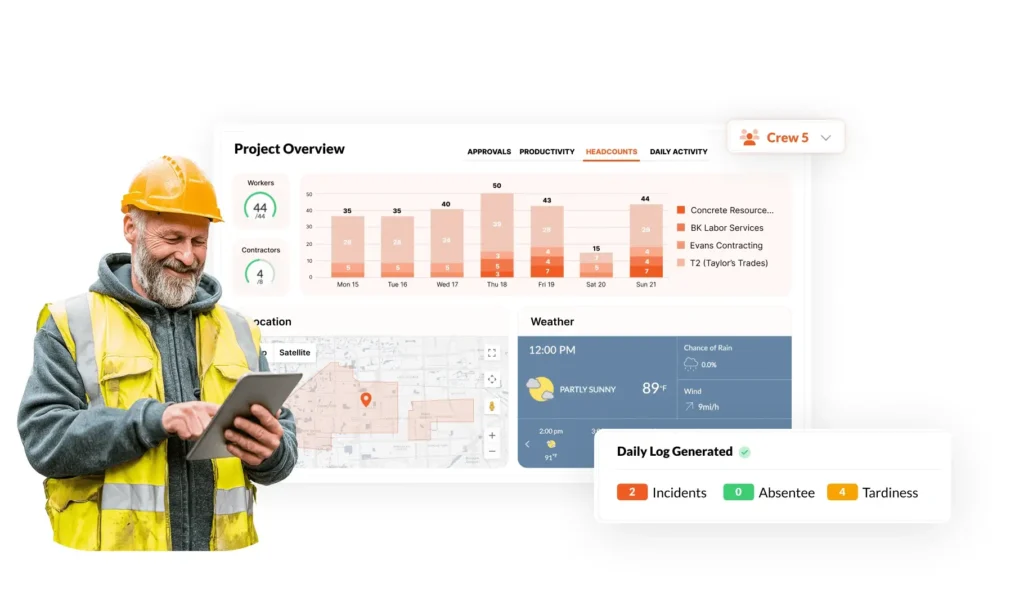
What it means for overtime management in practice:
Automatic overtime calculations
Overtime thresholds, double time rules, and union-specific schedule requirements are configured at the project level. The system applies construction overtime laws automatically, including California’s daily overtime trigger and CBA provisions for union workers. No manual rule application, no missed triggers, no overtime expenses appearing after the workweek closes.
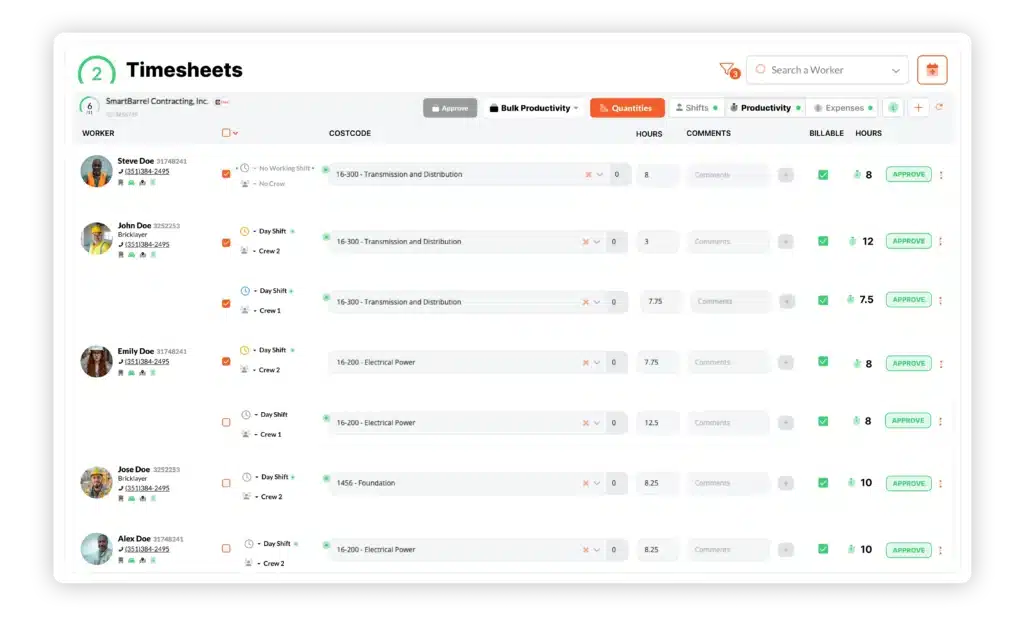
Pre-populated timesheets
Foremen start their approval process from a verified, timestamped record rather than creating one from memory. The shift from creation to approval removes the single largest source of overtime pay errors from approval to payroll.
Real-time visibility
Project managers and foremen see overtime hours accumulating in real time, before construction workers hit the 40-hour threshold. That visibility enables proactive scheduling decisions that reduce unnecessary overtime; costs that would otherwise surface as surprise costs after the pay period closes, rather than reactive payroll corrections after the fact.
Audit-ready records
Every punch is biometrically verified with a hard timestamp. On T&M jobs, those records win billing disputes. On prevailing wage work, they’re the foundation of certified payroll. On union projects, they ensure fair compensation reaches every construction worker who earned it, and help ensure compliance with overtime regulations across the entire workforce.
Harper Electric, a large non-union electrical contractor operating across Texas, reduced payroll errors by 20% and eliminated more than 20 hours of weekly payroll processing time after implementing SmartBarrel.
WPI, a multi-state trade contractor, cut timesheet verification time by 75% and reduced their error rate to near zero; directly improving their ability to ensure compliance with overtime regulations across their full workforce, and to ensure compliance well before a DOL audit is triggered.
SmartBarrel’s automatic overtime and double-time calculations are built into the platform’s zero manual entry setup. Payroll software integrations push verified, overtime-calculated data directly to systems like Procore, Foundation, and Vista; meaning the labor costs feeding payroll reflect what actually happened on the jobsite, not what a foreman reconstructed at the end of the week.
Frequently Asked Questions About Construction Overtime
Does overtime pay apply to temporary workers on T&M jobs?
Overtime obligations follow employment status, not contract type. If a trade contractor’s temporary workers or direct employees are performing work on a T&M job, those construction workers are still entitled to receive overtime pay under the Fair Labor Standards Act for hours worked beyond 40 in a workweek. The contractor is responsible for paying it regardless of whether overtime costs can be billed to the client. Accurate records give construction companies the ability to recover that paid overtime from the client rather than absorb it as sunk overtime expenses.
How do I handle overtime pay for a worker paid at multiple rates in the same week?
When a worker performs two or more types of work at different pay rates within the same workweek, calculating overtime pay requires the weighted average method. Add all straight-time earnings for the week and divide by total hours worked to find the regular rate. The overtime premium is 0.5 times that blended rate for each overtime hour.
Alternatively, under Section 7(g)(2) of the Fair Labor Standards Act, the parties can agree in advance to calculate overtime pay at 1.5 times the wage rate in effect when the overtime hours were worked, but the agreement must be made before the work is performed.
What records do contractors need to ensure compliance in an overtime audit?
The Labor Standards Act FLSA requires payroll records retained for at least three years, time records for at least two, and Davis-Bacon certified payroll for at least three years post-project completion (see record-keeping requirements table in Best Practices above).
Records should document each worker’s name, occupation, pay rate, daily and weekly hours across all construction projects, and the basis for any overtime calculations. Biometrically verified timestamps and cost code data provide a significantly stronger defense against back wages claims than manually completed timesheets.
Can a construction worker waive their right to overtime pay?
No. The FLSA’s overtime pay provisions cannot be waived. A non-exempt employee cannot legally sign away their right to overtime compensation, and any such agreement is unenforceable under federal and state laws. Under federal and state laws, employers who rely on such agreements and fail to pay overtime remain liable for unpaid wages plus potential penalties and attorney’s fees.
Construction overtime isn’t a math problem. The math is table stakes. The real problem is that the inputs feeding overtime calculations are built on guesswork for most construction companies still relying on foreman-entered or paper-based time records. Getting overtime pay right starts with getting hours worked right, and that starts the moment a construction worker steps onto the jobsite.
See how SmartBarrel delivers 100% accurate field time so your overtime calculations are built on verified data, not estimates.