


Prevailing wages are a legal requirement that directly shapes how trade contractors price public work, structure payroll, and document workforce hours for public projects.
For subcontractors bidding on federally funded or state-funded construction, understanding prevailing wage laws is essential. Failing to comply with those laws can mean back-pay obligations, fines, and in serious cases, losing the ability to bid for public work for three years.
This guide explains:
- What prevailing wages are in construction
- How wage rates get determined
- When prevailing wage laws apply
- and where compliance gaps most commonly appear.
This guide is for specialty contractors and self-perform general contractors who manage their own workers on public projects and want a clear, practical foundation for prevailing wage compliance.
What Are Prevailing Wages, Exactly?
Prevailing wages are government-established minimum pay rates that contractors must pay workers on covered construction projects (public works funded by federal, state, or local government). The rates vary by trade classification and geography, and they apply to both the base hourly wage and any required fringe benefits.
Prevailing wage is not the same as minimum wage. The federal minimum wage sets a broad employment floor across most industries. Prevailing wages are a project-specific requirement for public construction work and are typically far higher, often at or near union scale for that trade in that local market.
Fringe benefits (health insurance, pension contributions, apprenticeship funds, and similar) are a mandatory part of the total compensation and can add 15 to 35 percent on top of the base hourly wage. You can pay them in cash on top of the base rate, contribute to a qualified benefit plan, or use a combination of both. Either way, the full fringe amount must be documented for every worker on the covered project.
Many contractors focus only on the base rate when estimating costs for public bids and underestimate what fringes add to their total obligation. When a prevailing wage looks like “$45/hour base plus $15 fringe,” you’re really committing to $60 per hour of total compensation, a critical difference when bidding multi-worker jobs.
Pricing the full package correctly is what separates contractors who keep winning certified payroll jobs from the ones who bid one, lose money on it, and never go back.
How Are Prevailing Wage Rates Determined?
The Davis-Bacon Act, enacted in 1931, is the foundational federal law governing prevailing wage requirements on federal construction projects. The Department of Labor’s Wage and Hour Division conducts local wage surveys to determine the applicable prevailing wage rates for each trade classification and geographic area, then publishes those rates as official wage determinations.
Each published rate covers a specific construction type, such as building, heavy, highway, or residential, and applies to work performed within a defined locality.
The 2024 Final Rule
The Davis-Bacon Act was substantially revised by the 2024 Final Rule, the first major update to Davis-Bacon regulations in roughly 40 years. The rule restored a three-step review process that generally produces higher prevailing wages than the prior standard.
It also expanded the definition of the site of the work to cover certain off-site operations directly connected to a covered federal construction project, extending prevailing wage requirements beyond the primary jobsite in some cases.
How to Find the Applicable Rate
Current Davis-Bacon wage determinations are published on SAM.gov. Before bidding on a covered project, contractors should:
- Identify the correct wage determination for the project location and construction type
- Verify the applicable prevailing rate for each trade classification on their crew
- Factor both base wages and required fringe benefits into their cost estimates
Prevailing wage rates are updated periodically, so confirming the applicable rates before work begins, and again mid-project on longer jobs, is standard practice for contractors who regularly take on federal construction projects.
State Prevailing Wage Laws
Beyond federal law, 28 states plus the District of Columbia have enacted their own prevailing wage laws that apply to state-funded construction projects. These are sometimes called Little Davis-Bacon Acts. State thresholds, covered project types, and rate-setting methods all differ from the federal framework. When both federal prevailing wage requirements and state law apply to the same project, contractors must pay whichever rate is higher for each trade classification.
The table below summarizes key requirements across all 28 states and DC. Rates and requirements change regularly; always verify current determinations with the applicable state agency before bidding.
Source: LCPtracker State Prevailing Wage Map
State | How Wages and Benefits Are Paid | Pay Frequency | When Overtime Applies |
Alaska | Total package, same framework as federal Davis-Bacon. Fringes paid to a union trust fund, approved benefit plan, or directly on paycheck | Weekly | Over 8 hours/day or 40 hours/week. Fringes not paid at overtime rate |
California | Wages and fringes paid individually. Employer fringe benefit payments cannot be used to reduce the required hourly straight-time or overtime wage obligation | At least twice per calendar month | Varies by classification. Generally over 8 hours/day; double time after 12 hours/day. Four classification-specific exceptions apply |
Colorado | Total package, same framework as federal Davis-Bacon | Weekly | Over 40 hours/week |
Connecticut | Total package, same framework as federal Davis-Bacon | Weekly or bi-weekly | Over 8 hours/day or 40 hours/week |
Delaware | Total package. Wages defined as basic hourly rate plus fringe benefits | Weekly | Over 40 hours/week |
Hawaii | Base wage plus fringes. Can be met through cash contributions to a fringe benefit plan, cash in lieu of fringes paid directly to the worker, or a combination | Weekly, within 5 working days after the end of the pay period | Over 8 hours/day, all Saturday and Sunday hours, legal state holidays, and over 40 hours/week. Some classifications require double time on Sundays |
Illinois | Wages and fringes paid individually | Not specified in state law | Over 40 hours/week |
Maine | Base wage plus fringe benefits. Fringes include health and welfare, pension, vacation, annuity contributions, and per diem where applicable | Not specified in statute | Over 40 hours/week |
Maryland | Total package | Weekly | Over 10 hours/day, on Sundays, and on legal holidays |
Massachusetts | Base wage and fringes paid individually. Allowable fringes limited to health and welfare, pension, and supplemental unemployment plans only | Weekly | Over 40 hours/week |
Michigan | Total package | Weekly | Over 8 hours/day, all Saturday and Sunday hours, and legal holidays. Over 10 hours/day on an established 4/10 schedule. Fringes included in overtime calculation |
Minnesota | Total package. Fringes include health insurance, pension, and holiday and vacation plans | Bi-weekly | Over 8 hours/day or 40 hours/week |
Missouri | Wages and fringes set separately in the General Wage Order. Total package paid as federal is acceptable, but some classifications require overtime on fringes. Check each classification individually | Weekly | Over 10 hours/day or 40 hours/week. Check individual classifications in the General Wage Order |
Montana | Total package. Base wage plus fringes as determined by the commissioner | Weekly | Over 40 hours/week |
Nevada | Total package. Published wage determination combines wages and fringes in a single rate; overtime must be paid on the full amount. Overtime does not apply to contributions made to a bona fide benefit plan | Twice a month | Over 40 hours/week or 8 hours/day, unless an approved 4/10 schedule applies |
New Jersey | Total package acceptable, but individual classifications may have special overtime requirements including double time | Twice a month | Typically over 8 hours/day, but varies by classification. Double time may apply |
New Mexico | Total package, same framework as federal Davis-Bacon | Weekly | Over 40 hours/week |
New York | Wages and fringes paid individually | Weekly | Varies by classification |
Ohio | Full prevailing wage rate paid in cash if no qualified fringe benefit plan is in place | Semi-monthly (1st of month for prior first-half hours; 15th for prior second-half hours) | Over 40 hours/week |
Oregon | Total package, same framework as federal Davis-Bacon | Weekly | Over 8 hours/day (or 10 hours/day on an established 4/10 schedule); all Saturdays, Sundays, and six legal holidays |
Pennsylvania | Total package | Weekly | Over 40 hours/week |
Rhode Island | Total package, same framework as federal Davis-Bacon. Overtime calculated on base rate only; fringe rate added back after | Weekly | Over 8 hours/day or 40 hours/week |
Tennessee | Base wage only. No fringe benefits required under state law. Applies to state highway construction projects only | Weekly | Over 40 hours/week |
Texas | No fringe benefits required under state law | At least twice a month; weekly for federally funded projects | Over 40 hours/week |
Vermont | Total package, same framework as federal Davis-Bacon. No fringe benefit requirement under state law | Weekly | Over 40 hours/week |
Virginia | Total package, same framework as federal Davis-Bacon | Not specified under state law | Over 40 hours/week |
Washington | Base wage plus usual benefits, paid individually. Cash fringe payments are treated as wages, not benefits | Weekly | Over 8 hours/day or 40 hours/week; double time between 6:00 PM Saturday and 6:00 AM Monday |
Wyoming | Two-tiered: excess fringe benefit payments above the minimum cannot offset the required base wage rate | Not specified (semi-monthly for railroad, mining, and manufacturing; weekly for federal-aid highway projects) | Over 8 hours/day or 40 hours/week |
District of Columbia | Total package, same framework as federal Davis-Bacon | Weekly | Over 40 hours/week; overtime calculated on base wage only |
When Do Prevailing Wage Laws Apply?
Federal prevailing wage laws under the Davis-Bacon Act apply to contracts for construction, alteration, or repair that are federally funded or federally assisted and exceed $2,000. That threshold is low enough to cover essentially all federal construction projects of any meaningful scope.
The Obligation Flows Downstream
Prevailing wage obligations flow down through the contracting chain. When a prime contractor on a covered project brings in specialty subcontractors, those subcontractors are also required under the Davis-Bacon Act to pay prevailing wages to workers on that project.
The prime contractor is responsible for monitoring subcontractor compliance, but subcontractors are independently obligated under federal law to pay the correct wage rates and submit their own certified payroll.
Trade contractors managing their own workers across subcontractor time tracking on multiple public projects should treat each site as a separate prevailing wage obligation, since applicable rates vary by geography and construction type. SmartBarrel captures verified clock-in and clock-out data segmented by jobsite and trade classification, giving contractors the site-level records needed to meet certified payroll requirements across multiple jurisdictions.
That same site-by-site discipline applies when workers move between job sites mid-shift on a single day, since federal wage-hour rules count that transit differently depending on where the workday actually begins.
Infrastructure and Clean Energy Projects
Infrastructure and clean energy projects funded under recent federal legislation also trigger prevailing wage requirements, alongside apprenticeship ratio requirements for qualifying field hours.
Electrical, MEP (Mechanical, Electrical, Plumbing), and solar contractors taking on federally assisted work in this space are increasingly encountering these obligations on project types that may not have carried them previously.
State and Local Prevailing Wage Laws
State prevailing wage laws apply to projects funded by state agencies or local governments. The applicable law and wage rates vary significantly by jurisdiction. Some state laws apply to smaller contracts or cover construction types not addressed at the federal level.
Trade contractors working across multiple states on public work need jurisdiction-level clarity for each project rather than assuming the federal Davis-Bacon Act is the only prevailing wage framework to account for.
Contractors self-performing on large multi-state programs, such as data center campuses, face the same jurisdiction-by-jurisdiction checks, which is why audit-ready time tracking on data center projects starts with verified punches at check-in.
Checking each state’s prevailing wage requirements before bidding is standard due diligence for multi-state operators.
Federally Assisted Projects
One area that often surprises contractors: federally funded projects don’t have to be exclusively publicly funded construction contracts to trigger prevailing wage requirements. Projects that receive federal financial assistance through grants, loans, or loan guarantees may also fall under the Davis-Bacon Act, depending on the program and funding structure. When in doubt, reviewing the contract documents and confirming with the contracting agency before bidding will establish whether prevailing wages apply.
What Are the Prevailing Wage Requirements for Public Works Projects?
Certified payroll reporting
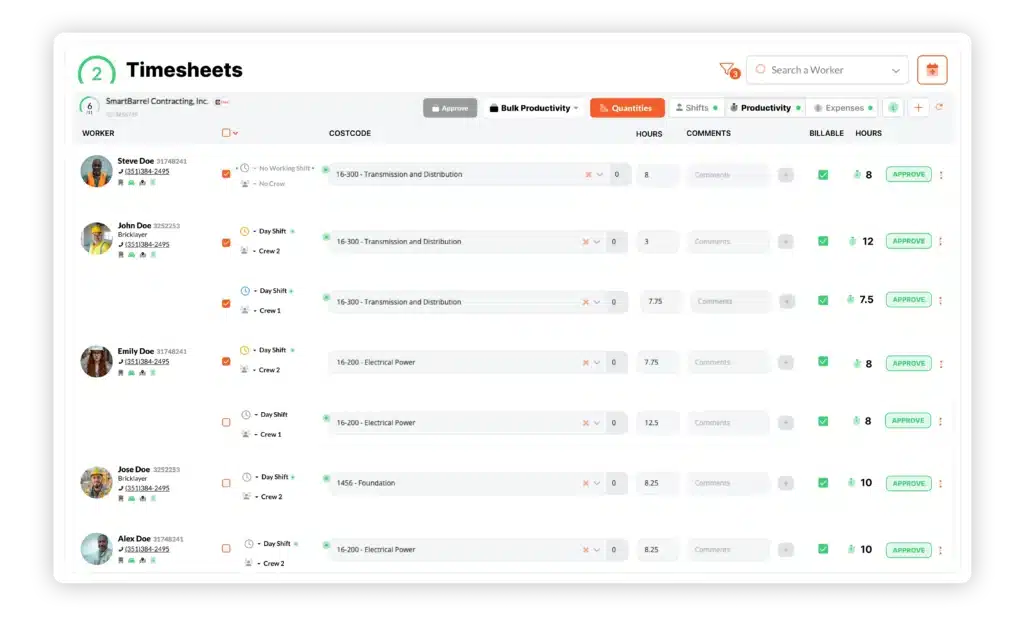
On federal projects subject to the Davis-Bacon Act, contractors must submit a certified payroll report each week using Form WH-347. The report documents every worker on the project that week:
Field | What It Documents |
Name and address | Worker identity and contact information |
Trade classification | The type of work performed (such as electrical, plumbing, drywall etc.) and applicable wage rate |
Hours worked each day | Daily attendance record for each worker |
Total weekly hours | Cumulative hours for the pay period |
Wages paid | Actual compensation received for hours worked |
Fringe benefits | Contributions or cash equivalents paid in lieu of benefits |
The Copeland Anti-Kickback Act, which runs alongside the Davis-Bacon Act, prohibits any contractor from inducing workers to return any portion of the wages they are legally owed and requires weekly payroll statement submissions as a condition of compliance.
Subcontractors submit their own certified payroll to the prime contractor, who then compiles and submits to the contracting agency. State prevailing wage projects follow similar logic, but submission formats, deadlines, and contracting authority requirements vary by state.
Contractors working across multiple states on public work need project-specific processes rather than a single one-size-fits-all certified payroll workflow.

Record keeping
Contractors must maintain complete payroll records for every worker on a covered project: full name, address, trade classification, hours worked each day, total weekly wages paid, and fringe benefit contributions. Federal Davis-Bacon law generally requires three-year record retention from project completion.
Records must be made available to the Department of Labor or the contracting agency on request. The applicable wage determination must also be posted in an accessible location at the jobsite so workers can see the prevailing wages that apply to their trade and work.
Penalties for not paying prevailing wages
Failing to pay prevailing wages carries substantial consequences under both federal and state prevailing wage requirements. Contractors found to have underpaid workers are liable for back wages covering every affected worker and every covered hour, regardless of whether the underpayment was intentional.
The Department of Labor recovered $259 million in back wages across labor law enforcement actions in fiscal year 2025. Contractors found to have willfully violated prevailing wage law can be debarred from federal contracting for up to three years and face criminal prosecution for falsifying certified payroll records.
State penalties follow parallel patterns. In California, fines for underpaying workers on public works projects reach up to $200 per worker per day under California Labor Code Section 1775. For a contractor with a 25-person crew working a 90-day project, even a technical compliance failure accumulates into a serious financial exposure.
Don’t let recordkeeping gaps turn a compliance question into a back-wage liability. See how SmartBarrel keeps your time data audit-ready. Request a demo.
Worker Classifications and Prevailing Wage Rates
The wage rate that applies to any given worker depends on how that worker is classified. A journeyman electrician and an apprentice electrician carry different prevailing wages. A laborer and a carpenter carry different rates under the same wage determination. Applying the wrong classification to a worker, even without any intent to underpay, creates a wage liability that can surface during a Department of Labor audit or a state labor compliance review.
On multi-trade jobsites, this complexity multiplies. Construction workers across different trades performing work on the same covered project each carry their own applicable prevailing wage rate under the relevant wage determination.
Foremen who spend more than 20% of their time during a workweek on manual or physical labor must be paid at least the prevailing rate for that physical work, not just a supervisory rate. This rule is commonly overlooked by trade contractors whose foremen are hands-on in the field.
Worker classification errors are among the most common findings in prevailing wage audits.
SmartBarrel’s construction labor cost tracking is tied to workers’ hours and easily applied by foremen, reducing the risk of a misclassification flowing through undetected into certified payroll. It also gives contractors a defensible record to present if classifications are questioned.
How Prevailing Wages Affect Non-Union Worker Pay on Government Jobs
Open-shop contractors sometimes assume prevailing wage law applies only to unionized workers. It does not.
Non-union construction workers on covered federal or state projects must receive the applicable prevailing wages for their trade classification. The law draws no distinction between union and open-shop work when it comes to the wage rates workers are owed on covered public construction work.
Prevailing wages are typically set at or near union scale
In most markets, prevailing wages are set at or near union scale for the relevant trade. For a trade contractor accustomed to bidding private commercial work, taking on a covered public project for the first time can mean a meaningful increase in costs, even if nothing about the scope changes.
That additional cost needs to be factored into the bid from the start. Discovering the prevailing wage requirement after winning work creates a difficult situation that some contractors handle by eating the difference, which erodes margins on what looked like a straightforward job.
Rates vary by state and jurisdiction
Prevailing rate calculations differ across jurisdictions. Some states base their determinations on local wage surveys that don’t directly mirror union rates, producing different outcomes by trade and region.
Before bidding any public works project in a new state, trade contractors should verify the applicable rate through that state’s prevailing wage division and confirm it’s built into the bid. Assuming that prevailing wages in one state reflect what applies in another is a common and costly mistake for contractors expanding their geographic footprint.
The Compliance Risk Hiding in Your Timekeeping
Most contractors who regularly take on prevailing wage jobs understand the wage schedules well enough. The compliance gap that often goes unaddressed is the accuracy of the underlying hours those wages are applied to.
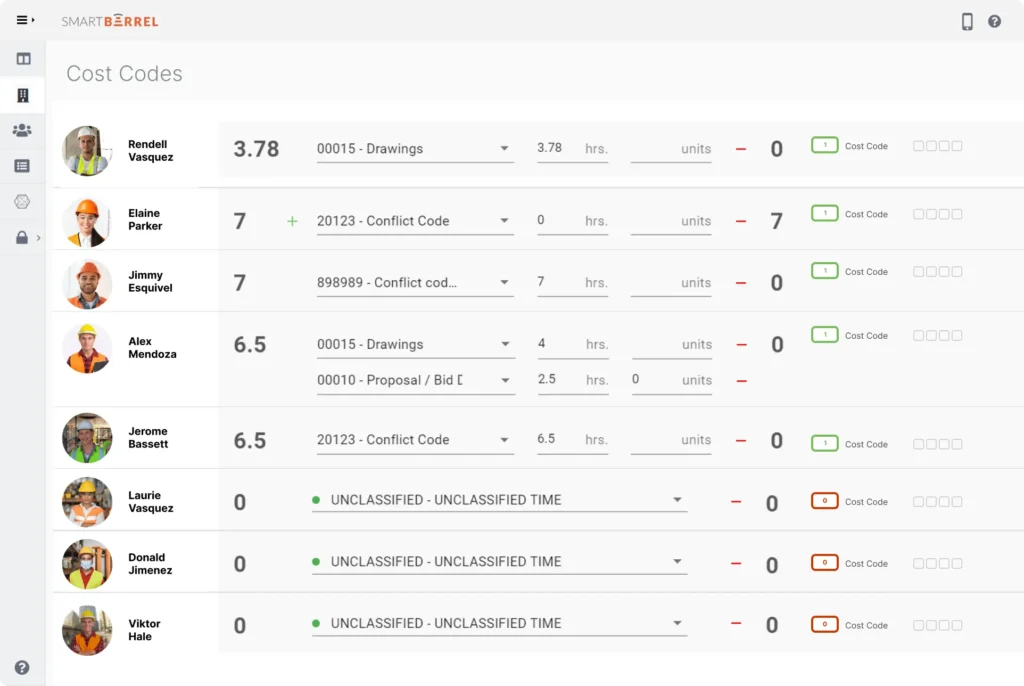
Certified payroll is only as reliable as the labor hours data feeding it. If time is being rounded, submitted on paper, or entered from memory at the end of the week, accuracy suffers. When a foreman is reconstructing hours across two active sites, certified payroll won’t reflect actual hours worked, even with correct prevailing wage rates applied.
Federal law requires that wages paid match actual hours worked at the applicable prevailing rate. When that documentation is shaky, even a good-faith compliance effort is difficult to defend under audit.
SmartBarrel captures verified clock-in and clock-out data in real time, and syncs directly to payroll platforms like Foundation, CMiC, and Vista, giving contractors a defensible, timestamped record for every worker on every covered project.
When the Department of Labor or a contracting agency requests documentation, the data is available without any manual reconstruction. That’s a meaningfully different position to be in than trying to recreate a worker’s hours from a foreman’s memory three weeks after the pay period closed.
See how SmartBarrel supports accurate certified payroll on prevailing wage jobs. Request a demo.

Frequently Asked Questions
What is the difference between prevailing wage and certified payroll?
Prevailing wage is the minimum pay rate required for a specific trade classification on a covered public project. Certified payroll is the documentation that proves those wages were actually paid. The two are related but distinct: prevailing wage sets the legal obligation, and certified payroll is how contractors demonstrate compliance with that obligation to the contracting agency.
A contractor can know the correct prevailing wage rate and still face violations if the certified payroll records are incomplete, inaccurate, or submitted late. Both matter, and problems with either can trigger back-wage liability and enforcement action.
What happens if a contractor discovers they underpaid a worker on a prevailing wage project?
The first step is to correct it quickly. Voluntary correction before a complaint is filed or an audit is initiated typically results in more favorable treatment from enforcement agencies. Under federal Davis-Bacon requirements, contractors are liable for the full difference between what was paid and what was owed, plus any applicable penalties.
Prompt correction, documented clearly, demonstrates good faith and reduces the risk of escalating penalties. Waiting for the issue to surface in an audit is a significantly worse position to be in. Contractors who catch underpayments through their own payroll review process and correct them proactively are in a much stronger compliance posture than those who don’t discover the error until the Department of Labor does.
What is the difference between a general wage determination and a project wage determination?
A general wage determination covers all projects of a specific construction type in a defined geographic area. These are issued twice a year by the Department of Labor’s Wage and Hour Division and are the determination most contractors encounter when bidding federal work.
A project wage determination, by contrast, is issued for a single named project at the specific request of a contracting agency, typically when the work involves an unusual classification not covered by the general determination for that area.
Most trade contractors working on standard federal construction projects will use general wage determinations pulled from SAM.gov. Project determinations are less common but binding when they apply, so reviewing contract documents carefully before bidding will confirm which type governs the work.