


For contractors running overtime-heavy crews, the qualified overtime deduction is one of the more consequential tax changes to land in years. Widely known as the “no tax on overtime” break, it was signed into law through the One Big Beautiful Bill Act in July 2025.
The Big Beautiful Bill Act lets eligible employees subtract part of their overtime pay from their federal taxable income for tax years 2025 through 2028. (The same law added a separate deduction for qualified tips, including cash tips, which rarely applies on a jobsite, so this article sticks to overtime.)
For trade contractors tracking their own field workforce, the tax on overtime deduction raises a practical question that has less to do with tax code and more to do with your timesheets: can your payroll system actually prove how much qualified overtime each worker earned?
That matters because the deduction covers only a specific slice of overtime pay, and reporting it accurately depends on the quality of the hours coming off your jobsites.
What The Qualified Overtime Deduction Actually Covers
The qualified overtime deduction applies only to the overtime premium, which is the overtime pay required under section 7 of a federal law called the Fair Labor Standards Act for hours worked over 40 in a workweek. That premium is the extra half of “time and a half,” the piece that exceeds a worker’s regular hourly pay.
If an hourly worker earns $30 an hour and gets $45 for an overtime hour, only the $15 above their regular wages counts as qualified overtime pay. Workers who receive qualified overtime compensation this way can deduct that premium; the base $30 does not qualify.
How Much Overtime Pay Can A Worker Deduct?
The maximum annual deduction depends on filing status and income:
Filing status | Maximum deduction | Phase-out begins (MAGI) |
Single filer | $12,500 | $150,000 |
Married couples filing a joint return | $25,000 | $300,000 |
Above those thresholds, the deduction phases out by $100 for every $1,000 of modified adjusted gross income over the line. It stays above the line, so workers can claim it whether or not they itemize, and it goes on the worker’s own federal tax return rather than through payroll.
Does The Deduction Make Overtime Pay Tax-Free?
No. Overtime pay still counts as paid wages in the taxable amount on the Form W-2, and it remains subject to Social Security and Medicare taxes. Depending on where the crew works, it can also carry state or local taxes. What changes is that eligible workers, whether single or married filing jointly, deduct the qualifying premium when they file, so they owe taxes on a smaller share of their overtime.
Why Construction Crews Earn More Qualified Overtime Compensation
Overtime is more common in construction compared to other industries. Deadline pushes, weather catch-up, night pours, and shutdown work regularly drive crews past 40 hours in a workweek. More overtime work means more qualified overtime compensation on the table, and the more workers who receive overtime pay, the more who stand to benefit at tax season.
The trade also carries complications that a factory or office does not. Only FLSA-required overtime qualifies. Overtime paid under some state daily-overtime rules, or premium pay owed only under a collective bargaining agreement beyond what federal law requires, does not count toward the deduction.
Crews on a public project for a local government agency may also work under prevailing wage rules. Multi-state contractors and union shops therefore have to separate federally required overtime from other premium pay before anyone can calculate the amount of qualified overtime correctly.
What Does The IRS Require You To Report On Form W-2?
The employer’s role becomes concrete here. IRS Guidance made 2025 a transition year, with mandatory reporting arriving the year after. The obligations are split cleanly by tax year:
Requirement | Tax year 2025 | Tax year 2026 onward |
Separate reporting of qualified overtime compensation | Not required (transition relief) | Mandatory |
Penalty for leaving it off | Waived, if the return is otherwise complete | Standard information-return penalties apply |
Placement on the Form W-2 | Voluntary, often Box 14 | Dedicated field the IRS is adding |
Even during the 2025 transition year, reporting the figure voluntarily spares workers from reconstructing it, so they can claim the deduction for qualified overtime without digging through pay records. Many payroll systems were never built to isolate the overtime premium, which is why the transition relief matters.
Most VPs of Operations aren't asking me about tax law. They're asking a much more uncomfortable question: 'If the IRS wants this broken out next year, can my system actually do it today?' And for a lot of them, the honest answer is no. Their overtime numbers live in three different places, foremen are still rounding on paper, and nobody's connected those dots to a workweek-by-workweek premium. The surprise isn't the deduction. It's realizing how much cleanup stands between where their data is now and where it needs to be by 2026.
Yana Tcharnaia, CRO, SmartBarrel
How Accurate Field Hours Make The Overtime Deduction Claimable
Whether an employer can report qualified overtime cleanly comes down to the accuracy of the hours captured in the field. The overtime deduction is figured per workweek, against each worker’s regular rate of pay. To produce it, a payroll system needs to know exactly when each worker started and stopped, on which day, and at which rate, with no rounding papering over the edges.
That is a tall order for any contractor still running paper timecards or foreman-entered hours. When time gets rounded to the nearest quarter hour or filled in from memory, the record stops reflecting the exact hours worked. Those small distortions do more than inflate labor cost. They blur the line between straight time and the overtime premium, the very number the deduction depends on.
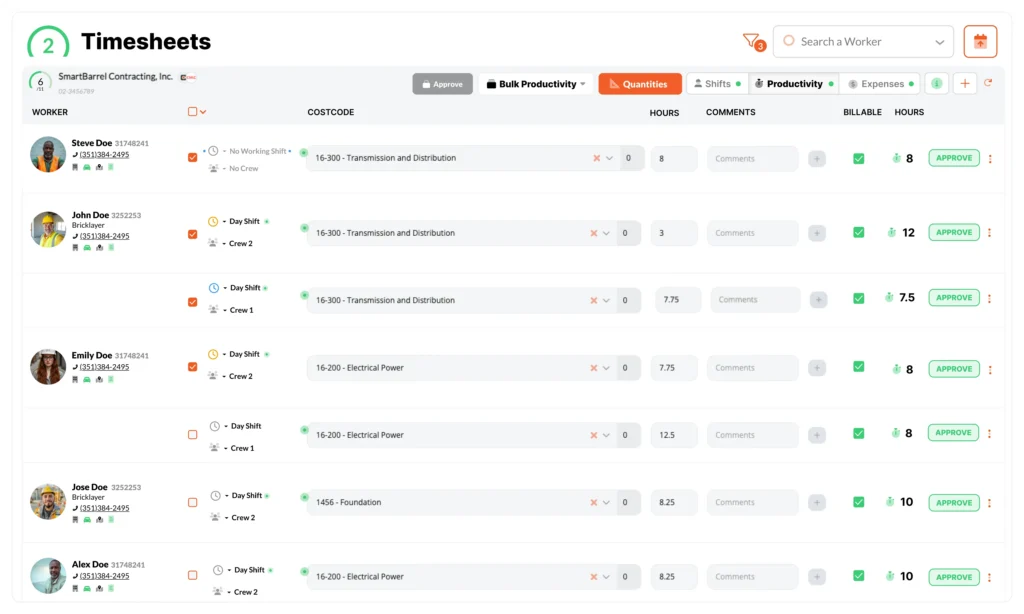
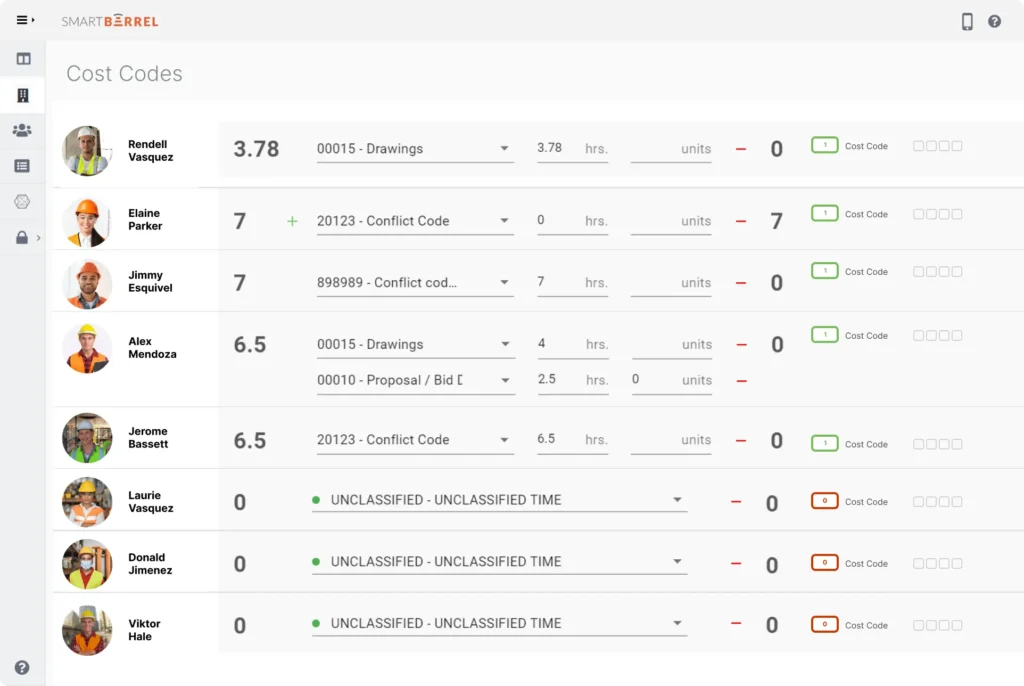
This is where accurate capture at the source pays off. SmartBarrel’s construction time tracking software records verified check-in and check-out times through biometric facial verification, then feeds structured hours straight into your payroll and ERP integrations.
Because time is captured to the minute and tied to each worker and jobsite, the overtime premium comes from real hours worked, not a rounded approximation. That is what “the most accurate time from the field” means in practice: the data behind payroll, job costing, and now a tax deduction traces back to one verified record.
Electrical contractor Prism Electric saw this firsthand. Before switching, thousands of weekly timesheets looked nearly identical, and time was routinely rounded, which meant the company was overpaying workers and could not trust the numbers. After moving to verified time capture, leadership reported that common timekeeping errors were eliminated. As EVP Luke Harmon put it, the company has “been able to maintain a very constant back-office staff while growing our field forces tremendously.”
Almost every time, it traces back to rounding. A contractor pulls a year of overtime and the totals don't match what they expected, and when we dig in, it's not one big error, it's hundreds of small ones: a foreman rounding to the nearest quarter hour on a Friday, a worker clocking in from memory after a phone died on-site. None of those look like a problem in the moment. Stacked across a year and multiplied by a crew, they're the difference between an overtime premium you can defend and one you're guessing at.
Albert Bou Fadel, Founder & CEO, SmartBarrel
See how verified field hours flow into your payroll. Request a SmartBarrel demo.
How Do You Calculate The Amount Of Qualified Overtime? (With Overtime Examples)
To calculate the amount of qualified overtime, start with the overtime pay earned for the year and isolate the premium. Under standard time and a half, that premium is one-third of the total overtime pay, and the IRS publishes overtime examples that follow this math.
Take a worker who received $24,000 in total overtime pay. Divide that overtime amount by three, and the qualified overtime premium is $8,000, the qualified overtime compensation received for the year. The hourly view matches: at $30 an hour, each overtime hour worked pays $45, and the $15 above the regular rate of pay is the deductible premium.
The math is straightforward once the hours are clean. The hard part comes before that: knowing precisely how many overtime hours each worker logged, in which workweek, at which regular rate. That is a recordkeeping problem before it is a tax problem. Public-sector rules differ, so where an agency grants one and one half hours of comp time per overtime hour, or applies a longer work period for certain roles, the deductible value follows separate IRS provisions.
What Construction Employers Should Do Before Tax Year 2026
The transition year is a window to get ready. A few steps put contractors in position for mandatory reporting and help workers claim what they are owed.
- Confirm which workers are FLSA overtime-eligible. Exempt salaried staff will not qualify, while most hourly employees on the crew will.
- Configure payroll to track the overtime premium separately from straight time, so the qualified figure pulls without manual math.
- For 2025, consider reporting qualified overtime voluntarily on the Form W-2 or a separate statement.
- Tighten field time capture so the hours feeding payroll are verified and accurate, because every number built on that data inherits its quality.
None of this is tax advice, and specifics should be confirmed with a qualified tax professional. What is squarely in a contractor’s control is the accuracy of the hours. Get that right, and qualified overtime reporting becomes one more clean output of a system that already runs your payroll.
Ready for 2026 reporting? Book a SmartBarrel demo and see the most accurate time from the field, from clock-in to payroll.

Frequently Asked Questions
Does the deduction cover double time, or only time-and-a-half?
Only the time-and-a-half premium the FLSA requires qualifies. If a worker is paid double time under a state rule, union contract, or company policy, just the federally required half-time portion counts toward the deduction, not the extra premium above it. Anything owed beyond what the FLSA requires falls outside qualified overtime compensation.
If a worker's hours were tracked on paper in 2025, can they still claim the deduction?
Yes. Because 2025 is a transition year, FLSA-eligible workers can use reasonable methods, such as pay stubs, earnings statements, or payroll records, to calculate their qualified overtime compensation if the employer did not report it separately. That reconstruction gets much harder for 2026, when separate reporting on the Form W-2 becomes mandatory and clean source data matters most.
Does the qualified overtime deduction reduce what an employer pays in overtime?
No. The employer still owes full FLSA overtime pay and still matches Social Security and Medicare taxes on it. The benefit goes to the eligible worker as a reduction in the federal income tax they owe when they file, not as a cut to the employer’s payroll costs.