

Construction payroll is, in theory, straightforward. Track hours. Apply the right rates. Cut the check.
In practice, it’s one of the most operationally complex processes a trade contractor runs, and the complexity starts in the field.
The problem most construction businesses don’t say out loud: the data feeding their payroll is only as reliable as the process used to collect it. When that process is a foreman’s handwritten notes, a spreadsheet filled in on Friday afternoon, or an app nobody consistently uses, inaccurate payroll isn’t a risk; it’s a near-certainty. Wrong rates get applied. Hours get rounded. Workers get misclassified. Certified payroll reports go out with data that won’t hold up to scrutiny.
This guide covers how construction company payroll actually works, where it tends to break down, and what it takes to run it with confidence across multiple projects, trades, and compliance requirements.
Why Construction Payroll Is Different from Standard Payroll
In most industries, employees work at a fixed location, on a fixed schedule, at a single pay rate. Processing payroll is largely a mechanical exercise. Construction doesn’t work that way.
A single trade contractor might have workers spread across multiple active sites in multiple tax jurisdictions, each running different cost codes, with crews that mix direct employees, temp labor, and hourly subcontractors; all carrying different wage structures and subject to different federal and local laws.
Some workers are on union payroll. Some are on a prevailing wage project. Some perform work that qualifies for one cost code in the morning and a different one in the afternoon.
Layered on top of that, jobs end. New jobs start. Crews get reassigned mid-week. Workers onboard quickly and sometimes exit just as fast. Managing labor costs, maintaining accurate job costing, and paying employees correctly across the construction industry requires systems that were designed for it, not adapted from something else.
That design starts with accurate hours from the field, because every rate, classification, and cost code calculation downstream inherits whatever problems the original time entry carries with it.
Standard payroll software was designed for the person writing the check. Construction payroll demands software for construction that understands the field, and a data collection process that can actually operate there.
SmartBarrel was built specifically for this environment. The product was designed field-first, starting with how a crew of hundreds workers clocks in across multiple jobsites, then working backward to how that data reaches payroll.
That’s the opposite of how most payroll and time tracking tools are built, and it’s why contractors running complex multi-site operations use it to get verified, real-time labor data flowing into their payroll systems without the manual overhead that comes with every other approach.
The Core Components of a Construction Payroll System
Getting construction payroll right starts with understanding what it’s actually made of. These are the moving parts every contractor needs to manage.
Wage Types, Pay Rates, and Hourly Rates
Construction workers typically earn straight-time pay, overtime (often at 1.5x for hours over 40 per week, though state thresholds vary), and sometimes shift differentials. On prevailing wage jobs, the applicable pay rates and hourly rates are determined by trade classification and geography, not by what the contractor normally pays.
Managing multiple pay rates across jurisdictions is one of the defining challenges of construction accounting, and one of the clearest reasons generic payroll software falls short.
Fringe Benefits and Union Dues
On prevailing wage projects, total compensation includes both a base wage and a fringe benefits component. This can be satisfied through a bona fide benefit plan (health, pension, apprenticeship) paid in cash as part of the hourly wage, or a combination of both.
Union payroll also involves dues remittance, which requires accurate hour tracking per worker per project to calculate correctly. Errors here have direct compliance consequences.
Job Costing and Cost Code Allocation
Construction payroll isn’t only about paying employees, it’s about allocating labor costs to the right construction project, phase, and cost code. That allocation drives job costing and feeds the payroll reports, job labor reports, and job hour variance reports that project managers and accounting teams software rely on.
When labor hours get posted to the wrong code, or go unallocated, the downstream impact touches every financial decision the construction business makes.
Submitting Certified Payroll: The WH-347 Requirement
On federally funded or assisted construction projects, contractors must submit weekly certified payroll reports (WH-347 form) documenting hours worked, trade classifications, and wages paid for each worker. This isn’t optional reporting, it’s a legal compliance obligation enforced by government agencies including the Department of Labor’s Wage and Hour Division.
Prevailing Wage Rates and Weekly Payroll Compliance: What’s Actually at Stake
Most articles on prevailing wage explain what it is. Here’s what they skip: the compliance risk usually isn’t in the wage rate itself. It’s in the classification and the records that support it.
Under the Davis-Bacon and Related Acts, workers must be paid the applicable prevailing wage rates for the specific work classification they actually perform each day. A worker doing electrical work in the morning and drywall work in the afternoon is legally entitled to two different pay rates for those two periods, and the contractor is responsible for the time records that prove it. These wage requirements don’t give contractors the benefit of the doubt on ambiguous records.
The DOL’s 2023 final rule update lowered the threshold for setting these rates from 50% to 30% of workers in a given area. More construction projects in more geographies are now subject to wage determination scrutiny. The compliance footprint for electrical, MEP, and solar contractors doing federally assisted work has expanded, and so has the exposure from imprecise field data.
The second issue contractors routinely run into: treating certified payroll as a compliance silo separate from regular payroll. When the two don’t share a common data source, reconciling them becomes a manual weekly exercise. The WH-347 form requirements haven’t changed substantially, but the systems contractors use to generate clean data for them absolutely have.
When hours from the field are captured with the right level of detail, worker identity confirmed, classification recorded, hours timestamped on the jobsite, weekly submissions become an export. When it isn’t, they become a liability.
How to Do Payroll for a Construction Company: Step by Step
Understanding how construction payroll gets processed means mapping the full flow from field to paycheck. Here’s how it typically runs, and where the friction concentrates.
Step 1: Field Time Collection
Workers clock in and out at the jobsite. This is where payroll data originates, and where construction accounting diverges most sharply from other industries. Every downstream step inherits whatever accuracy (or inaccuracy) exists here.
Step 2: Time Review and Approval
Foremen or superintendents review their crew’s hours, flag discrepancies, and approve timecards. In manual environments, this typically happens Friday afternoon from handwritten notes accumulated across the week.
Step 3: Cost Code Assignment
Approved hours are allocated to the relevant construction project, phase, and cost code. This step often requires significant back-office intervention – chasing down foremen for cost codes and hours – when field data lacks the detail needed for accurate job costing.
Step 4: Accounting System Entry
Allocated hours flow into payroll software (Vista, CMiC, Foundation, QuickBooks), where wages are calculated based on classification and location. Data entry at this stage is where errors from upstream get locked in.
Step 5: Payroll Calculation
The payroll software applies the applicable rate for each classification, calculates overtime, applies any fringe benefits where required, handles workers compensation calculations, manages tax filings, and processes deductions.
Step 6: Payroll Run and Distribution
Employees get paid. On Davis-Bacon covered projects, payroll reports and weekly compliance submissions are generated and submitted to the relevant government agencies for that week.
The friction concentrates at steps 1 through 3. When construction time tracking software captures verified, real-time data with cost codes assigned at the point of entry, steps 2 and 3 compress significantly.
When it doesn’t, the back office spends days chasing field data, payroll processing gets delayed, and teams spend too much time verifying hours.
The Hidden Cost of Manual Time Entry on Construction Payroll and Cash Flow
The conversation around manual time entry in construction usually focuses on fraud, buddy punching, padded hours and ghost workers. That’s a real problem. But the bigger cost for most construction companies is the lack of a structured time capture process.
When foremen record and submit time for their entire crew manually, they spend hours weekly on administrative tasks instead of running the job. When payroll admins chase missing timecards, reconcile inconsistencies, and re-run payroll due to errors; they lose days that directly impact cash flow. Worse, contractors take a reputational hit in the eyes of the worker. Yes, they eventually get paid correctly, but workers may begin to lose trust and share their frustrations with peers.
The numbers from real construction companies illustrate the scale. Western Partitions, Inc. (WPI), a trade contractor with 1,500+ field employees across multiple regions, carried a 10-15% estimated error rate in timesheet entries before switching to verified time capture.
After rollout, that dropped to nearly zero, and their payroll approval process went from five hours to two. Construction accounting accuracy improved across all their active projects. The New Mexico region alone estimated $36,000 in annual labor costs recovered.
JENCO, Inc., an electrical contractor managing 50+ active construction projects at a time in Arizona, cut their payroll cycle from three days to two and eliminated re-runs entirely after moving to automated field data collection. Estimated savings: $260,000 per year across foremen and payroll administration.
In both cases, the payroll software wasn’t the limiting factor. The field data was.

Union Payroll, Multi-State Construction Payroll, and EEO Compliance
Construction payroll gets significantly more complex when companies operate across union agreements, multiple pay structures, multiple tax jurisdictions, and multiple states simultaneously. For trade contractors working regionally or nationally, this isn’t an edge case.
Union Payroll
Union payroll in construction typically runs on structured shift schedules, 5/8s (five eight-hour days) or 4/10s (four ten-hour days). The compliance concern isn’t usually about 15-minute rounding. It’s about presence verification.
Union contractors often bring in workers they don’t have a prior history with, and they need to confirm people are actually on the jobsite at the times reported, to maintain compliance with attendance requirements and address tardiness or early departures. Payroll errors here don’t just create financial exposure; they create labor relations risk.
Multi-State Payroll and Tax Jurisdictions
Multi-state payroll in construction means managing varied overtime thresholds, prevailing wage laws, tax filings, workers compensation classifications, and reporting requirements depending on where each job sits. California’s daily overtime threshold differs from Texas’s weekly one.
Getting pay rate calculations right across state lines means tracking not just base wages but also which threshold triggers premium pay, who qualifies, and how premiums stack.
Some states have their own prevailing wage statutes that apply independently of federal Davis-Bacon. Contractors running multi-state operations across different jurisdictions need payroll software that can handle these variances, applying the correct pay rates for each location and keeping cash flow predictable without manual reconfiguration for every new project.
Trade contractors running multi-site subcontractor operations across different states find that the bottleneck usually isn’t knowing the applicable rate, it’s having field data precise enough to apply it. Workers performing different classifications in different states within the same pay period need granular time records, not approximations.
EEO Minority Compliance
On federally funded construction projects, contractors are also subject to EEO minority compliance reporting requirements. Accurate worker classification records and hours-by-trade data are foundational to these reports. When field time data is unreliable, EEO reporting becomes another manual reconciliation exercise, and another compliance exposure.
What SmartBarrel Does With This Complexity
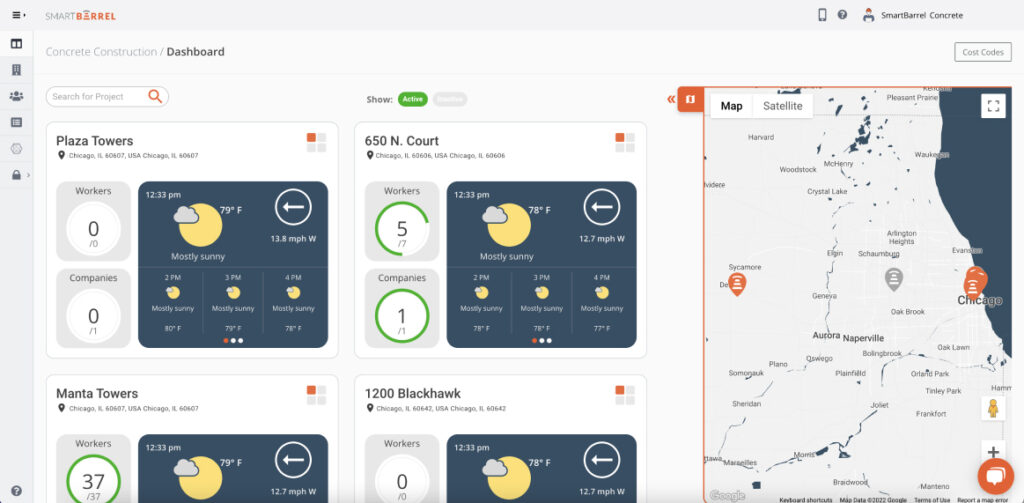
Union payroll, multi-state compliance, and EEO reporting all share the same dependency: accurate, verified field data. SmartBarrel captures who was on the jobsite, when they arrived, and what cost codes were performed in real time, without relying on a foreman to remember and report it later.
That data flows directly into your payroll system, so whether you’re reconciling 5/8 shift attendance for a union crew in Arizona or pulling hours-by-trade for an EEO report on a federal project in three states, you’re working from the same verified source.
Choosing the Best Construction Payroll Software for Multiple Jobs and Multiple Sites
A lot of construction companies have discovered the hard way: generic payroll software wasn’t built for how they work. Here’s what to look for when evaluating the best construction payroll software for trade contractors.
Accounting System Integration
Hours from the field need to flow directly into the construction accounting software already running the business, Viewpoint Vista, CMiC, Foundation, to name a few. If the connection requires manual re-entry between systems, it’s not a real integration. The best construction payroll solutions eliminate that gap entirely, giving payroll service teams clean data without the reconciliation burden.
Real-Time Field Data
Time data collected at end-of-week is already stale. Errors that could be caught Tuesday get discovered Friday. The standard for payroll software for construction should be data that’s visible and actionable as it’s captured.
Automated Job Costing and Custom Reports
Labor cost allocation shouldn’t require manual intervention. Cost codes should flow from project setup, with job labor reports and job hour variance reports generated automatically rather than compiled by hand. The ability to produce custom reports and payroll reports by project, trade, classification, or region matters significantly at scale.
WH-347 Compliance and Non-Federal Work Hours
For construction companies doing both Davis-Bacon work and non-federal work hours on different projects simultaneously, the right payroll software needs to handle both cleanly, generating compliant WH-347 submissions from the same data used for regular payroll, without a parallel manual process.
Workers Compensation and Multi-Jurisdiction Compliance
Workers compensation calculations, multi-state tax filings, and the ability to maintain compliance with federal and local laws across multiple tax jurisdictions should be built into the payroll software, not managed as workarounds. A payroll system that can’t handle this natively forces back-office teams into manual processes that don’t scale.
Multi-Company and Pay-Rate Flexibility
Contractors managing direct employees alongside temp labor and hourly subs need payroll software that handles different pay rates, verification requirements, and project management needs across every job site simultaneously.
The SmartBarrel integrations ecosystem is built around this framework, connecting verified hours and cost codes from the field directly to the accounting software and payroll systems trade contractors already run, without manual re-entry.

Frequently Asked Questions About Construction Payroll
What are the most common construction payroll compliance mistakes construction companies make?
The most common construction payroll compliance mistakes are worker misclassification, inaccurate or incomplete certified payroll reports, and failure to apply the correct wage rates for each classification. In most cases these errors trace back to one root cause: field time data that wasn’t collected with enough precision to support compliance-level reporting. A foreman who records total weekly hours without noting what classification each worker performed each day creates a gap that no payroll software can close after the fact.
How does worker classification affect construction payroll on prevailing wage jobs?
Worker classification directly determines which applicable rates, and specifically, which hourly rates apply to each hour worked on a Davis-Bacon covered project. A worker performing electrical work is subject to the electrician classification’s wage; that same worker doing general labor is subject to a different rate.
Contractors are required to maintain records showing which classification each worker performed and for how long, not just total daily hours. When those records don’t exist or lack sufficient detail, contractors are typically required to pay the highest applicable classification rate for all hours, which is the most expensive compliance outcome possible.
How do you automate construction payroll to reduce compliance errors?
Automating construction payroll starts with automating the field data collection that feeds it. The most effective approach replaces foreman-reported time with verified, real-time capture at the job site, biometric check-ins restricted by geofencing capabilities, with cost codes preset by the foreman. This is where payroll software for construction delivers the most value, turning accurate field data into compliant payroll without manual intervention.
For any construction business managing Davis-Bacon compliance or multi-state operations with different pay rates across jurisdictions, this matters even more: the best construction payroll outcomes, and the best construction payroll software results, come from accurate field data, not from configuring back-office software differently. When the data is clean and the integration is solid, payroll compliance becomes a routine export.
The Bottom Line: Construction Payroll Starts in the Field
Construction payroll is complex because the work it reflects is complex. Multiple projects, varied compliance frameworks, and a workforce that moves faster than the systems designed to track it. That complexity isn’t going away.
What can change is the quality of the data feeding the process. When field time is verified, real-time, and structured, with worker verification, cost codes assigned on the jobsite, and data flowing automatically through the platform into accounting software, every downstream step runs faster and more accurately. Certified payroll stops being a separate ordeal. Job cost entries stop requiring manual reconciliation. Payroll runs smoothly, and reruns are eliminated.
For any construction business running multiple jobs across multiple sites, the most accurate time from the field isn’t a nice-to-have. It’s the foundation that everything else depends on.
Ready to stop chasing field time every payroll week? See how SmartBarrel gives trade contractors verified, real-time field data that flows directly into payroll, with zero manual entry.


