


Every contractor knows there’s some gap between hours paid and hours worked. On a single jobsite, it might not seem like a big deal. Multiply it across a full crew and several projects and it becomes a real drain on company time and money.
The question is how wide that gap is, and whether your current system is designed to close it. Tracking time accurately is what separates contractors who have confidence in their labor data from those who are guessing. Most workers aren’t out to pad their hours. The system just makes it easy to do without thinking about it.
This article covers what time theft actually looks like on construction jobsites, the most common forms of it, why traditional approaches make the problem worse, and how contractors are using biometric time tracking for construction to solves these problems.
What is Time Theft in Construction?
Time theft is any situation where an employee receives pay for hours they didn’t actually work. On a construction jobsite, this is almost always a system design problem, not a character problem. When workers submit time data based on memory, when foremen batch-enter crew hours at the end of the day, or when clock-ins happen on paper clipboards, losing track of actual hours is built into the process.
The same design gap shows up in jobsite security, where a paper sign-in sheet leaves no reliable record of who was on site when something went missing.
Time theft in construction covers a spectrum. On one end is a few minutes added to a timesheet by accident. On the other is deliberate time fraud, where workers or supervisors systematically falsify paid time to inflate wages. Most contractors deal with what lives somewhere in the middle: gradual time slippage across a crew, with no malicious intent, that adds up to real money by the end of a pay period.
The Most Common Types of Time Theft on the Jobsite
Understanding the different types of time theft helps identify where your current system has gaps. There are many ways employees commit time theft. Understanding how workers commit time theft starts with recognizing these forms that show up most consistently across trade contractor operations.
Buddy Punching
Buddy punching is the most well-known form of time theft in construction and one of the most common. It happens when one worker clocks in for other employees who are leaving early, or clocks out for someone who hasn’t arrived yet. On paper-based systems or PIN-entry time clocks, it’s almost frictionless.
Research from the American Payroll Association estimates that buddy punching affects roughly 75% of businesses in the United States. For contractors managing large crews across multiple sites, the cumulative cost adds up faster than most expect.
Timesheet Rounding and Late Clock-Ins
This is where most time theft in construction actually lives. A worker arrives at 7:16 a.m. and notes 7:00 on the timesheet. Another leaves at 3:45 p.m. but records a later clock out time of 4:00. Individually, a few extra minutes here or there seems trivial. Across a crew of 50 workers over a full year, those rounded clock-ins compound into a significant payroll leak. Work hours that drift by even five minutes per worker per day add up fast across a full crew. Manual employee timesheets are especially prone to this because the system literally requires a worker to fill in their own start and end times from memory.
Extended Breaks and Unauthorized Breaks
Unauthorized or extended breaks, lunch breaks that run long, and multiple smoke breaks that stretch well past their allotted time are all forms of stealing time from the company. Workers who are physically present on site but not working are still on paid time and consuming company time. Break time that goes untracked adds up across a full crew.
Extended breaks and longer breaks are harder to track than buddy punching because they don’t always show up in time records. Workers are still technically clocked in even when break time runs long. Break time and longer breaks aren’t always easy to verify when no one is actively monitoring them.
Personal Activities During Work Hours
Personal tasks, phone calls, online shopping, or personal errands during work hours represent another layer of time theft that’s especially common when supervision is stretched thin. Employees spend company time on personal activities when the work environment makes it easy to go unnoticed. On a multi-site operation, a foreman can’t be everywhere. Workers taking personal calls, using personal time for excessive socializing on the clock, or leaving the site for personal errands represent real paid time that isn’t going toward the job.
Inflated Travel and Prep Time
Some contractors pay for travel between sites or for time spent gathering tools and materials before work begins. When these windows aren’t clearly defined or verified, they become an easy opportunity to commit time theft. Workers who know the system relies on self-reporting have little pressure to be precise about their actual work hours.
Paid travel time follows its own rules on when the clock starts, so foremen need the same clarity here that they’d want for any other billable hour.
Per diem expenses fall into the same gray area. Contractors paying daily allowances for lodging, meals, or travel to out-of-town jobs need accurate records of which days a worker was actually on site. When check-in data is inconsistent, per diem can get paid for days a worker wasn’t present, with no clean way to reconcile it against actual attendance.
Why Traditional Systems Make Employee Time Theft Worse
Paper timesheets and manual clock-ins don’t just fail to prevent workplace time theft, they actively make it easier. The damage isn’t limited to payroll accuracy. Lost productivity and missed deadlines are often the downstream result when labor hours aren’t where they’re supposed to be.
The deeper problem is what these systems do to foremen and to the overall work environment on a jobsite. When a superintendent is responsible for capturing crew hours, they’re being asked to play two incompatible roles at once: motivating and managing the crew while also policing their timekeeping.
Those two things are in direct conflict. A foreman who enforces strict timekeeping risks damaging employee morale and the trust that makes crews function. One who goes easy on clock-ins to keep the peace ends up enabling the exact behavior that inflates your labor costs.
Most time tracking systems and manual processes don’t fix theft in the workplace. Theft in the workplace persists when the system gives it room to. Any tracking software that relies on manual input carries the same distortions, just with a new bottleneck in your payroll process. Work hours captured after the fact are always going to carry some variance.
How to Prevent Employee Time Theft on Construction Sites
Preventing time theft on construction jobsites requires closing the gap between when work actually happens and when it gets recorded. Effective time tracking is what makes that possible. The more that gap relies on human memory, manual input, or foremen enforcement, the wider it tends to get.
That is where geofencing time tracking tools earn their place, refusing a punch unless the worker is standing inside the jobsite boundary when the clock starts.
Here’s what actually works.
Replace Manual Clock-Ins with Verified Check-Ins
The most effective way to reduce time theft is to remove the manual entry step entirely. When workers check in by taking a picture on a timeclock, the time record is created at the moment of check-in. There’s no rounding, no foreman interpretation, no room for a coworker to commit time theft on someone else’s behalf.
Use Geofencing to Verify Physical Presence
Geofencing ensures that an employee clocks in only when physically present within the jobsite boundary. When an employee clocks in remotely or outside the geofence, the system flags it. Combined with biometric verification, geofencing time tracking closes off the ability to clock in remotely or have a co worker check in for you from across the site. Workers can’t be marked as present if they’re not there.
Give Supervisors Real-Time Visibility
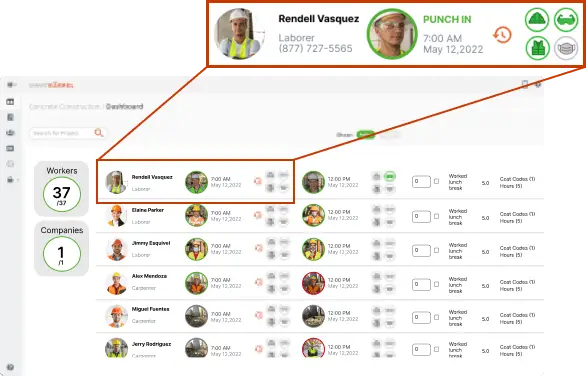
When project managers and superintendents can see live headcount and clock-ins from any device, they can identify time theft patterns in real time rather than discovering discrepancies after payroll has already run. Time and attendance software that surfaces real-time data turns clock-ins from a retrospective log into an active management tool.
Remove Foremen from the Timekeeping Role
This is underrated as a preventative measure. When workers self-verify and clock-ins populate automatically, foremen go from creating to approving timelogs. More importantly, they go back to leading crews. Disciplinary action around time fraud becomes cleaner and less personal when the record was created by the system rather than by a person.
SmartBarrel brings all of this together in one system built for the field. Biometric AI facial verification handles check-ins. Built-in geofencing confirms workers are physically on site. The live dashboard gives supervisors real-time visibility across every jobsite. And because workers check themselves in and out, foremen stay focused on the work instead of the clock.
Stop paying for hours that weren’t worked. Book a demo with SmartBarrel to see every one of these features in action.
How to Prevent Time Theft with Biometric Timeclocks
Biometric time clocks verify that the right employee clocks in on every check-in, not just that someone is clocking in. But not all biometric approaches are equally suited to construction jobsites. Most timekeeping software built for office environments doesn’t account for field conditions.
Fingerprint readers struggle in the field. Workers with welded fingertips, worn skin from labor-intensive trades, or gloves on in cold conditions can’t reliably register. That friction leads to workarounds, which leads back to the same problems manual systems have.
Mobile-only apps with GPS run into their own issues. Phones die. Workers don’t want to use their personal device on the clock, or they don’t have one. GPS verification alone doesn’t prevent a worker from handing their phone to a co-worker, and remote work or off-site check-ins are just as easy to fake. These systems shift where the problem is, but they don’t close it.
SmartBarrel’s TimeClock 4.0 takes a different approach. Workers take a picture with a dedicated device. The system uses AI-powered biometric facial verification (not facial recognition) to compare the current image against previously verified photos of that worker. Timestamped punches appear automatically on a foreman’s dashboard.
No photoshoot is required to enroll; the system builds its reference library automatically through repeated clock-ins. The result is a continuous, self-improving verification layer that guarantees accuracy.
Built-in LTE connectivity means data syncs in real time, not when someone gets back to the office.

What Happens When You Fix the System
The impact of addressing time theft isn’t just payroll accuracy. When time records are generated by the system rather than reconstructed from memory, you’re collecting accurate hours at the source. Time theft becomes significantly harder when the system itself handles verification. When labor hours are generated by the system, approved in real time by foremen and not reconstructed by memory, you also achieve clean job costing, faster payroll processing speed, and accurate T&M billing confidence.
Apache Industrial, a specialty contractor with roughly 6,000 field employees across 40+ North American locations, was dealing with buddy badging, ghost badging, and customer disputes over whether crews were actually on site. With no verified check-in system, their team had no fast way to respond when clients pushed back on billing. After implementing SmartBarrel, Apache gained auditable clock-ins across every location, reduced fraud and overpayment risk, and could answer presence disputes with a data trail rather than a conversation.
Likewise, DSI, a nationwide mechanical subcontractor with roughly 2,500 workers, discovered the scale of the problem when they piloted SmartBarrel on two projects.
The hours being submitted to payroll were double or triple what the system was actually recording. After a full rollout across 50+ job sites, DSI identified $2.6 million in overreported labor hours and cut the time supervisors and foremen spent collecting hours by $260,000 per year.
See the difference accurate time data makes. Book a demo and see how SmartBarrel delivers the most accurate time from the field.

Frequently Asked Questions
What is the difference between time theft and wage theft?
Time theft and wage theft are different problems. Time theft means employees receive pay for hours they didn’t work; the cost falls on the employer. The opposite issue involves employers failing to pay workers what they’re legally owed: unpaid overtime, minimum wage violations, or misclassified hours.
Both are problems with real financial consequences. Federal laws and wage and hour laws address unpaid wage claims through the Department of Labor; time theft is typically addressed through internal company policies and disciplinary action rather than through legal enforcement against workers.
What is the difference between buddy punching and time card fraud?
Buddy punching is when a co-worker clocks in or out for another employee, usually to cover for a late arrival, early departure or sometimes even no-shows. It’s common, often habitual, and in most cases isn’t treated as a serious offense, though it does constitute a form of time theft. Time card fraud is deliberate falsification of time data for personal financial gain such as inflating overtime hours, altering clock-ins after the fact, or systematically submitting false clock-ins. Time card fraud can carry legal consequences depending on scale, employer policies, and applicable federal laws. The line between them is largely one of intent and pattern.
How to prevent theft at a construction site?
Construction site theft covers two distinct categories: equipment and materials theft, and labor time theft. For equipment and materials, standard preventative measures include site perimeter security, equipment tagging, and surveillance systems. The National Equipment Register estimates over $1 billion in annual equipment losses across the industry.
Can an employer take disciplinary action for time theft?
Yes. Phone calls, long breaks, and other personal activities during work hours are all covered under most company time theft policies. Most employers treat employee theft of time as a serious violation and handle it through a progressive process: a verbal warning for minor or first-time issues, a written warning for repeat incidents, and termination for documented patterns or deliberate time fraud. Having a clear employee handbook policy on timekeeping expectations makes disciplinary action more defensible and gives employees clear notice of what constitutes stealing time or stealing company time. Biometric and verified timekeeping systems strengthen these cases because clock-ins are system-generated rather than self-reported, which removes ambiguity from the conversation.