


A fully burdened labor rate is the true hourly cost of an employee, including base wages plus all additional expenses required to keep that worker on the job. This includes payroll taxes, workers’ compensation insurance, health benefits, paid time off, training, equipment, and allocated overhead. While base wages might be $35 per hour, the fully burdened rate often lands between $50 and $70 per hour once every cost is accounted for.
Construction companies know how to calculate a fully burdened labor rate. The formula isn’t complicated: base wages plus payroll taxes, workers’ compensation, employee benefits, and overhead costs. Most estimators and CFOs can recite the components without hesitation.
The problem isn’t the calculation. It’s the data feeding it.
That same data problem shows up in cost control on every project, where a small error in base hours quietly inflates per diem, overtime, and reimbursements down the line.
When your fully burdened labor rate calculation begins with base labor hours that carry 3-5% variance from manual timesheets – whether from rounding, memory-based entry, or buddy punching – that variance compounds through every layer of labor burden.
A 5% error in base hours doesn’t stay at 5% when multiplied through payroll taxes, workers’ compensation, benefits, and overhead expenses. It becomes cost variance that undermines bidding accuracy, job costing reliability, and margin protection.
Closing the gap at the source is what produces more accurate bids, because the historical hours feeding the estimate stop carrying yesterday’s rounding with them.
This guide provides a comprehensive view for calculating your burdened labor rate while addressing the data accuracy challenge most contractors overlook.
Importance of Calculating Your Fully Burdened Labor Rate
Specialty contractors operating on 3-5% margins cannot afford inaccuracy in labor cost calculations. Understanding your fully burdened labor rate serves multiple strategic functions for your business.
Accurate Bidding & Cost Estimation
Accurate bidding depends on knowing the real cost of labor. Underbidding by 5% on a $2 million project represents $100,000 in exposure – potentially eliminating all expected margin before the first worker arrives on site.
Profitability Protection and Margin Analysis
Profitability protection requires measuring actual labor costs against revenue. Contractors who estimate labor expenses using unburdened rates or outdated labor burden rates consistently discover their apparent 8% project margin was actually 2% when true costs are calculated.
Competitive Positioning and Pricing Strategy
Competitive positioning improves when construction companies know their overall labor costs. Understanding burdened labor rates through effective cost tracking methods enables strategic pricing decisions about when to bid aggressively on high-volume work versus when premium project pricing is required to maintain target margins.
Financial Planning and Forecasting
Financial planning relies on accurate historical cost data. Projections built on unreliable labor related costs produce unreliable business planning. Getting a more accurate picture of labor expenses through comprehensive labor cost tracking enables better financial planning across the organization.
The calculation itself is straightforward. The challenge emerges when perfect labor burden formulas operate on imperfect time data – a reality most contractors don’t discover until job cost reports reveal unexpected losses.
Unburdened vs. Fully-Burdened Labor Costs
The distinction between unburdened and burdened labor costs determines whether contractors make money or subsidize their clients. Understanding direct costs versus indirect costs is fundamental to accurate project pricing.
Unburdened labor costs represent direct wages only – what appears on a worker’s paycheck. A carpenter earning $25 per hour in base salary has an unburdened cost of $25 per hour. This hourly wage appears on payroll reports and basic timesheets. Many contractors mistakenly stop here: “We’re paying $25 per hour, so that’s our labor cost.”
That unburdened figure is the starting point for any direct labor cost calculation, and it holds up only when the hours behind it were measured rather than recalled.
Fully-burdened labor costs include gross wages plus all labor-related expenses. That same carpenter at $25 per hour in base pay typically costs $38-42 per hour when payroll taxes, workers’ compensation, employee benefits, and overhead allocation are included. This represents the total cost to the company and provides a clearer picture of actual expenses.
The financial impact of this distinction is significant. Contractors who estimate and bid using unburdened rates guarantee losses. A project estimated at 1,000 labor hours using $25 per hour unburdened rates shows $25,000 in direct labor costs. The actual fully burdened cost at $40 per hour is $40,000 – a $15,000 variance that eliminates margin and often creates losses.
Aspect | Unburdened Labor Costs | Fully-Burdened Labor Costs |
Definition | Direct wages only | Wages + ALL employment costs |
Example (Carpenter) | $25/hour | $38.75/hour |
What’s included | Base paycheck amount | Base + taxes + insurance + benefits + overhead |
Where it appears | Payroll reports, timesheets | Job costing, true profitability |
Common mistake | “We pay $25/hour, that’s our cost” | Understanding this is break-even point |
Components of Fully Burdened Labor Rate
Base Wages
Direct wages form the foundation of all labor burden calculations – hourly wages, base salaries converted to hourly rates, and overtime premiums. This is also where inaccuracy typically begins.
Manual timesheets introduce variance through 15-minute rounding, memory-based entry captured days after work completes, and buddy punching where workers clock in for absent colleagues. Industry standards indicate manual time tracking systems commonly produce 3-5% variance in recorded hours versus actual hours worked.
Inaccurate base hours don’t stay contained in payroll. Every burden component multiplies the same flawed number, distorting payroll taxes, workers’ compensation premiums, and benefit allocations across every calculation that follows.
Payroll Taxes
Employers pay mandatory payroll taxes on gross wages:
- FICA (Social Security): 6.2% on first $168,600 of wages
- Medicare: 1.45% on all wages
- Federal Unemployment Tax (FUTA): 0.6% on first $7,000
- State unemployment insurance: 0.5-10%, depending on state and experience rating
For most construction workers, the total payroll tax burden runs 8-10% of gross wages. These percentages apply to all reported hours – including overstated hours from inaccurate timesheets.
Workers’ Compensation Insurance
Workers’ compensation represents the largest variable in labor burden calculations. Rates vary widely by trade classification and state jurisdiction.
Electrical contractors in many states face 5-8% workers’ compensation rates. Concrete contractors, classified as higher risk, often pay 15-25%. The same trade can vary widely between states – an electrician costing $35 per hour fully burdened in Texas might cost $48 per hour in California, with workers’ compensation driving much of the difference.
Proper classification is critical. Misclassification can create 10-15 percentage point errors in burdened labor rate calculations.
“When specialty contractors calculate burden rates, what’s the most commonly overlooked cost category that impacts their accuracy?”

Employee Benefits
Voluntary employee benefits significantly impact total labor burden rates:
Health insurance: According to the 2024 KFF Employer Health Benefits Survey, average employer contributions range from $7,584 annually for single coverage to $19,276 for family coverage. For employees earning $50,000 annually, this represents 15-39% in additional costs.
Retirement contributions: Retirement plans with 401(k) matching at 3-6% of wages is typical for contractors competing for skilled trades. These retirement benefits represent strategic investments in the labor force.
Paid time off: 10-15 days of PTO annually represents approximately 5-7% of total annual hours.
These voluntary costs represent strategic investments in workforce retention. The labor burden rate impact is substantial, but the alternative – higher turnover and recruiting costs – often proves more expensive for the business.
Overhead Allocation
Indirect expenses associated with employment include:
- Company vehicles and related costs
- Tools and equipment (varies by trade)
- Safety equipment and PPE
- OSHA-required training and certifications
- Cell phones and communication
- Administrative time and systems
These indirect costs typically add 8-15% to the labor burden rate, depending on company structure and service model.
Mandatory and Voluntary Costs Included In Fully Burdened Labor Rate
Mandatory Costs
Certain labor related costs cannot be avoided:
- Federal and state payroll taxes including Social Security
- Workers’ compensation insurance (required in most states)
- State unemployment insurance and federal unemployment tax
- OSHA compliance and safety requirements
These non-negotiable indirect labor costs typically represent 20-35% of base wages for specialty contractors. They form the minimum labor burden rate floor – the absolute lowest cost to employ workers in your labor force.
Voluntary Costs
Strategic investments in workforce quality include:
- Health insurance and medical benefits for employees
- Retirement plan contributions and retirement benefits
- Paid time off beyond legal minimums
- Professional development and training
- Company vehicles for personal use
Voluntary indirect costs can add 15-25% additional burden, but drive competitive advantage in recruiting and retaining skilled labor. The calculation decision for some construction companies: separate the mandatory labor burden rate (minimum viable bid floor) from the total burdened labor rate (target pricing for sustainable operations).
A journeyman electrician example:
- Base wage: $25/hour
- Mandatory burden (30%): $7.50/hour
- Voluntary burden (15%): $3.75/hour
- Total burdened labor rate: $36.25/hour
Understanding this distinction enables strategic pricing decisions based on project type, client relationship, and market conditions.
Calculating Your Fully Burdened Labor Rate
Step 1: Identify Base Wages
Start with annual gross wages for the worker classification.
Example: Journeyman electrician earning $25 per hour in hourly wage
- Annual salary: $25/hour × 2,080 hours = $52,000
Step 2: Calculate Mandatory Costs
- Payroll taxes (8.7%): $52,000 × 0.087 = $4,524
- Workers’ compensation (6% for electrical, Texas): $52,000 × 0.06 = $3,120
- Unemployment insurance: $7,000 × 0.015 = $105
- Mandatory labor burden costs total: $7,749
Step 3: Calculate Voluntary Costs
- Health insurance (employer portion): $9,000
- 401(k) match (4%): $52,000 × 0.04 = $2,080
- Paid time off (10 days): ($52,000 ÷ 260 workdays) × 10 = $2,000
- Training and certifications: $800
- Voluntary indirect labor costs total: $13,880
Step 4: Calculate Overhead Allocation
- Company vehicle: $400/month × 12 = $4,800
- Tools and equipment depreciation: $1,200
- Cell phone: $50/month × 12 = $600
- Administrative overhead allocation: $2,400
- Overhead total: $9,000 in other costs
Step 5: Calculate Total Burden
- Mandatory: $7,749
- Voluntary: $13,880
- Overhead: $9,000
- Total labor burden: $30,629
Step 6: Calculate Burden Rate Percentage
Total burden ÷ Base wages = $30,629 ÷ $52,000 = 58.9% labor burden rate
Step 7: Calculate Fully Burdened Hourly Rate
Base wage × (1 + Burden rate) = $25 × 1.589 = $39.73/hour total hourly cost
The Data Accuracy Factor
This calculation produces reliable results only when base hours are accurate. If manual timesheets introduce 5% variance:
- Reported hours: 2,080 annually
- Actual total hours worked: 1,976 (5% less)
- Phantom hours paid: 104 hours
Financial impact:
- 104 phantom hours × $39.73 = $4,132 per worker annually
- Across 50 electricians: $206,600 in unnecessary fully burdened labor costs
- This variance compounds through job costing, affecting future bid accuracy
The effect scales with the job, and on large self-performed scopes that same math is a big part of what makes the cost to build a data center so hard to forecast.
The formula works. The question is whether the hours feeding the formula reflect reality and provide a realistic picture of labor expenses.
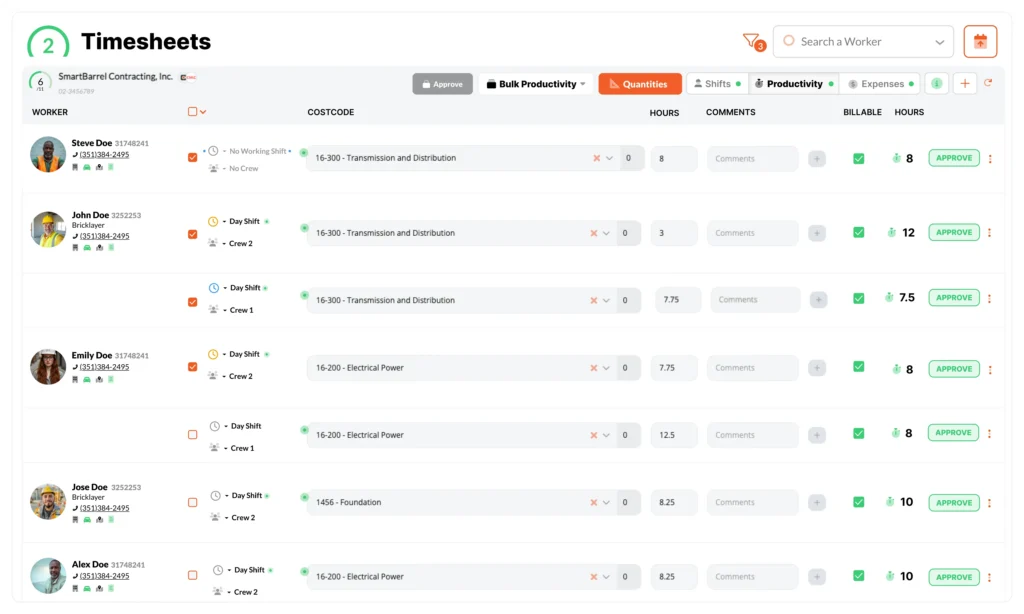
For specialty contractors managing multiple jobsites, SmartBarrel eliminates manual entry variance at the source – biometric facial verification captures actual hours the moment workers check in, so fully burdened labor calculations start with numbers you can trust.
How SmartBarrel eliminates the variance that corrupts your burden calculations
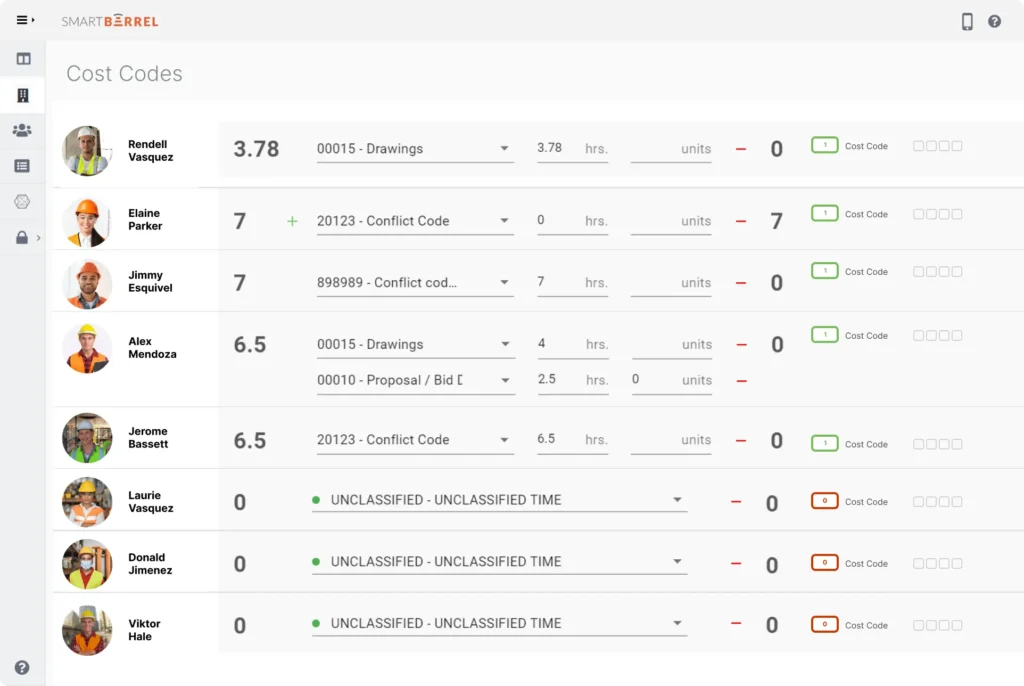
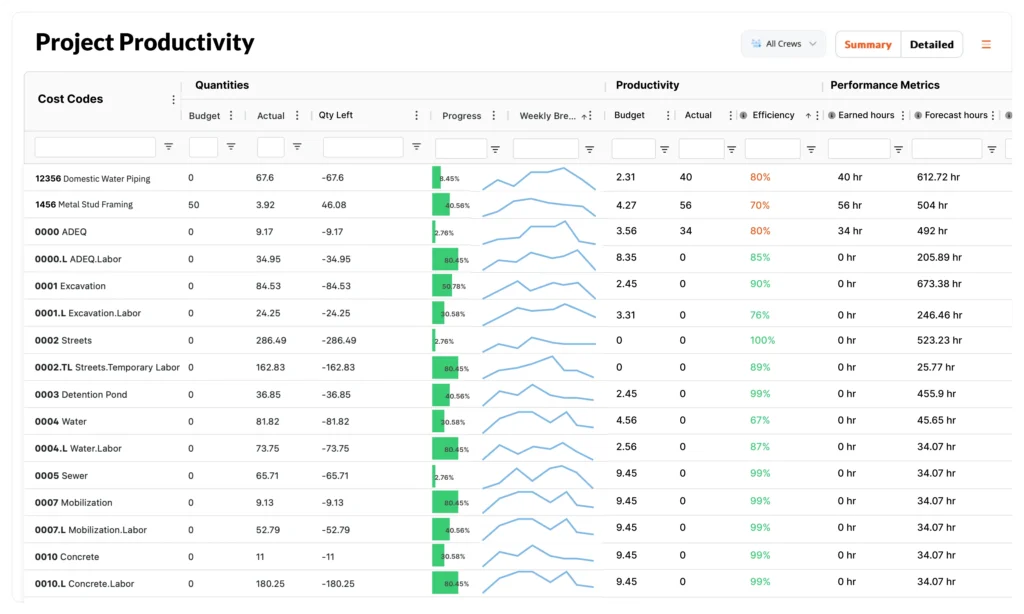
SmartBarrel replaces manual timesheets with biometric facial verification at the point of capture. Workers take a photo and enter their phone number when they arrive and when they leave – verified hours and cost codes are synced to your ERP without memory-based entry, foremen time-entry or manual handoffs. What enters your burden calculation is what actually happened in the field.
The financial impact is direct: $4,285+ recovered per worker annually in eliminated time theft and payroll variance. 800+ hours saved on manual entry per year. And fully burdened labor calculations that finally reflect actual hours worked.
Dynamic Systems, Inc. discovered $2.6 million in overreported labor hours after switching to verified time tracking. That’s not a software problem. That’s a data quality problem – and it’s exactly what SmartBarrel solves.
Factors Impacting Your Fully Burdened Labor Rate
Worker Classification and Union Status
Union contractors face fully burdened labor rates of 60-70% compared to non-union contractors at 24-33%, according to Construction Business Owner research. This differential reflects higher benefit packages, pension contributions, and apprenticeship program funding.
Within the same company, different trade classifications carry different workers’ compensation rates. An electrical contractor might face 5-8% workers’ comp for inside wiremen but 12-15% for linemen, creating different burdened labor costs across the labor force.
Location
State-level variations in workers’ compensation and state unemployment insurance create significant regional cost differences. The same journeyman electrician might represent different fully burdened labor rates:
- $35/hour in Texas
- $42/hour in Florida
- $48/hour in California
Multi-state construction companies must calculate state-specific labor rates to maintain accurate job costing across jurisdictions.
Benefits Package Decisions
Strategic choices around employee benefits directly impact labor burden rates:
- Self-insured health plans versus fully-insured options
- High-deductible health plans with HSA contributions
- Retirement match percentage (3% versus 6% creates 3-point burden difference)
- PTO policy generosity
Each decision represents a trade-off between the burdened labor rate percentage and the workforce retention capability for employees.
Time Tracking Accuracy
Manual time tracking systems introduce 3-5% variance through:
- 15-minute rounding increments (7 hours 45 minutes becomes 8 hours)
- Memory-based timesheet entry captured days after work completes
- Buddy punching where workers clock in for absent colleagues
SmartBarrel’s biometric facial verification captures actual hours at the moment of check-in – no memory-based entry, no buddy punching. Fully burdened labor calculations operate on verified hours, not estimates, so the numbers your ERP and job costing platforms receive are accurate from the start.
For contractors managing specialty contractor operations across multiple sites, consistent time data accuracy becomes critical to reliable financial planning.
Strategies to Reduce Your Fully Burdened Labor Rate
Optimize Workers’ Compensation Classification
Verify workers are properly classified. Misclassification typically results in overpayment. Safety programs and reduced claims lower experience modification rates, directly reducing workers’ compensation premiums and overall labor costs.
Strategic Benefits Design
High-deductible health plans paired with employer HSA contributions often reduce insurance premiums 15-25% while maintaining employee value. Review benefit utilization – construction companies sometimes pay for benefits their labor force doesn’t use, adding unnecessary expenses.
Improve Time Tracking Accuracy
Eliminating buddy punching, rounding variance, and memory-based entry removes phantom labor burden costs. The financial impact for your business:
- 200-person operation
- Average fully burdened labor rate: $38/hour
- Reduce time variance from 5% to 0%
- Savings: 200 workers × 2,080 hours × 5% × $38 = $791,040 annually
This isn’t theoretical cost reduction. It’s paying for actual hours worked instead of overstated hours from inaccurate timesheets – providing a more accurate picture of true labor expenses.
Operational Efficiency
Reduce administrative time per worker through productivity tracking systems like SmartBarrel. Contractors like JENCO reclaimed 60 hours weekly by eliminating manual timesheet processing and Prism Electric scaled accurate time tracking across 700 employees without adding administrative overhead.
Implement tool tracking to minimize replacement costs, invest in training that reduces errors and rework, and optimize vehicle utilization.
Never reduce your burdened labor rate by cutting corners on mandatory costs or misclassifying workers. The legal and financial risks far outweigh any apparent savings.
Common Pitfalls to Avoid When Estimating with Fully Burdened Labor Rates
Using Outdated Burden Rates
Insurance premiums change annually, often mid-year. Benefits costs rise faster than wages. Workforce composition shifts as apprentice-to-journeyman ratios change. Contractors who calculate fully burdened labor rates once and use them for 18-24 months guarantee inaccuracy in their labor burden calculations.
Solution: Recalculate quarterly at a minimum, annually at an absolute minimum.
Applying the Single Burden Rate Across All Workers
Apprentices carry different burden profiles than journeymen. Salaried superintendents differ from hourly field workers in salary composition. Different trades have vastly different workers’ compensation rates – electrical at 6% versus concrete at 20% creates 14-point differences in burdened labor rates.
Solution: Calculate labor rates by worker classification and apply appropriately in estimates and job costing to get an accurate picture of costs.
Confusing Burdened Cost with Billable Rate
Burdened labor rate represents your cost – the break-even point. Billable rate includes fully burdened labor cost plus markup for profit and general administrative overhead costs.
Common mistake: “Our electricians cost us $42/hour in fully burdened labor, so we’ll bill them at $42/hour on T&M work.” This generates zero margin on labor.
Correct calculation: For 25% gross profit margin:
- Fully burdened labor cost: $42/hour
- Billable rate: $42 ÷ 0.75 = $56/hour
The $14/hour difference represents where profit comes from. Contractors who confuse these labor rates work at break-even or a loss.
Ignoring Time Data Accuracy
The most critical pitfall: Perfect labor burden rate formulas operating on inaccurate base hours produce unreliable numbers.
Manual timesheets introduce a minimum variance of 3-5%. This variance multiplies through every burden component in your fully burdened labor calculations.
Not Reconciling Estimates to Actuals
Estimating with one burdened labor rate while actual costs differ creates a feedback loop failure. Without tracking actual fully burdened labor costs by project and comparing to estimates, contractors miss opportunities to improve future bid accuracy.
Solution: Real-time job costing systems that capture actual burdened labor and generate variance reports. SmartBarrel feeds verified hours directly into ERPs, eliminating manual reconciliation while improving data accuracy for labor related expenses.
Underestimating Overtime Impact
Overtime premium (1.5× base rate) affects all labor burden calculations. A $25/hour base wage becomes $37.50/hour in overtime. Payroll taxes, including Social Security, are calculated on the full $37.50, not just the $25 base. Workers’ compensation premiums apply to the overtime premium as well.
That overtime premium is also the exact slice the qualified overtime deduction targets, so separating it cleanly from base pay matters for more than burden math.
Solution: Calculate separate overtime burdened labor rates for projects with planned overtime exposure. Don’t apply regular labor burden rates to overtime hours.
Fully Burdened Rate vs Billable Rate: What’s the Difference?
Fully Burdened Labor Rate = Your Cost
The fully burdened labor rate represents total employment cost – all expenses to have that worker available for one hour. This is the break-even point.
Example: $42/hour fully burdened labor.
Billable Rate = What You Charge
The billable rate includes fully burdened labor cost plus markup for profit and general administrative overhead expenses. This is where margin is generated.
Example: $56/hour billable for 25% gross profit.
Calculating Billable Rates
Rate Type | Purpose | Example Calculation | Result |
Fully Burdened Rate | Your total cost | Base + all burden costs | $42/hour |
Billable Rate (Method 1) | Markup approach | $42 × 1.33 | $56/hour (25% margin) |
Billable Rate (Method 2) | Margin formula | $42 ÷ 0.75 | $56/hour (25% margin) |
Why This Distinction Matters
Contractors who confuse fully burdened labor rates with billable rates work at break-even or loss. “We’re charging $45/hour and our workers make $25/hour” sounds profitable until you realize the burdened labor cost is $42/hour – leaving only $3/hour margin instead of the intended $20/hour.
For Time and Material billing, contractors must bill the fully burdened labor rate plus markup, not base salary plus markup. The difference between billing $25/hour + 50% ($37.50) versus billing $42/hour + 25% ($52.50) is $15/hour in lost margin – $120/day per worker, $31,200 annually per worker across 2,080 total hours.
The Bottom Line
A fully burdened labor rate is only as reliable as the hours feeding it. The components are well understood: base wages, payroll taxes, workers’ compensation, employee benefits, and overhead. Where most specialty contractors lose margin isn’t in the formula. It’s in the 3-5% variance baked into manual timesheets that quietly compounds through every burden layer, recalculation cycle, and bid. Recalculate quarterly. Calculate by trade classification. Separate burdened cost from billable rate. And start with verified field hours, because accurate burden math built on inaccurate base data still produces unreliable numbers.

Frequently Asked Questions
How often should I recalculate my fully burdened labor rate?
You should recalculate your fully burdened labor rate at a minimum annually, ideally quarterly. Immediate recalculation triggers include insurance rate changes (workers’ compensation renewal), employee benefits package modifications, labor force composition shifts (ratio of apprentices to journeymen), or significant overtime pattern changes. Insurance costs alone can change 10-15% annually, making outdated labor burden rates increasingly unreliable for accurate financial planning.
Should I use different burden rates for different trades within my company?
Yes. Workers’ compensation rates vary widely by trade classification. Electrical workers might carry 5-8% workers’ comp, while concrete workers face 15-25%. Using a single blended burdened labor rate across all trades creates cross-subsidization where electrical work is overbid, and concrete work is underbid. Calculate separate fully burdened labor rates by major trade classification and apply them appropriately.
How does workers' compensation classification affect my burden rate?
Workers’ compensation often represents the largest variable component of labor burden rates. Misclassification can mean 10-15 percentage point differences. An electrician correctly classified might face $0.06 per $100 of payroll, while misclassification could result in $0.15 per $100 – a 9% labor burden rate difference. Always verify correct classification codes and challenge improper classifications with your insurance carrier to get a realistic picture of actual costs.
What's the impact of time tracking accuracy on burden calculations?
Time accuracy directly impacts labor burden calculation reliability. Manual timesheets introduce 3-5% variance through memory-based entry and buddy punching. A 5% overstatement in base hours means calculating and paying full labor burden on phantom hours. For a 200-person operation at $38/hour average burdened labor rate, 5% variance represents approximately $791,000 in annual labor cost exposure – paying full burden on hours that were never actually worked by employees.
Can I reduce the burden rate by eliminating voluntary benefits?
Technically, yes, but consider the total cost to your business. Cutting health insurance might reduce your labor burden rate by 15%, but if turnover increases by 30% and recruiting costs rise, the net impact is negative. The burdened labor rate number itself is less important than total profitability. Strategic retirement plans and other employee benefits that retain skilled labor often deliver better ROI than bare minimum packages for construction companies.
Protecting Your Margins Starts with Accurate Data
When fully burdened labor rate calculations begin with base labor hours that carry 3-5% variance from manual timesheets, that variance compounds through every layer of labor burden costs. A 5% error in base hours doesn’t remain at 5% when multiplied through payroll taxes, workers’ compensation, employee benefits, and overhead allocations. It becomes 6-8% cost variance.
For a 200-person specialty contractor, that variance represents over $750,000 in annual fully burdened labor cost exposure. Across 20 competitive bid projects, it’s the difference between winning profitable work and subsidizing clients with margin dollars that should contribute to your business profitability.
Your burdened labor rate calculation deserves accurate data. Perfect formulas built on imperfect time tracking produce unreliable numbers that undermine bidding accuracy, job costing reliability, and profitability analysis. 100% accurate time tracking eliminates the compounding error that makes even well-calculated labor burden rates untrustworthy for construction companies.
See how zero-variance time tracking delivers the data accuracy your fully burdened labor calculations deserve.
Schedule a demo to see SmartBarrel’s biometric facial verification in action.