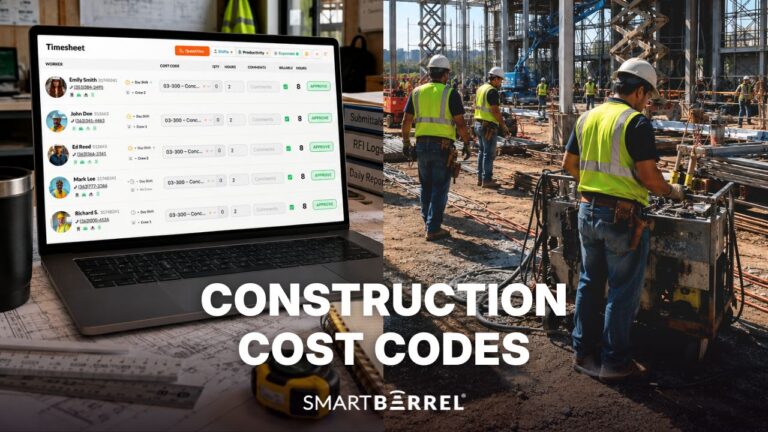


AI time tracking is changing the way trade contractors manage labor data, and the shift is long overdue.
For decades, trade contractors running crews across multiple jobsites have depended on manual timesheets to capture hours, assign cost codes, and process payroll. The result has been a predictable cycle of inaccurate data, disputed billing, and payroll backlogs that eat into already thin margins.
The challenge was never really about effort or intent. It was about system design. Asking foremen to manually collect, record, and submit hours for dozens of workers, across multiple tasks, under field conditions, is a structural problem. No amount of discipline closes that gap. AI-powered time tracking addresses the problem at its root by removing human error from the data capture process entirely.
This article covers:
- How AI time tracking systems work in construction
- Where they create real financial value
- What makes implementation succeed or fail
- What the next generation of automated labor reporting looks like for trade contractors.
Why Time Tracking Has Always Been a Data Problem, Not a People Problem
Construction’s productivity challenge is well documented. Research from the McKinsey Global Institute has found that global labor productivity in construction has averaged only 1% annual growth over the past two decades, a fraction of what manufacturing or retail has achieved in the same period. A major contributing factor is how the industry has historically managed labor data.
Manual timesheets introduce variance at every step. A foreman managing 30 workers across two tasks can’t be in three places at once. Workers who forget to check out get rounded. Workers who arrive late get the same entry as those who were on time.
Temp labor gets lumped in with direct employees. By the time those hours reach payroll, the data has passed through enough hands and memory gaps that it no longer reflects what actually happened on site.
The cumulative effect is the same pattern of manual timesheet errors on almost every project: temp labor overreporting, rounded lunches, and hours built on memory rather than measurement.
The pattern holds across most timekeeping methods contractors rely on, whether workers write down their own hours or a foreman enters them for the crew.
This is not a people problem. Foremen are being asked to do an impossible dual role: lead a productive crew and act as a timekeeper with perfect memory. Manual time tracking created the conditions for inaccuracy. The fix isn’t more accountability. It’s a better system.
Part of that better system is closing the quiet gaps where unverified hours tend to hide, which is where most contractors start when they rethink labor accountability across a large crew.
The gains from automated time tracking tools reach past payroll into bid accuracy, job costing, and the decisions a super makes with a live headcount in hand.
What AI Time Tracking Actually Does in the Field
AI powered time tracking replaces the manual data capture step with a process that requires nothing from the foreman and almost nothing from the worker. Here’s what that looks like in practice.
The check-in process
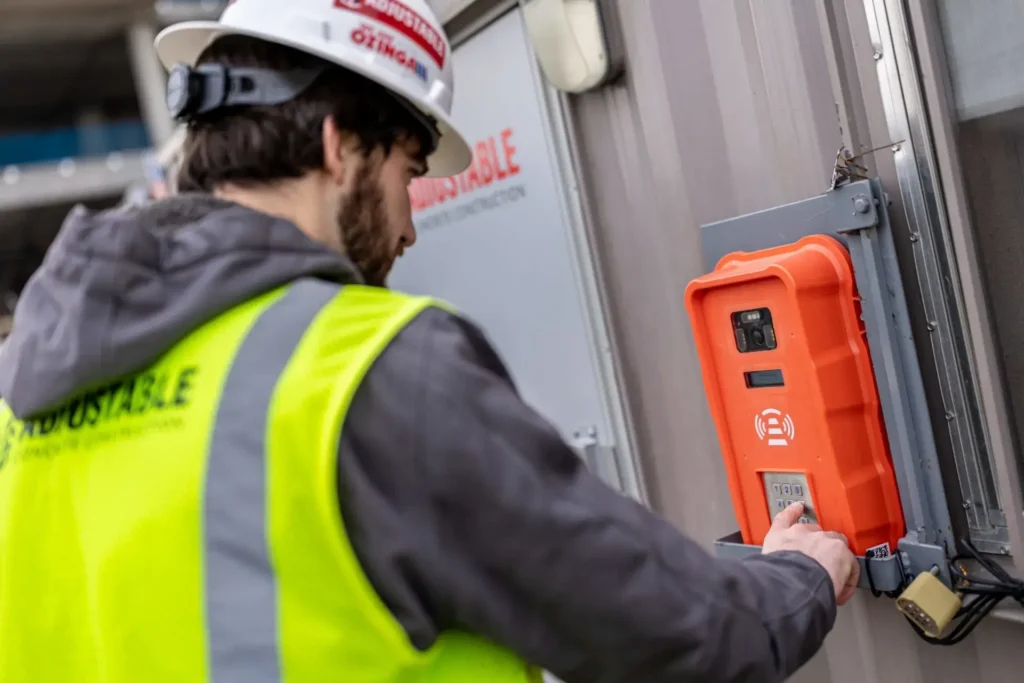
The core mechanism on the jobsite is biometric facial verification. A worker walks up to the device, confirms their presence, and moves on. The system records the time, assigns it to the project, and sends it to the dashboard in real time. No paper. No app login. No hassle.
How the system compares workers’ images over time
What separates AI-driven verification from older biometric approaches is that workers don’t need to take a photoshoot before their first shift. The system builds its own reference data over time, adjusting for changing field conditions, lighting variations, PPE, and the kind of wear and tear that construction faces every day. This makes it practical in a way that fingerprint scanners or iris readers never were on a dusty, glove-heavy jobsite.
What happens after the clock-in
The AI time tracker also handles downstream tasks automatically. Break rules, overtime calculations, lunches, and jobsite-specific rounding rules are all configured once and applied consistently after that. The time spent on administrative cleanup drops substantially because the data arrives structured rather than as a pile of paper timesheets to reconcile.
For contractors managing multiple projects simultaneously, the system tracks workers across jobsites, flags anomalies when check-in patterns look unusual, and surfaces that information in a live dashboard without anyone having to build a report manually.
Real-Time AI Tracking vs. “Sync Later” Systems: Why the Difference Is Non-Negotiable
Not all automated time tracking systems operate the same way. The difference between real-time and sync-later systems has direct consequences for data quality, billing accuracy, and operational visibility.
Sync-Later (Mobile-First) | Real-Time AI Tracking | |
Data delivery | Syncs when connectivity allows | Sends data the moment a worker checks in |
Field reliability | Fails in basements, steel structures, remote sites | Built-in LTE operates independently of jobsite WiFi |
Visibility | Hours or days behind | VP of Operations sees headcount across all sites in real time |
Payroll prep | Foreman submits at end of week, often incomplete | Data flows automatically, no submission required |
T&M documentation | Gaps in record create billing disputes | Timestamped, verified record supports every billable hour |
For contractors billing clients on a time-and-materials basis, that last row is where the financial risk lives. Clients push back on disputed billable time, and without a verifiable record, contractors absorb the cost. This real-time visibility also connects directly to daily log and reporting accuracy. When check-in data flows automatically into the daily log, contractors have a timestamped record of who was on site, when they arrived, and how long they stayed.
See how SmartBarrel delivers real-time verified hours for your crew. Book a demo.

How AI Time Tracking Improves Construction Project Profitability
The financial case for AI time tracking software in construction runs across several lines simultaneously.
Reducing time theft and buddy punching
When workers know their check-in requires biometric facial verification rather than tapping a shared fob or handing a phone to a coworker, the incentive to game the system largely disappears. For contractors managing a mix of direct employees, union workers, and temp labor, that shift in accountability has a measurable impact on labor costs.
Cutting payroll processing time
Moving from manual timesheets to automated time tracking removes the reconciliation step that typically consumes hours of administrative labor every week.
Western Partitions Inc. reduced payroll processing time by 60% and achieved 100% error-free reporting after implementing SmartBarrel across more than 500 projects.
Southwest Plumbing cut payroll processing time by 40% by replacing manual, error-prone timesheets with real-time, verified time tracking from the field.
JENCO reclaimed 60 hours per week from the payroll cycle.
Harper Electric cut manual time entry by 70%. These aren’t rounding improvements. They’re changes to how time moves through the company.
Improving job costing accuracy
When hours are captured correctly at the source and assigned to the right cost codes, the data feeding into project budgets and ERP systems reflects what actually happened.
Closing the manual gap between that capture and accounting is the job of a direct payroll sync, which lands coded hours in the ERP instead of a spreadsheet.
Estimators can build future bids from real field data instead of averages padded for uncertainty. That’s a genuine competitive advantage for contractors running complex, multi-site operations.
What Contractors Get Wrong When Implementing an AI Time Tracker
The failure mode in AI time tracking implementation is almost never the technology. It’s the expectation that the tool alone fixes an adoption problem. A device on a jobsite doesn’t change behavior unless the rollout creates the conditions for consistent use from day one.
Those conditions are easier to judge before you buy, and a checklist for evaluating time tracking vendors lets you test each one’s rollout requirements up front.
Implementation Risk | Why It Happens | What Solves It |
Connectivity dependence | App-only tools rely on worker phones and jobsite WiFi, which fail in basements, steel structures, and remote sites | Hardware with built-in LTE that operates independently of worker devices and jobsite infrastructure |
Enrollment friction | Systems requiring a pre-registration photoshoot create a setup bottleneck that foremen end up managing before a single shift starts | Self-learning systems that register workers at first check-in, with no coordinator required |
Foreman resistance | Any new process that looks like added complexity on top of an already full day will face pushback | A system that removes the timesheet burden from the foreman’s plate rather than adding a new task to it |
AI Time Tracking and the Downstream Data Problem
Accurate time is only as valuable as what happens to it after capture. A time tracker that produces verified hours but requires manual export and re-entry into payroll software is still a partial solution. The full value of AI time tracking systems comes from their ability to feed structured data into payroll software and ERPs without rekeying.
Where the data goes
For trade contractors running ERP systems, the integration design matters as much as the field hardware. When labor hours flows directly into payroll, job costing, and reporting systems without a manual step in between, the operation gets clear insights in real time.
SmartBarrel integrates directly with Procore, CMiC, Viewpoint Vista, and PowerBI. Payroll runs faster and job cost reports reflect current data rather than last week’s approximation. Executives can track time allocation across the entire portfolio without asking a project manager to pull a report.
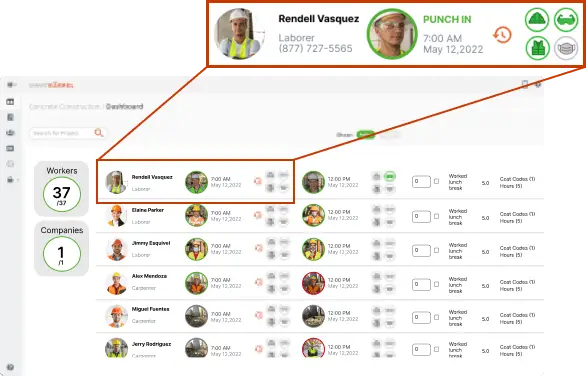
That accuracy is what makes deeper analysis possible in the first place. How does productivity on Project A compare to Project B for the same trade? Where is overtime concentrated, and does it correlate with crew composition or task type? Those questions can’t be answered from manual timesheets. They require the kind of structured, consistent data that construction productivity tracking tools can analyze only when the upstream time is reliable.
The Future of Automated Labor Reporting for Trade Contractors
Most trade contractors are at the foundational step right now: replacing manual timesheets with verified, real-time insights. What comes next builds directly on that foundation.
Predictive labor analytics will allow contractors to compare current project burn rates against historical data for similar projects and flag deviations before they become overruns. AI anomaly detection already flags unusual check-in patterns. The next iteration applies that same logic to productivity trends and overtime concentrations, surfacing actionable insights rather than just raw hours.
Contractors don’t have to wait for that next step to start, since verified hours exported from the field already work with ready-made AI prompts for construction like a weekly crew productivity review.
Verified hours also become a competitive asset in T&M billing negotiations. Clients pushing back on hours find it significantly harder to dispute a timestamped, biometrically verified record than a foreman-submitted timesheet.
Labor is the largest controllable cost on most trade contractor projects. The quality of decisions made about that cost depends entirely on the quality of the data behind them. That’s what construction time tracking software at this level is actually delivering.
Ready to move beyond manual timesheets? See SmartBarrel in action. Book your demo.

Frequently Asked Questions
Does AI time tracking work for workers without smartphones?
Yes. Hardware-based AI time tracking systems operate independently of worker-owned devices. Workers register and check in using biometric facial verification directly on a jobsite device, with an optional fob tap for workers who prefer it. AI time tracking also works on a company-owned tablet or smartphone. For individual workers, no smartphone, no app download, and no data plan required. This is a critical distinction for trade contractors running large crews with high turnover or temp labor.
How does AI facial verification differ from facial recognition in construction?
Facial verification confirms that the person checking in matches a previously captured photo for that worker, essentially asking ‘is this the same person who worked here yesterday?’ Facial recognition, by contrast, attempts to identify an unknown person from a broader database. SmartBarrel uses facial verification specifically, which means the system cannot identify strangers and does not store data that links to any external record. The distinction matters both for worker privacy and for how the technology is described and regulated.
What are the challenges of implementing AI time tracking on jobsites?
The most common challenges are connectivity dependence, enrollment friction, and foreman adoption. Solutions that rely on worker smartphones or jobsite WiFi fail in the environments where construction actually happens. Systems requiring pre-registration sessions before workers can use them create rollout bottlenecks. And any new process that adds perceived complexity to a foreman’s day will face resistance. Hardware-based systems with built-in LTE, self-learning enrollment, and a genuinely simple worker experience address all three.
What is AI time tracking and how does it work in construction?
AI time tracking in construction uses machine learning and biometric verification to automate the capture, recording, and routing of labor data from the jobsite. Workers check in using facial verification. The AI model confirms the match against a previous photo, records the timestamp, and routes the data to the appropriate project and cost code automatically. The system self-learns over time, adapting to changing field conditions without requiring manual updates or photo re-enrollment. The result is a continuous, verified time record that flows to payroll, ERP, and reporting systems without manual intervention.