
Construction productivity rates have barely moved in decades. While manufacturing output per labor hour has grown roughly threefold since the 1950s, construction productivity has largely stagnated; and in many advanced economies, such as Europe and the United States, it’s actually lower today than it was in the late 1960s.
The McKinsey Global Institute estimates construction productivity grew only 0.4 percent annually from 2000 to 2022, compared to 2 percent across the broader economy. That gap represents a $1.6 trillion annual opportunity sitting uncaptured.
Most trade contractors are aware of their productivity problem, but struggle to measure and improve.
The answer has less to do with methodology and more to do with where the data comes from. When the labor hours feeding your productivity formula are inaccurate, the formula produces confident-looking numbers built on a shaky foundation.
What Are Construction Productivity Rates and Why Are They So Hard to Measure?
Labor productivity in construction is defined as the value of output produced per hour worked. For the construction industry, that typically means installed quantities divided by labor hours consumed, measured at the cost code or task level. Simple in theory. Difficult in practice.
The construction sector faces a measurement challenge that most industries don’t. In manufacturing, a production line generates continuous output data automatically. On a jobsite, installed quantities have to be reported by field crews, and labor hours have to be captured at the point of work. Both inputs depend on human data collection, which creates room for error before any analysis even begins.
The result is a recurring pattern: project management teams run productivity reports, the numbers look reasonable, and then the job finishes over budget. While the productivity formula is correct, the inputs were wrong from the start.
The gap gets expensive fast on AI-era builds, where denser MEP scopes stack more trades into the same rooms and change the labor math on data center projects.
How to Calculate Construction Productivity Rates
The core labor productivity formula used across construction projects is straightforward:
Productivity Rate = Installed Quantity ÷ Labor Hours
For example, an electrical contractor tracking conduit installation might measure linear feet installed per electrician-hour. If a crew of four installs 120 linear feet in an eight-hour shift, that’s 120 ÷ 32 = 3.75 linear feet per labor hour.
Two additional metrics give that number context:
Metric | Formula | What It Tells You |
Performance Factor (PF) | Planned Hours ÷ Actual Hours | Whether a crew is ahead or behind their labor estimate. Above 1.0 = efficient. Below 1.0 = consuming more hours than planned |
Earned Hours vs. Burned Hours | Earned = planned hours for work completed. Burned = actual hours consumed | When burned consistently outpaces earned, a cost overrun is forming |
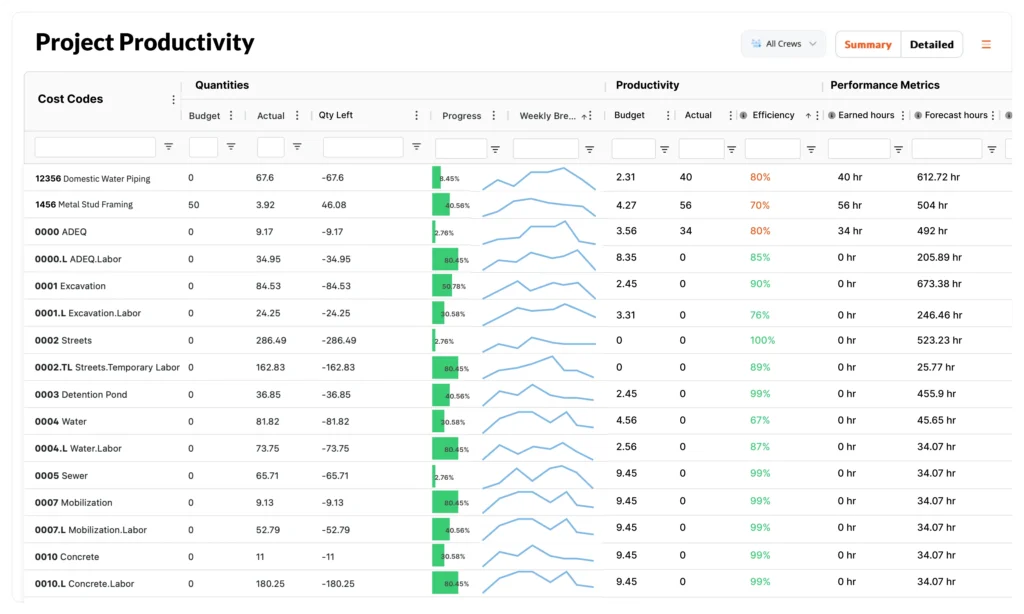
These metrics work at the cost code level, which is where productivity measurement becomes genuinely useful. A project-level number hides too much. Two crews on the same project can have opposite productivity trends that cancel each other out in aggregate reporting.
Tracking productivity by cost code, by crew, and by week produces the historical data needed to set realistic benchmarks and spot performance shifts early.
Construction Labor Productivity Rates by Trade: Benchmarking Across the Industry
The U.S. Bureau of Labor Statistics tracks construction labor productivity across subsectors, and the numbers vary significantly. The table below reflects the most recent data available:
Subsector | 2024 Productivity Trend | Primary Driver |
Industrial building construction | +16.0% growth | Output increased 16.7% while hours grew only 0.7% |
Single-family residential | +6.1% growth | Output rose 5.9% with hours roughly flat |
Multiple family housing construction | -12.8% decline | Output fell 12.2% while hours slightly increased |
Highway, street, and bridge construction | Declining every year since 2021 | Output and hours moved inconsistently across the period |
Source: U.S. Bureau of Labor Statistics, Construction Labor Productivity Highlights
The variation across subsectors is the point. Trade-level productivity rates for construction tasks like drywall installation, pipe fitting, or concrete forming vary just as dramatically, shaped by region, crew experience level, and equipment availability. Using a published benchmark as a fixed performance target often produces more confusion than clarity.
The more actionable use of benchmark data is internal. Setting a baseline from your own completed projects, then tracking week-over-week and project-over-project trends, gives you something more reliable than an industry average: a measure of your own operation against itself. That’s where measuring productivity growth becomes a real management tool rather than a reporting exercise.
For multiple family housing construction and commercial trades, equipment usage plays a significant role in productivity outcomes. Tracking how effectively crews utilize equipment alongside labor hours gives a fuller picture of where efficiency is being gained or lost.
The Data Problem That Undermines Every Productivity Calculation
There’s a concept in construction data that deserves more attention than it gets: the gap between what’s on the screen and what’s actually happening in the field. When attendance and hours are self-reported, or captured by a foreman who’s managing ten other things at once, that gap is almost always present.
Paper timecards get filled in at the end of the week from memory. Digital timesheets submitted by crew leaders reflect estimates. Ghost workers clock time on projects they’ve already left. None of this is malicious in most cases, and by the time an overrun is visible in the numbers, the actual inefficiency happened weeks earlier.
This is why productivity decline in construction is so persistent even when contractors are actively trying to measure and improve it. The measurement itself is compromised at the source.
SmartBarrel’s foundational premise is that the data on the screen matches the data from the field and that the only way to guarantee removing human reporting from the equation entirely. Time captured at the source autopopulates timesheets removing foremen time-entry altogether.

Why Real-Time Data Changes What You Can Actually Measure and Act On
When labor hours are captured automatically through biometric facial verification at the point of clock-in, the input to every subsequent calculation changes. Hours worked are verified, timestamped, and then assigned to the correct cost code in seconds.That data flows into productivity tracking reports in real time, not weeks later.
For trade contractors managing multiple jobsites simultaneously, that timing difference is substantial. When labor data arrives in real time, over-budget trends surface while there’s still time to correct them. When it arrives at the end of the week, it’s a record of damage, not a warning.
With verified hours flowing automatically, project management can:
- Compare productivity rates across crews doing similar work
- Identify which jobsites are trending over budget before they get there
- Make resource allocation decisions based on current data rather than lagged reports
Automatic daily log reporting captures what was completed alongside who was on site and for how long. That connection between output and hours worked is what makes the productivity formula meaningful, not just mathematically correct.
How to Benchmark Construction Productivity Across Your Own Projects
Before comparing to industry averages, build an internal baseline. Take your three most recently completed projects of similar scope, calculate the labor productivity rate at the cost code level for each, and establish a range. That range is your benchmark.
From there, track weekly. If a current project’s productivity rate on electrical rough-in is running 15% below your baseline by week three, that’s an early signal worth investigating. The most common causes show up in the trend data before they become budget problems:
- Equipment usage issues that slow output without reducing hours on paper
- Crew composition changes that affect pace on specific cost codes
- Rework consuming labor hours that don’t show up as installed quantities
Western Partitions Inc. scaled this kind of accountability across 500 simultaneous projects using verified labor data. The ability to compare performance across projects consistently depended on having a reliable data source.
The key discipline is consistency. Track the same cost codes, the same way, across every project. Inconsistent tagging produces incomparable data and makes benchmarking meaningless. Easy cost code assignment, where crews are assigned to the right cost code without manual re-entry in ERPs, is what makes that consistency achievable at scale.
Request a Demo – See how SmartBarrel gives you verified labor data and real-time productivity tracking across all your jobsites.

Five Ways to Improve Construction Productivity Without Guessing
Improving construction productivity doesn’t start with scheduling changes or crew reshuffling. It starts with knowing what’s actually happening. Here’s what that looks like in practice:
1. Fix the Input Before Optimizing the Output
Every productivity improvement initiative built on inaccurate labor hours is optimizing a fiction. Verified, automatic time capture is the prerequisite for everything else.
2. Move from Weekly Reports to Daily Visibility
Weekly labor reports tell you what already happened. Daily data lets you react while the week is still in progress. One day of a crew operating at 60% productivity is recoverable. Five days of it, discovered on Friday, is a cost overrun.
That math is harsher on compressed data center schedules, where a slow week during rough-in can push the commissioning window.
3. Track at the Cost Code Level, Not the Project Level
Project-level productivity numbers are averages that hide outliers. Cost-code-level tracking reveals which specific construction tasks are consuming hours faster than planned, which is where corrective action is actually possible.
4. Remove the Timesheet Burden from Foremen
Foremen who are building timesheets aren’t managing crews. When automatic time capture eliminates the daily data-entry task, foremen get back to directing work, which is where their contribution to productivity actually shows up.
5. Build a Data Baseline Before Trying to Improve It
Improving construction productivity requires knowing where you are first. Contractors who don’t have consistent historical data can’t benchmark progress. Start by capturing clean, consistent labor data for two to three projects, then begin setting improvement targets against that baseline.
SmartBarrel makes that baseline reliable from day one. Every clock-in is biometrically verified and timestamped, which means the historical data accumulating in the background is consistent across projects, crews, and jobsites. When it comes time to set improvement targets, the numbers contractors are benchmarking against actually reflect what happened in the field.
How Weather and Environmental Conditions Affect Construction Productivity Rates
Weather and environmental conditions affect construction productivity in ways that don’t show up in labor tracking unless the documentation system is built to capture them. Rain delays, extreme heat affecting work pace, and safety incidents that pull crews off scheduled construction tasks all consume labor hours without producing installed quantities; which depresses productivity rates even when the crew and project management team did everything right.
The practical response is documentation discipline. Accurate daily logs that record weather conditions, delay durations, and affected crew counts give contractors two things: a defensible record for T&M billing disputes, and the historical data to adjust future labor estimates for similar conditions.
For bridge construction and civil work especially, where crews are fully exposed to weather and project completion timelines are fixed, this documentation becomes critical for both productivity analysis and contract protection.
Undocumented weather delays disappear from the record. A week later, they show up as a productivity decline with no apparent cause. Contractors who systematically capture these variables can separate true inefficiency from external conditions, which is the only way to make productivity data genuinely actionable.
Ready to see what accurate labor data does to your productivity tracking? Request a Demo.

Frequently Asked Questions
What are the common causes of low productivity in large-scale construction projects?
Low productivity in large construction projects typically stems from a combination of data fragmentation, crew coordination gaps, and administrative overhead. At scale, labor is distributed across multiple trades and subcontractors, and project management often lacks real-time visibility into what each crew is actually producing versus what’s planned. Scope changes that aren’t reflected in updated labor estimates, poor cost code discipline that makes output tracking inconsistent, and the compounding effect of inaccurate hours across a large workforce all contribute. The larger the project, the more each of these issues amplifies.
Capital projects show this clearly, since data center build phases move a crew from a few dozen workers at grading to several hundred at rough-in without changing how hours get recorded.
What is the difference between a production rate and a productivity rate in construction?
A production rate measures output over time regardless of how much labor produced it, for example, cubic yards of concrete poured per day. A productivity rate connects that output to the labor hours consumed, giving a measure of efficiency. Two crews can have the same production rate while one uses 30 percent more labor hours to achieve it. Tracking both metrics provides a more complete picture of where labor is being used well and where it isn’t.
Can construction productivity rates vary between trades on the same project?
Yes, significantly. Different trades operate at different rhythms, with different equipment usage patterns and crew structures. An MEP subcontractor and a drywall crew working on the same floor of a building can have entirely different productivity trends. This is why project-level productivity reporting often misleads: it averages across trades in ways that obscure where the real performance gaps are. Trade-specific, cost-code-level tracking is the only way to see what’s actually happening.
How do you calculate a productivity factor in construction?
The productivity factor (PF) is calculated by dividing planned labor hours for a scope of work by the actual hours consumed to complete it. A PF of 1.0 means the work came in exactly on budget. Above 1.0 indicates the crew outperformed the estimate. Below 1.0 means more hours were consumed than planned. Tracking PF by cost code and by crew over time is one of the most practical ways to measure productivity growth within your own operation.