


https://smartbarrel.io/blog/time-tracking-data-center-construction/The data center construction process runs through seven phases: site selection and power procurement, site preparation, foundations and shell construction, electrical and mechanical rough-in, white space fit-out, commissioning, and turnover.
Most guides describe what gets built in each phase. Far fewer describe what happens to the crew. For the electrical, mechanical, concrete, and scaffolding contractors doing the work, every phase puts a different number of people on site in a different mix of trades, and the phases where headcount spikes are the phases where labor cost control starts to slip.
This guide walks it from that angle. ConstructConnect reported $81.5 billion in US data center construction starts through June 2026, already past the $72.5 billion recorded across all of 2025.
The Seven Phases Of The Data Center Construction Process At A Glance
Data center construction involves a sequence familiar to anyone who has built industrial work, with one difference: the back half of the schedule is far more labor-dense than the front half.
Phase | What gets built | Crew density | Where trade contractors carry cost risk |
1. Site selection and permitting | Land control, interconnection, approvals | Minimal | Bids priced before scope is firm |
2. Site preparation | Grading, utilities, access roads, laydown | Low to moderate | Weather delays, early utility rework |
3. Foundations and shell construction | Slabs, frame, roof, envelope | Moderate | Supply chain disruptions on long-lead items |
4. Electrical and mechanical rough-in | Conduit, switchgear rooms, piping, duct | Peak headcount | Trade stacking, miscoded hours, change orders |
5. Fit-out and infrastructure installation | Cooling units, power distribution, racks, fiber | High, many trades | T&M work without clean backup |
6. Commissioning | Levels 1 through 5 testing, system integration | Declining but specialized | Punch list labor against a closed budget |
7. Turnover and closeout | Documentation, as-builts, handover | Low | Unrecoverable admin hours |
Phase 1: Site Selection, Power Availability, And Permitting For A Data Center Project
Site selection for a data center project is decided by power before anything else. Grid interconnection timelines and substation capacity determine whether a site is viable, and grid constraints have become the most common reason a promising parcel gets abandoned. Water access, fiber routes, and exposure to natural disasters are the other key considerations.
Local regulations shape the rest. Zoning laws, environmental regulations, environmental impact studies, and the review calendars of local governments and state government agencies can add a year before a shovel moves.
Trade contractors rarely participate here, but they inherit the outcome: bids priced against a schedule set before permitting risk was understood.
Phase 2: Site Preparation And Early Data Center Development Work
Site preparation covers clearing, mass grading, stormwater systems, access roads, laydown yards, and the underground utilities everything later depends on. On a large campus, this is heavy civil work, months of earthmoving before vertical construction begins.
Data center development timelines start diverging from plan here, because new power lines and utility tie-ins run in parallel with grading, and coordination between those scopes drives the early schedule.
Crew size is modest, often a few dozen workers. That makes it easy to manage by hand, which sets a habit that stops working three phases later.
Phase 3: Foundations And Shell Construction
Data center design favors repeatable, fast-erecting approaches: tilt-up concrete panels or pre-engineered steel frames, sized around equipment layouts rather than occupancy. Some data center owners now use modular systems for portions of the electrical and mechanical build, fabricating skids off-site to compress the schedule.
Supply chain management becomes a live concern. Switchgear, generators, and transformers are ordered long before they are needed, and a delay on any one reshuffles the sequence downstream.
Headcount climbs as concrete crews, steel erectors, and scaffolding contractors move on site and multiple trades begin working the same footprint at once. HC Concrete hit that wall as it expanded across the Southeast and Midwest: handwritten cost codes stopped arriving complete or legible, and verifying a week of hours meant three days of phone calls to foremen. Payroll now closes in a day and a half.
Phase 4: Electrical And Mechanical Rough-In, Where Data Center Construction Peaks
This is the labor peak of the data center construction process. Electrical systems, power distribution, conduit runs, chilled water piping, and duct go in simultaneously, and a project that ran 60 workers during grading can run several hundred here.
Critical components take shape now: switchgear rooms, generator yards, uninterruptible power supplies, and the pathways that later feed power distribution units at the rack.
Why Trade Stacking Makes This The Hardest Phase To Cost Code
When six or eight trades work the same building at once, the field data problem changes shape. Hours still get captured, but attributing them correctly gets harder. A foreman running 80 people across three buildings and four cost codes is being asked to reconstruct a day’s work from memory at the end of a shift.
Prism Electric ran into this at 2,000 field employees, with thousands of weekly timesheets showing the same generic schedule and time routinely rounded up. Changing where time got captured let the company grow its field force while holding back-office headcount flat.
That is a process limit, not a people problem. Manual capture was designed for crews of 20, and it degrades predictably as project scale grows.
That gap is exactly why time tracking in data center construction needs a different approach than the paper systems built for smaller jobs.
Accurate construction manpower tracking matters most in exactly the weeks when it is hardest to maintain by hand, which is why contractors who hold accuracy through this phase are usually the ones who changed their capture method before headcount climbed.


Phase 5: Fit-Out And Infrastructure Installation
Fit-out is where the building becomes a data center. Cooling units, computer room air handlers, advanced HVAC systems, backup generators, and battery energy storage systems deployed on site all land here, alongside the network infrastructure, storage systems, and networking equipment the facility will use for data processing.
Cooling technologies have shifted as rack densities climbed. Liquid cooling is now common on AI-oriented builds, because the heat generated by high-density racks exceeds what conventional air-based cooling systems handle economically.
Fiber infrastructure and fiber connectivity get pulled and terminated in this phase, along with physical security work: card readers, cameras, mantraps, and the rest of the security infrastructure hyperscale sites require.
Infrastructure installation generates a high volume of change orders. Owner-driven revisions are routine, much of the added scope moves to time and materials, and billing accuracy depends on whether hours were documented as they happened.
Phase 6: Commissioning The Cooling Systems, Power Systems, And Backup Systems
Commissioning validates that installed systems perform as designed, and on critical infrastructure of this kind it is unusually rigorous. It runs in five levels, from factory acceptance testing through component verification, system startup, integrated system testing, and full-load simulation using load banks.
Redundant systems get their real test here. Backup systems are failed deliberately to confirm generators start, transfer switches operate, and the building management system responds under loss of utility power.
Uptime Institute notes that a typical data center project involves more than 50 different disciplines, which makes construction-phase deviations from design both likely and consequential.
Crew size drops, but the remaining labor is specialized and expensive, and much of it is punch list work charged against a budget set months earlier.
Phase 7: Turnover, Documentation, And Closeout On Data Center Construction Projects
Turnover packages for data center construction projects are substantial: as-builts, O&M manuals, warranty documentation, training records, and test results for every system, plus regulatory compliance documentation, certified payroll records, and union reporting.
Closeout is where documentation gaps get expensive. Hours never coded correctly cannot be recoded a year later, and disputed T&M work is hard to defend without a contemporaneous record.
See how verified field data holds up across a full data center build. Book a SmartBarrel demo.
Where The Data Center Construction Process Goes Over Budget
Cost overruns concentrate in phases four and five, and the reason is volume. Those phases carry the highest headcount, the densest trade stacking, and the most change order work. A one percent error in labor attribution costs little during grading. The same error rate during rough-in, across several hundred workers over many months, produces a number worth arguing about.
Labor is also the one line in data center construction costs that nobody can price with certainty at bid time, which is why it absorbs most of that drift.
Three patterns recur:
- Miscoded hours. Work under one cost code gets recorded against another, so job costing reports drift from reality while still appearing complete.
- Unsupported T&M billing. Change order work gets billed from reconstructed records, and owners on well-capitalized projects have the staff to scrutinize those claims closely.
- Late payroll visibility. When field hours reach the office days late, a labor overrun surfaces after the money is spent.
Effective project management here depends on field data arriving accurate the first time. Project management systems downstream cannot correct a number that was wrong at capture.
What Rural Data Center Building Changes About Workforce Cost
Roughly two-thirds of newly planned data centers are being built in rural areas of the South and Midwest, away from traditional metro clusters. That shift carries a workforce cost most guides to data center building leave out.
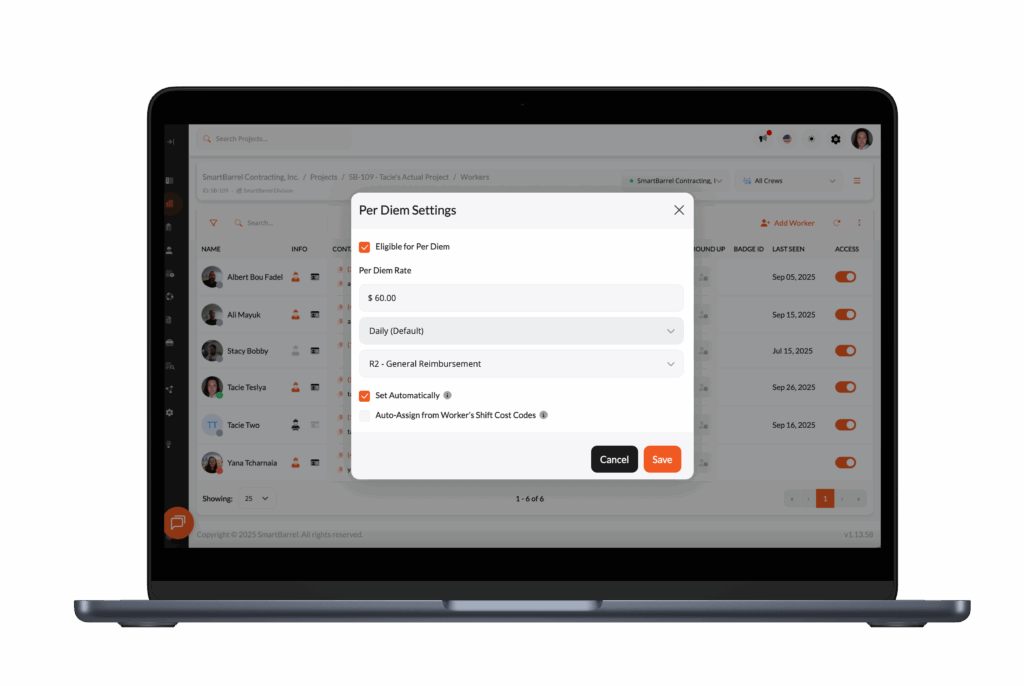
Rural sites rarely have the local trade labor to staff a project this size. Contractors bring in travel crews, so per diem, lodging, mileage, and truck allowances become a material line item rather than an occasional exception. Those costs have to be tied to verified shifts to be defensible, which is why per diem and mileage tracking belongs in the same system as the hours.
Prevailing wage and union agreements add another layer, since certified payroll and union remittance both depend on hours, classifications, and cost codes being correct at the source.


What The Biggest Data Center Construction Projects Show About Labor Scale In 2026
Project | Location | Owner | Trade contractors named publicly |
Crusoe Abilene and Amarillo campuses (Stargate) | Abilene and Amarillo, TX | Crusoe Energy | Rosendin (electrical), Southland Industries (mechanical) |
Meta Temple Data Center | Temple, TX | Meta | Rosendin (electrical), Brandt (MEP), multiple trades under JE Dunn |
QTS Fayetteville, “Project Excalibur” | Fayette County, GA | QTS | Allison-Smith and Andrew Electric (electrical), Aldridge Electric (underground) |
Microsoft Boydton campus | Mecklenburg County, VA | Microsoft | Lithko Contracting, reporting 500-plus workers across nine buildings |
Vantage “Frontier” campus | Shackelford County, TX | Vantage Data Centers | GC confirmed as Kiewit; trades not yet named publicly |
Details as publicly reported at time of writing; project teams change as campuses phase.
These are multi-building campuses where one trade contractor may staff hundreds of workers for two years or more, a different management problem from running 30 people on a six-month commercial job.
What Data Center Construction Management Demands From A Trade Contractor’s Back Office
Data center construction management asks more of a contractor’s administrative systems than almost any other commercial work: crew sizes are larger, durations are longer, and owners have both the motivation and the staff to audit what they are billed.
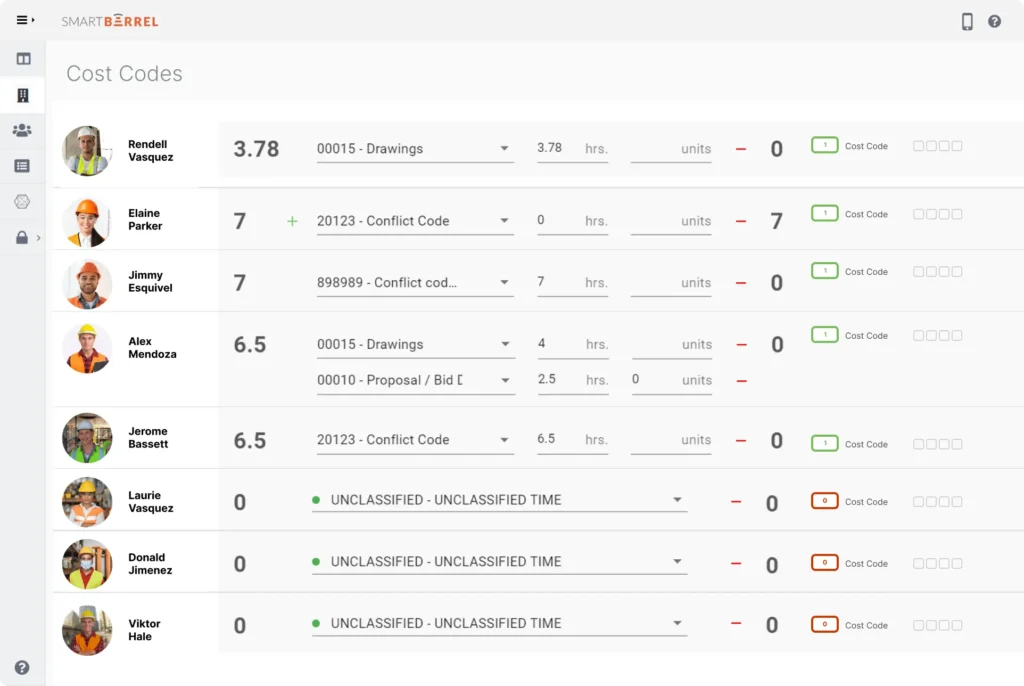
That is where SmartBarrel fits. Workers check themselves in using AI facial verification, so hours are captured at the source instead of reconstructed at the end of a shift. Foremen assign cost codes daily from a dashboard, and verified hours sync to the ERP and payroll systems the office already runs. The result is the most accurate time from the field, the input everything downstream depends on.
Newtron scaled its data center projects on that model, cutting payroll processing time by 20% and manual data entry by 25%, with rollout across six projects completed in three weeks. Cost codes and classifications stopped going missing, which mattered because union reporting depends on both.
Operational efficiency on a data center build is decided long before closeout. It is decided by whether the labor data was right on the day it was captured.
Building data centers with crews of 100 or more? See how SmartBarrel keeps hours, cost codes, and per diem accurate from day one. Request a demo.
Frequently Asked Questions
How long does it typically take to build a hyperscale data center?
Hyperscale data centers generally take 18 to 30 months from groundbreaking to commissioning for a single building, with campuses phased over several years. Site selection, grid interconnection, and permitting often add one to three years beforehand. Schedules have compressed as AI demand pushes owners toward faster delivery, though power availability remains the most common constraint.
What are the current trends in green and sustainable data center construction?
Current trends center on power sourcing, water use, and cooling efficiency. Operators increasingly pair new capacity with renewable energy sources through power purchase agreements or on-site generation, and liquid cooling is being adopted partly because it improves power usage effectiveness against air cooling at high rack densities. Energy efficiency has become a permitting issue too, since data center energy usage has grown for over a decade and now draws scrutiny from utilities and regulators reviewing new renewable energy commitments.
Do trade workers need background checks or badging to work on a data center jobsite?
Frequently, yes. Owner-operated sites often mandate their own screening and access protocols, including background checks, site-specific badging, and escort requirements in secured areas. Confirm those requirements during preconstruction, since onboarding delays for a large travel crew can push a mobilization date.
What is the difference between building a hyperscale, colocation, and enterprise data center?
The difference is mostly scale and tenancy. Hyperscale builds serve cloud service providers and cloud computing platforms at campus scale, colocation facilities lease space to multiple tenants and are often sited near internet exchange points, and enterprise data centers are smaller facilities built for a single organization’s own digital infrastructure. Edge data centers are smaller still and placed close to end users to cut latency. Most data centers in that category are built in months rather than years, since these data centers rely on prefabricated shells rather than ground-up campuses.