


Building a data center is on track to cost about $11.3 million per megawatt in 2026. A megawatt here means power delivered to the servers, not the whole building, and it is roughly what several hundred homes draw around the clock. Mid-size builds run 50 megawatts or more, and AI optimized facilities cost more still. That is the honest answer to most questions about data center construction costs, and it is where most budget conversations stop.
For specialty contractors self-performing scope on data centers, that per megawatt figure is a starting point rather than a working number. Electrical, mechanical, and concrete contractors don’t build megawatts. They install scope, staff it, and carry the labor risk. What follows is a data center construction costs breakdown by category, and the one line item that behaves differently from every other construction cost.
What Is The Average Construction Cost Per Megawatt For Data Centers In 2026?
Global average shell and core cost is forecast to reach $11.3 million per MW in 2026, according to the latest data in JLL’s 2026 Global Data Center Outlook. That is a 6% rise from $10.7 million in 2025, and up from $7.7 million in 2020, roughly 7% compound growth over the same period.
That covers the physical structure plus base power and cooling distribution. JLL notes tenant technology fit out for AI infrastructure can cost as much as $25 million per MW on top, which is why published data center costs so often contradict each other.
Scope | 2026 benchmark | Source |
Shell and core, global average | $11.3M per MW | JLL |
Liquid cooled premium | 7% to 10% above air cooled | Turner & Townsend |
Tenant AI technology fit out | Up to $25M per MW additional | JLL |
How Does Building Type Change The Construction Cost Per Square Foot?
Two data centers of identical footprint can carry very different total costs, which is why data centers are benchmarked per megawatt rather than per square foot. Building type, redundancy requirements, and rack density drive the spread across data centers of similar size.
Costs range widely and move fast. ConstructConnect data reported by Quartz put the average US data center at $960 per square foot in the twelve months through November 2025, up from $534 a year earlier, with hyperscale facilities at the top. A higher redundancy tier costs more than a lower tier of the same footprint, and greenfield costs differ from brownfield redevelopment.
Where Do Data Center Construction Costs Vary Most By Market?
Location moves the number on data centers more than almost any design decision. Turner & Townsend’s data centre construction cost index ranks Tokyo at $15.2 per watt, Singapore at $14.5, and Zurich at $14.2 as the three most expensive markets to build in. On the land side, Cushman & Wakefield put the 2024 weighted average US data center land cost at $5.59 per square foot even as parcels of 50 acres or larger surged 23%, a split that reflects buyers chasing campus scale.
A Data Center Construction Costs Breakdown By Category
Cost category | Scale | What moves the number |
Electrical systems | Largest single category | Redundancy tier, capacity, switchgear lead times |
Cooling systems | Rising share on liquid cooled builds | Rack density, water access, climate |
Building shell and site preparation | Varies with floor loading and clear height | Soil conditions, structure, sitework scope |
Land and utility interconnection | Varies widely by market | Distance to capacity, grid queue position |
Labor | Largest controllable cost on self-performed scope | Hours reported, cost code accuracy, wage premiums |
Electrical Systems And Power Distribution Units
Electrical scope is typically the largest single category of construction costs on data centers. Those costs cover:
- Utility interconnection and switchgear
- Backup generators and UPS
- Bus duct, grounding, and power distribution units
Reliable power is what these data centers sell, so redundancy requirements land here first. The critical components inside that scope carry the longest equipment lead times on the job.
Cooling Systems And Advanced Liquid Cooling
Cooling systems are the fastest moving line in data centers. Turner & Townsend puts construction costs for liquid cooled data centers 7% to 10% above comparable air cooled builds of similar IT capacity. Advanced liquid cooling systems are no longer an exception in AI data center work. They are the working assumption.
Building Shell, Site Preparation, And Land Acquisition
The building shell, foundations, and site preparation on data centers carry floor loading and clear height requirements that a warehouse of the same size never sees. Utility interconnection adds materially to total costs depending on how far the site sits from existing capacity.
Those scopes land early in the data center construction phases, well before the headcount peak that makes labor the hardest cost to hold.
Power availability, land costs, and tax incentives now shape where developers break ground, and JLL identifies speed to power as the primary criterion driving site selection. Established markets no longer win data center investment by default, and site costs are rising faster than data center spending overall.
Labor, The Category That Never Arrives With A Price On It
Most breakdowns list labor last and treat it as a safe estimate. On self-performed scope it rarely is. The reason has less to do with how big labor costs are than with how those costs get counted.
Why Does Labor Behave Differently From Every Other Data Center Construction Cost?
Every other major cost on data centers arrives with a price attached before it reaches the site. Switchgear has a purchase order. So does a chiller. Steel and concrete are bought at prices locked at buyout. Equipment pricing is knowable months out, and when lead times stretch, the costs are still the costs.
Labor is different. It is bid as an estimate of hours, then reported back weeks later after someone wrote hours on a card and someone else keyed them in. On data centers where a contractor may self-perform tens of millions of dollars of scope, the largest controllable cost on the job is also the only one measured by the least precise instrument on the jobsite.
That gap is where the hidden costs of data centers live, and it is measurable. Dynamic Systems Inc., a union mechanical contractor with 2,500 employees, identified $2.6 million a year in overreported and inaccurate hours after moving off self-reported time. Accurate construction time tracking software doesn’t lower the labor rate. It closes the distance between the labor line as estimated and the labor line as spent.


What Does One Misreported Hour Actually Cost On Data Center Work?
An hour of variance does not add one hour of wage to project costs. It compounds through four stages, and the wage is the smallest of them.
- It carries a burden first. Payroll taxes, insurance, and union fringes ride on top of the base rate, so the fully burdened labor rate sits well above what the timecard implies.
- It lands in the wrong cost code. An hour recorded against the wrong phase corrupts the productivity rate for two scopes at once, the one that gained it and the one that lost it. Cost code and productivity tracking tied to verified hours is what keeps that rate honest.
- The next bid inherits it. Historical cost data is how the next data center project gets priced. Bad history quietly becomes a bad estimate, and it’s rarely traced back to the timecard.
- On T&M scope it becomes a disputed line. Time and material billing on data centers gets audited hard. An hour without defensible backup is an hour the owner’s reviewer removes.

See how verified field hours flow into your ERP. Request a demo.
How Did Artificial Intelligence Change The Labor Math On Data Center Projects?
Artificial intelligence raised equipment costs in ways every cost index tracks, and it moved the labor math just as much. What gets less attention is what AI workloads did to the labor line. Higher rack density means more MEP systems packed into less space, more trades stacked in the same room on AI data centers, and energization schedules with zero tolerance for a missed commissioning window. Data center construction schedules have compressed as a result.
Peak headcount tells the story. A large commercial project once ran a few hundred workers at peak. Hyperscale AI data centers run several thousand. Data center spending at that scale converts into crews, and every crew reports hours someone must reconcile.
How Do Labor Shortages In The Construction Industry Shape Data Center Development?
The construction industry needs an estimated 349,000 net new workers in 2026 and 456,000 in 2027 to keep labor supply and demand in balance, according to Associated Builders and Contractors. ABC’s chief economist notes that failing to close that gap places upward pressure on labor costs, especially in certain occupations and regions.
Two things follow for contractors pricing data center construction work:
- Labor costs climb on the same curve as equipment pricing. Wage premiums for data center qualified trades are real and rising.
- Project timelines are now a labor question as much as a procurement one. Lead times and crew availability drive both cost and schedule together.
Power infrastructure constraints and grid queues stretch schedules further, and when crews sit waiting, those hours land somewhere in the construction process. In data centers that somewhere is a cost code.

How A Union Electrical Contractor Scaled Data Center Projects Without Scaling Payroll Admin
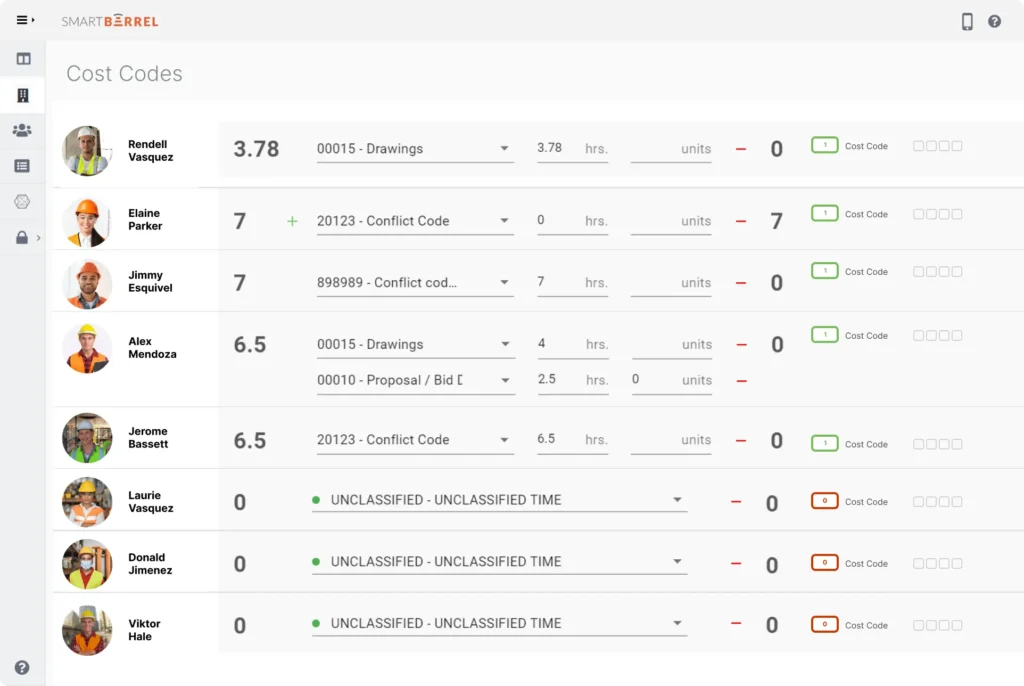
Newtron, one of the largest privately owned industrial electrical and instrumentation contractors in the US, works on data center projects with hundreds of workers on site. Paper timecards were physically submitted to the office and rekeyed into their ERP, frequently arriving without the cost codes or worker classifications required for union reporting.
After replacing that process with SmartBarrel’s biometric facial verification at clock in, Newtron scaled data center projects while cutting payroll processing time by 20%. The reported results:
- Payroll corrections down 25%
- Six projects live in three weeks
Project managers now work from timestamped hours that hold up against certified payroll audits.

What Can Construction Professionals Control On Data Center Builds?
The labor line is the largest controllable cost on self-performed scope, and on data centers it is the one contractors can act on. Transformer lead times, interconnection fees, and tariffs are set somewhere above the contractor. Total costs on data center builds move with market conditions and infrastructure investment cycles no project team controls, and data center development absorbs whatever capacity the market frees up.
Getting the most accurate time from the field won’t change what a chiller costs. It changes whether the labor figure reaching job costing is the figure that happened on the jobsite, which is the difference between managing data center development and reconstructing it after the fact.
Talk to SmartBarrel about verified time tracking on your next data center project. Request a demo.
Frequently Asked Questions
How much does it cost to build a 50 MW data center?
At the 2026 global shell and core average of $11.3 million per MW, a 50 MW facility runs roughly $565 million. Costs for AI optimized data centers run substantially higher once advanced liquid cooling and denser power infrastructure enter the design. Land acquisition and tenant fit out sit outside that figure.
What is the difference between shell and core cost and total project cost?
Shell and core covers the physical structure, foundations, and base power and cooling distribution, which is the scope most published benchmarks measure. Tenant technology fit out, IT hardware, land, and interconnection are separate. That is why one source quotes $11.3 million per MW for data centers and another quotes three times that for the same building.
Do data center projects pay higher wages than other commercial construction work?
Yes, for qualified trades. Electricians, controls specialists, and commissioning teams with mission critical experience command a premium over standard rates, especially those staffing data centers competing for the same limited pool. The premium shows up in bid labor rates well before it appears in cost indices.
Why is power availability the biggest constraint on data center construction?
JLL identifies speed to power as the primary criterion driving site selection, ahead of latency and proximity to customers. Grid interconnection queues and utility capacity now determine which data centers can break ground and when. That makes power infrastructure, rather than land or capital, the practical limit on data center development.