

Davis-Bacon overtime rules create more problems for construction payroll teams than any part of prevailing wage compliance. Workers are paid one and one-half times the base wage for hours worked over 40 in a workweek. The wages on your certified payroll are only as accurate as the hours and classifications captured on the jobsite.
For trade contractors paying crews on prevailing wage work, accurate wages start in the field, and that is where finished wages go wrong. These prevailing wage overtime rules sit on labor laws that push wages above the minimum wage. This is general information, not legal advice; confirm specifics with the Department of Labor.
Which Law Actually Creates Davis-Bacon Overtime Rules?
The Davis-Bacon Act does not create overtime pay. Overtime pay on covered construction work comes from two other laws. One of the common challenges is knowing which rule does what:
Law | What it governs |
Davis-Bacon Act (DBA) | Sets prevailing wage rates, base wages, and fringe benefits by classification |
CWHSSA | Requires one and one-half times the basic rate for hours worked over 40 in a workweek |
Fair Labor Standards Act (FLSA) | Provides the baseline overtime standard behind CWHSSA |
Prevailing wages, including fringe benefits, are paid on every hour worked, and how overtime wages are calculated is determined by the wage determination. Contractors on prime contracts over $100,000, or $150,000 for FAR procurement, owe the CWHSSA premium. State prevailing wage laws and federal regulations add stricter standards, and the prime contractor stays responsible for subcontractors and workers meeting Davis-Bacon requirements.
How The Base Wage And Fringe Benefits Are Treated Differently In Overtime
Fringe benefits change how overtime is calculated, one of the common challenges in fringe calculations. The overtime premium applies to the base hourly wage, not to fringe benefits, with overtime calculated based on the base wage alone. Consider an employee earning $30 per hour in base wage plus $12 per hour in bona fide fringe benefits:
Component | Amount per hour | In the overtime premium? |
Base wage | $30 | Yes, at one and one-half times $30 per hour |
Fringe benefits | $12 | No, paid at the same rate on every hour worked |
Only the base hourly rate carries the multiplier, not the total hourly rate. Folding the fringe rate into one blended figure inflates overtime wages and overpays the wages. Fringe payments in cash, such as health insurance, retirement, or social security, are credited per hour across all hours worked, so health insurance tracks the hourly wage. Overtime hours still earn a fringe at the base rate per hour.
Why Most Davis-Bacon Overtime Errors Start In The Field, Not At The Payroll Desk
Most Davis-Bacon overtime errors are not calculation mistakes; they reach payroll already broken. Certified payroll reproduces whatever wages the field recorded, so a wrong classification or uncaptured hour becomes a compliance issue before employers certify payroll reports.
These compliance issues surface in an audit as underpaid wages. The weighted average method shows this: when an employee works multiple classifications in a week, the regular rate is determined by dividing total straight-time wages by total hours, then applying one-half of that regular rate to each overtime hour.
Here is how that plays out for a worker who spends a 48-hour week across two classifications:
Step | Calculation | Result |
1. Straight-time base wages | (30 hrs electrician × $40) + (18 hrs laborer × $28) | $1,704 |
2. Regular (blended) rate | $1,704 ÷ 48 total hours | $35.50/hr |
3. Overtime premium owed | ½ × $35.50 × 8 overtime hours | $142.00 |
The $142.00 premium is owed on top of the straight-time base wages, and fringe benefits are added at the flat rate for all 48 hours worked, not at the premium rate. Every input in that calculation comes off the jobsite: the hours in each classification, the classification itself, and the base rate. If a split shift is logged under one classification at check-in, the blended rate and the overtime premium are both wrong, and the certified payroll carries that error forward.
Those blended rates are only as sound as the wage rates feeding them. If the straight time rate or the classification is wrong at check-in, the blended rates and the overtime rate are wrong, and workers are paid incorrect wages on a prevailing wage project.
The math is rarely where things break. When a contractor first connects field data to certified payroll, the gaps I see almost always trace back to how the hours were captured on the jobsite: a split shift logged under one classification, travel time that never made the record, hours from two jobs that were never added together. Get the capture right at check-in, and the payroll numbers usually follow.
Albert Bou Fadel, Founder & CEO, SmartBarrel
The Field Breakdowns Behind Common Wage Errors
Four field breakdowns cause most wage errors:
- Wrong classification on split-shift days: An employee who splits a shift between two trades needs both wage rates on record. When certified payroll shows one rate, overtime calculations drift and workers are paid the wrong wages.
- Unaggregated hours across projects: CWHSSA counts every hour an employee logs across covered work in a week, so an employee on two federal projects for one employer can pass 40 total hours while no single site shows the overtime hours, and employers miss the overtime wages.
- Manual entry and rounding drift: Manual entry rounds a 7:15 to 3:30 day to eight hours, and across 200 workers the wages paid drift from the hours worked.
- Yard, travel, and site-of-work time: Time logged inconsistently breaks the site-of-work rules, so overtime calculations and certified payroll records stop matching the hours worked and the wages paid on prevailing wage jobs.
How Does Accurate Field Data Keep Certified Payroll Audit-Ready?
Accurate field data keeps certified payroll audit-ready when it is captured at the source. SmartBarrel does that with construction time tracking software built for prevailing wage jobs:
- Biometric facial verification at check-in confirms worker presence, so contractors capture the hours worked for the employee who is paid.
- Cost codes and classification on the jobsite are applied in the field, not rebuilt at the payroll desk.
- Correct wage rates by jurisdiction. Time tracking for specialty contractors applies the right prevailing wage rates or union wage rates automatically, keeping blended rates, the overtime rate, and wages consistent across multiple jurisdictions.
- Built-in LTE sends verified hours in real time, so payroll teams process wages from current data.
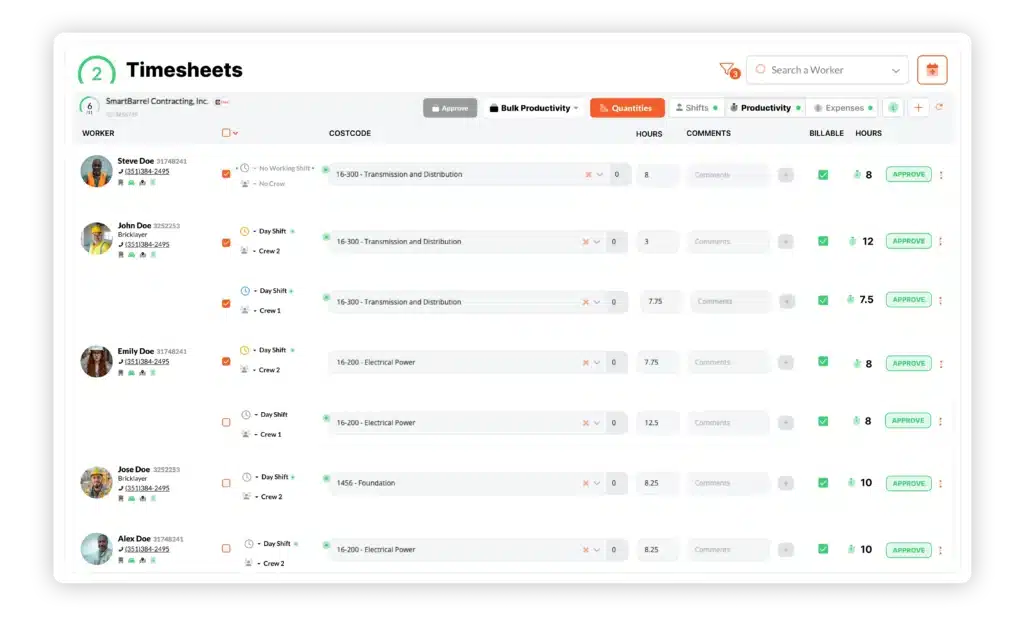
Records flow to payroll and ERP, cutting the manual handling that produces wage errors and bad overtime calculations on prevailing wage payroll. For employers on public work, that means less time rebuilding certified payroll reporting from paper and more time on the wages, with fringe benefits credited correctly.
Contractors who reach that point usually start taking on more certified payroll projects, because the reporting stops being the reason to pass on federal work.
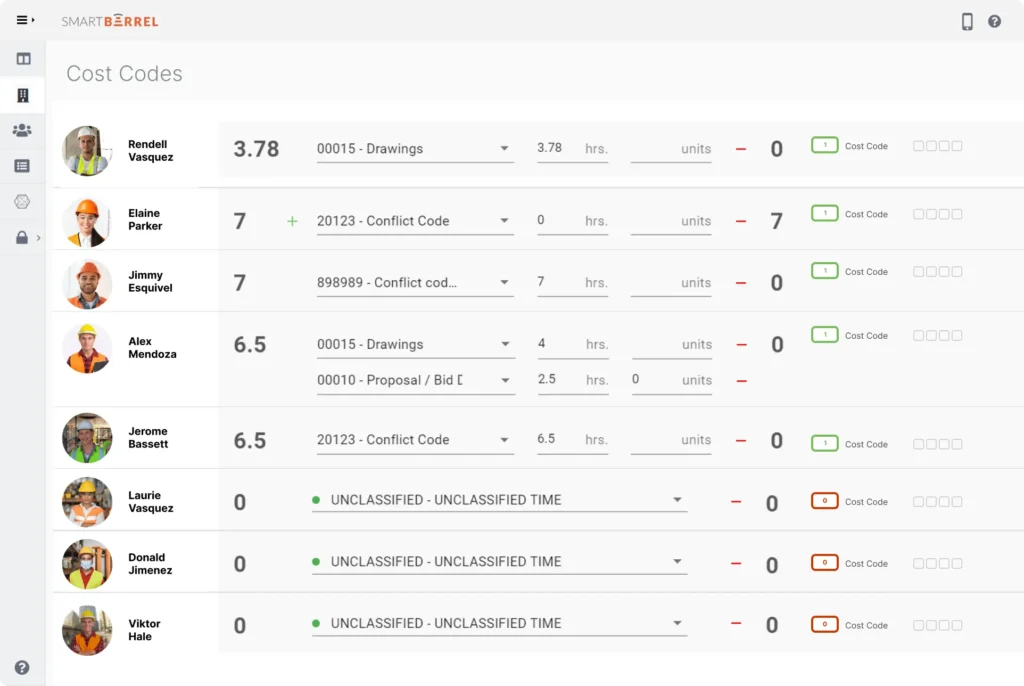
Related Urban Construction, a Miami firm on federal projects, spent up to two hours per job reviewing paper timesheets for certified payroll compliance, about 18 hours a week. Verified records gave its team one source of truth behind the wages on its payroll reports.
The whole audit conversation shifts. When classification and cost codes are reconstructed at the payroll desk weeks later, a contractor is essentially defending a best guess, and auditors can tell. When those same details are captured at check-in, the certified payroll matches what actually happened on the jobsite, worker by worker and day by day. The contractor walks into an audit with records that hold up on their own, instead of scrambling to explain why the numbers look the way they do.
Yana Tcharnaia, SmartBarrel
Request a SmartBarrel demo to see how verified field data feeds certified payroll.
What Are The Penalties For Davis-Bacon Overtime Violations?
Penalties for Davis-Bacon overtime violations are steep:
- Back wages: Contractors owe back wages and the prevailing wages due to every affected employee for the full period of unpaid wages.
- Liquidated damages: CWHSSA adds liquidated damages for each day of overtime hours an employee was paid incorrectly, at a per-day amount set by federal rule.
- Withheld payment: A wage error can freeze payment from contract funds until the unpaid wages and overtime are satisfied.
- Debarment and criminal exposure: Willful or repeat violations bring debarment from future government contracts for up to three years, and falsifying certified payroll reports carries criminal exposure.
Recovering overpaid wages later is limited by permissible deductions, so workers are paid the right wages the first time. These regulations reward employers who keep clean records and protect workers with verified wages.
The most common one is treating certified payroll as something the office can clean up later, instead of getting the classification and hours right at the point of work. On prevailing wage jobs that assumption is expensive. A worker gets logged under the wrong classification, or overtime hours from two jobsites never get combined, and the certified payroll goes out looking fine. Months later it surfaces in an audit as underpaid overtime, and now the contractor is facing back wages on work that closed long ago, sometimes with payment withheld on the jobs still running. The mistake was small and preventable at check-in. The bill arrives after the job is over.
Yana Tcharnaia, SmartBarrel
Building A Davis-Bacon Compliance Process That Starts At Check-In
A durable process treats certified payroll as output of good field data. A few practices help contractors, employers, and payroll teams stay ahead of the overtime rules and prevailing wage laws:
- Have foreman or supervisors capture classification and cost codes in the field, so the base hourly rate and wages are right before you calculate overtime.
- Aggregate hours worked across the covered project, so combined overtime hours trigger the right overtime rate and the regular hourly rate stays accurate.
- Verify presence at the source, so buddy punching does not inflate the hours or the wages paid.
- Pull the correct wage determination from SAM.gov. Match every classification to the published wage rates so wages are determined correctly, and pay each employee at the same rate the wage determination sets.
When the data is right, the wages, overtime calculations, and weekly certified payroll reports line up. Regulations reward contractors who calculate overtime from verified records and pay the correct wages. The most accurate time from the field makes prevailing wage overtime routine and lets contractors calculate overtime on every prevailing wage job.
Contact SmartBarrel to keep certified payroll compliant across every jobsite

Frequently asked questions about Davis-Bacon overtime rules
Do overtime rules apply to apprentices on prevailing wage jobs?
Yes, though registered apprentices can be paid approved percentages of the journeyworker wage rates. Apprentices must be enrolled in a program registered with the Department of Labor, and their overtime is paid at one and one-half times the base rate. If the apprenticeship agreement is silent on fringe benefits, the full fringe amount is paid to the apprentice.
Are foremen and supervisors covered by these overtime rules?
It depends on the work they perform. Foremen and supervisors who spend over 20% of their time on manual labor are treated as laborers for those hours, and are paid the prevailing wage and overtime. Purely supervisory time is outside coverage.
How do state overtime laws affect a Davis-Bacon job?
When a state or local law sets a higher overtime standard than the federal government, contractors follow the stricter rule. Some states require daily overtime federal law does not. On the job, the prevailing wage rates and state prevailing wage laws still apply beneath whichever overtime rule is stronger, and workers are paid the higher wages.