

Time and material billing should be straightforward: track hours, document materials, invoice the client, and get paid. But for specialty contractors working on complex projects in commercial construction, the reality is different. Paper timesheets go missing. Hours get disputed. Clients push back on invoices. Payment delays stack up.
The problem isn’t the contract structure. It’s proving that the actual work happened.
Accurate field time records do more than defend your invoice; they also set the baseline for every labor calculation that runs after the crew leaves the site.
When you’re managing crews across multiple jobsites – mixing the contractor’s employees with temp labor and hourly subs – accurate documentation becomes the difference between protecting your margins and eating costs. With mega construction projects like data centers and semiconductor plants pushing more work into time and material billing, contractors need detailed records that clients can’t dispute.
This article breaks down how T&M billing actually works in commercial construction, where documentation typically breaks down, and what reliable contractors are doing to protect their margins.
What is Time and Material Billing?
Time and material billing is a contract structure where specialty contractors invoice clients based on actual labor hours worked and materials consumed, rather than a fixed price for the construction project.
Unlike fixed price contracts, where you quote one price upfront, T&M billing lets you charge for exactly what the job requires. You set hourly rates for different worker classifications – carpenters at $75/hour, licensed electricians at $95/hour, and project managers at $110/hour. Material costs get billed at cost plus markup, typically 15-35%.
This flexibility matters when project scope changes mid-stream. That wall you’re demoing reveals water damage and outdated wiring. Under a fixed price model, you’re renegotiating. Under T&M, you document the extra work and bill for it.
How Does Time and Materials Billing Work?
T&M billing works by documenting every hour worked and material used, then applying pre-agreed rates and markups to generate invoices backed by verifiable records.
The billing process flows like this: Workers clock in at the jobsite. Labor hours accumulate in real-time. Foremen assign cost codes. Materials get logged as they’re consumed. At billing time, you multiply hours by rates, add material costs with markup, and submit an invoice with supporting documentation.
Here’s where it breaks down in practice. Paper timesheets get lost or filled out days later from memory. Foremen enter time for entire crews, opening the door to errors or inflated hours. Both the client and contractor struggle when invoices show “180 hours of electrical work” with no way to verify who was actually on-site or when they worked.
Without verified documentation – time-stamped check-ins, worker photos, geofenced location data – you’re asking the client to trust numbers they can’t validate. That’s when disputes start, and payments stall.
When to Use Time and Materials Billing for Construction Projects
Use time and materials billing when project scope is uncertain, conditions are unpredictable, or when the GC or owner needs flexibility for scope changes without constant contract renegotiation.
T&M works best for:
- Renovation projects where you can’t see conditions until work begins
- Fast-tracked construction where projects start before full design completion
- Jobs with volatile material costs that make fixed pricing risky
- Complex projects with field conditions that evolve during the project lifecycle
- Work requiring specialized resources that’s hard to estimate upfront
Don’t use T&M when scope is well-defined, the client demands budget certainty, or when you’re competing against fixed price contracts. You’ll likely lose those jobs even if T&M better protects your margins.
The key is matching contract type to project reality. If you can’t accurately predict duration or scope, T&M protects you. If you can, fixed price often wins the bid.
Whichever contract type wins, the loaded labor rates baked into the bid are what determine whether the work returns a real margin or just covers itself.
Why Tracking Hours is Critical for T&M Projects
Accurate time tracking isn’t just good practice for T&M billing – it’s your only defense against disputes that can delay payment for weeks or kill your cash flow entirely.
Here’s what most contractors miss: T&M contracts create an inherent trust gap between both the client and contractor. You want to bill for all actual hours worked. The GC wants to limit hours to control project costs. Your incentives don’t align.
This gap widens when you’re managing multiple workforce types. You trust your own W-2 employees. You might be less certain about the temp labor company sending workers.
Without verified documentation, disputes become inevitable. Research from Levelset shows over 80% of construction companies spend moderate to substantial time chasing down payments, with missing invoices and disputed work hours among the leading causes of delays. When you can’t prove actual time spent, clients push back. Your AP team scrambles to gather evidence. Meanwhile, you’ve already paid your workers, but the client hasn’t paid you
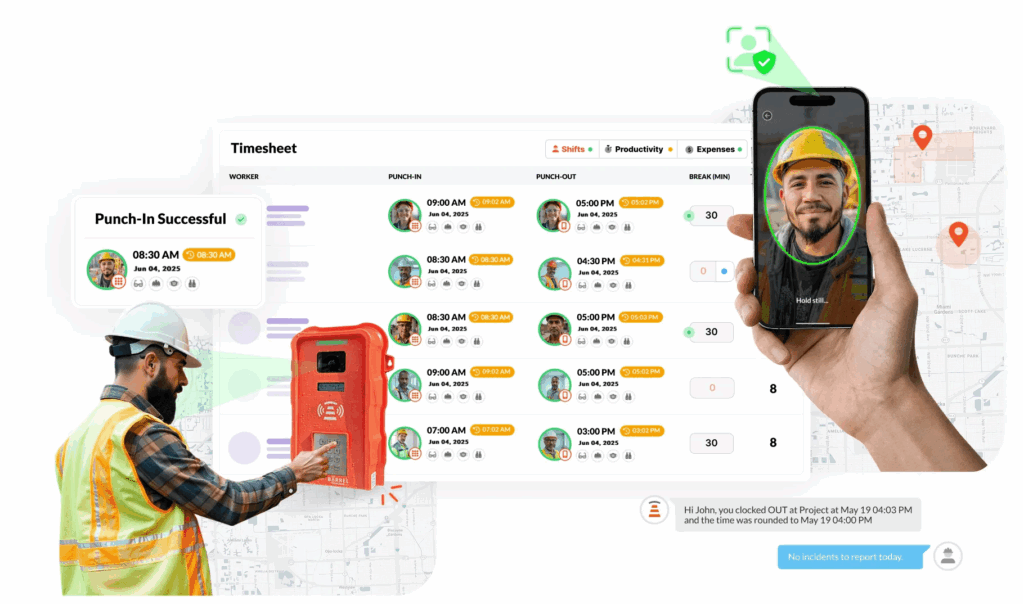
Real-time labor data changes this equation. When every clock-in is biometrically verified, time-stamped, and geofenced to the actual jobsite, disputes evaporate. The data is either there or it isn’t. No arguments about whether someone worked eight hours or ten. No questions about which jobsite they were on.
That’s the standard GCs and project owners now expect for T&M work. Not estimates. Not foreman-reported hours. Verified data they can audit.

Time and Materials Contract Essentials
A T&M contract must include labor rates by worker classification, material markup percentages, overhead calculations, profit margins, and an NTE (Not-To-Exceed) clause establishing a maximum price for budget protection.
Core Contract Components
Every T&M contract needs these fundamentals:
Labor rates by classification. Specify exactly what you charge per hour for each worker type: apprentice electricians, journeyman electricians, master electricians, foremen, project managers. Don’t use blanket “labor” rates.
Material markup. Set a fixed percentage – typically 15-35% – that covers procurement, freight, storage, and your margin on project expenses. Be clear whether this applies to all materials or just certain categories.
NTE clause with upper limit. Most clients demand a ceiling price so budgets don’t spiral and to prevent budget overruns. Set the maximum they’ll pay, with language specifying that overages require written authorization or you absorb them.
Overhead and profit allocation. State how you’re calculating overhead (percentage of labor, fixed amount, or cost plus) and what profit margin you’re including in project costs.
Critical Terms to Include
Beyond the basics, these terms prevent disputes:
Payment schedule. Will you invoice weekly, bi-weekly, monthly, or at project milestones? Net 30? Net 15? Get this in writing before work begins.
Maximum labor hours. Some contracts bill clients based on capped total hours to protect against financial risk. Know your limits before starting.
Material quality specifications. If clients want specific brands or grades, document it. If they want you to source materials, specify your selection criteria.
Change order process. Define exactly how scope changes get authorized. Email? Written change order? Verbal approval from the superintendent? Don’t assume.
Documentation requirements. This is where construction management software and material billing software become critical. Specify what backup you’ll provide: daily logs, time-stamped worker photos, geofenced clock-ins, and material receipts. The more specific, the fewer disputes.
Pulling that backup together is far easier when your field reporting tools capture logs, photos, and clock-ins in one place instead of scattered across apps.
The Multi-Site T&M Documentation Challenge
Managing T&M documentation across one jobsite is manageable. Across 3, 10, or 50 construction projects simultaneously? That’s where contractors lose control.
Each site has different crews. Different GCs with different documentation requirements. Some want daily logs emailed by 6 PM. Others need weekly summaries with worker photos. Federal projects demand certified payroll. Union jobs require specific classifications and 5/8s or 4/10s documentation.
If you’re billing T&M across sites, allowances can become part of the documentation burden – here are the core per diem rules to align with payroll.
Now multiply that complexity by your temp labor companies and hourly subs. They want to maximize hours billed. You need to verify they actually worked those hours on the job. Missing timesheets create gaps in your billing documentation that are difficult to reconstruct after the fact.
The paper trail typically breaks down like this:
The foreman fills out the timesheet on Friday afternoon from memory. Drops it at the trailer. The office picks it up on Monday. Data entry happens on Tuesday. Errors get caught on Thursday. Corrections requested Friday. Corrected timesheet received the following Tuesday. By then, invoice preparation is delayed by two weeks, and reconstructing the actual hours worked becomes increasingly difficult.
Material billing software with real-time data flow eliminates this lag. When workers clock in at the device on-site, data hits your dashboard instantly. Foremen approve from their phones. Timesheets pre-populate. Cost codes get assigned in real-time. Your accounting team processes payroll in hours, not days. And when the GC asks for backup, you send time-stamped photos and geofenced data that’s impossible to dispute.
Learn how contractors are managing time tracking across 15+ active jobsites without paper timesheets or disputed hours.

T&M Billing: Challenges, Trade-offs, and Fixed Price Comparisons
Common T&M Billing Challenges
Even with solid contracts, T&M billing introduces operational headaches and administrative tasks:
- Paper documentation failures. Illegible handwriting makes timesheets impossible to read. Lost tickets mean lost revenue. Processing delays of days or weeks create invoicing gaps and increase financial risk.
- Foreman-entered time issues. When foremen log hours for their entire crew, you lose worker accountability. They’re stuck choosing between being the crew’s motivator or the timekeeper enforcing accuracy. It’s an unfair dual role that hurts client relationships.
- Buddy punching and time theft. Without verification, workers clock in for absent colleagues. You pay for phantom hours that create project expenses without actual work performed.
- Delayed approvals. Manual review processes mean tickets sit waiting for signatures while your cash flow suffers and administrative tasks pile up.
- Lack of real-time visibility. Project managers can’t see who’s actually on-site right now. They discover problems days later when it’s too late to adjust resources or project costs.
Weighing the Pros and Cons
Understanding T&M trade-offs helps you decide when to propose this contract type:
Advantages | Disadvantages |
Cost coverage guaranteed – you won’t eat overruns | Budget overruns make clients nervous |
Easy scope adjustments without contract renegotiation | Requires detailed documentation (time-consuming) |
Financial risk protection when conditions are unpredictable | More administrative tasks than fixed price contracts |
Transparency builds client relationships when honest | Clients often prefer fixed price model for planning |
Profit margins stay consistent regardless of surprises | Workers may lack efficiency incentive without NTE |
The documentation disadvantage – historically the biggest barrier to T&M efficiency – disappears with the right tools. When data flows automatically from jobsite to dashboard to invoice, administrative tasks drop by 80%.
T&M vs Other Contract Types
T&M vs Fixed Price Contracts. Fixed price contracts offer budget certainty but lock you into a number before you know actual conditions. T&M provides flexibility when scope changes but requires clients to trust your hour documentation. Use fixed price when scope is clear before work begins. Use T&M when it’s not.
T&M vs Cost Plus. Both pass project expenses to clients, but cost plus agreements typically cover broader expenses including overhead and indirect costs. T&M focuses narrowly on labor hours and materials. Cost plus often includes a percentage fee on total costs; T&M builds profit into hourly rates.
T&M vs Unit Price. Unit price contracts set rates for specific, measurable outputs – per square foot of concrete poured, per linear foot of pipe installed. T&M contracts bill for time regardless of output. Unit pricing works for repetitive tasks with clear deliverables. T&M works for variable, unpredictable work.
T&M vs GMP Contracts. GMP contracts establish a maximum price with a guaranteed upper limit, protecting the client side from overruns while contractors absorb excess costs. T&M with NTE clauses provides similar protection but maintains hourly billing throughout the project lifecycle.
Regardless of contract type, documentation quality matters. But T&M requires the most rigorous tracking because every hour must be justified.
Best Practices for T&M Billing Success
Proper T&M tracking isn’t complicated. It just requires discipline, the right tools, and clear communication.
1. Set clear contract terms upfront
Define hourly rates for every worker classification. Specify material markup percentages. Establish labor hour caps. Document the authorization process for extra work. Walk your team through the agreement before work begins so everyone understands billing requirements.
2. Create time tracking as a daily habit
Log hours immediately when workers clock in and out. Record materials as they’re consumed, not at week’s end. Obtain authorizations before work accumulates. Hours tracked days later from memory create disputes. Hours tracked in real-time prevent them.
3. Go digital with material billing software
Eliminate paper timesheets and handwritten T&M tickets. Use mobile-accessible systems that work on phones and tablets for users in the field. Enable digital signatures for approvals. Automatically back up records to prevent loss. Paper-based tracking costs you time and money through errors alone.
4. Onboard teams properly
Explain pay rates, hour caps, and billing limits clearly to both the client and your crew. Establish tracking instructions – show workers exactly how and when to record data. Introduce tools early, before the construction project starts, so nobody’s learning systems under deadline pressure.
5. Maintain clear communication
Hold regular check-ins to discuss progress and resolve issues before they become disputes on the client side. Use project management tools to keep everyone aligned on project costs. Designate a single point of contact for tracking or billing questions so problems get caught early.
The SmartBarrel approach simplifies this: Workers scan their faces to create time entries instantly. Biometric verification confirms identity. Data flows to the dashboard in real-time. Foremen approve pre-populated timesheets. Cost codes get assigned with one click. Everything’s ready to invoice without manual data entry.

How Technology Solves T&M Documentation Problems
The right tools don’t just digitize your old billing process. They eliminate the problems that made paper-based T&M billing so painful.
Real-Time Data for T&M Accuracy
Modern software for construction time tracking deliver five critical improvements for T&M work:
- Instant labor capture. Biometric verification at clock-in means no missing hours and no buddy punching. The person physically on-site scans their face. Data flows to your dashboard immediately, capturing actual hours worked.
- Billing based on verified data, not estimates. Time-stamped records with worker photos and geofenced location data provide proof the client pays for that can’t be disputed.
- Faster invoicing. When labor data flows automatically to your accounting system, you process payroll in hours instead of days. Invoices go out faster. The client pays sooner. Administrative tasks decrease.
- Fewer disputes. Verified records eliminate the back-and-forth over whether someone worked ten hours or eight. The data is either there or it isn’t. Approvals happen faster when clients trust your documentation, and client relationships improve.
- Audit-ready compliance. Digital detailed records with facial verification create an audit trail that satisfies even the strictest requirements. If a client or auditor questions your billing, you hand them time-stamped photos and geofenced data.
SmartBarrel’s T&M-Specific Features
Built specifically for specialty contractors managing multiple construction projects:
- Biometric facial verification (NOT facial recognition). The system compares current photos to previous check-ins using AI self-learning. Green circle = verified match. Red circle = review needed. No photoshoot required – workers are automatically learned by the system.
- Geofencing for jobsite verification. Workers can only create time entries when physically present at the geofenced project location. Combined with the on-site TimeClock device, this eliminates off-site punches.
- TimeClock 4.0. Weatherproof, magnetic, solar-powered device that lives on the jobsite. Out-of-box setup in under 60 seconds. No WiFi required – built-in LTE keeps data flowing in real-time.
- Works with PPE, gloves, and challenging construction conditions. System functions even with hard hats, safety glasses, gloves, or welded fingerprints. Built for actual field conditions, not office environments.
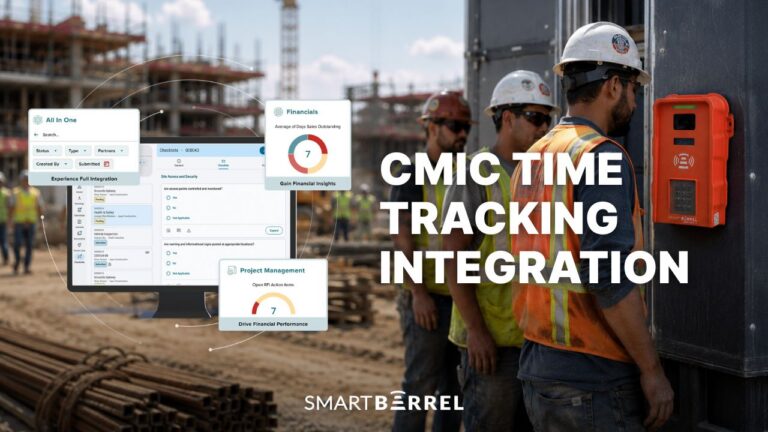
- Integration with Procore, CMiC, Vista, Foundation. Real-time labor data flows directly to your existing project management and accounting systems. No manual data entry. No import/export. Just seamless integration.
- Ongoing support and training. Users get comprehensive onboarding to maximize the right tools for their teams, reducing the learning curve for construction management software adoption.
Book a demo with SmartBarrel to see how contractors are achieving zero T&M disputes with verified time tracking across 20+ active projects simultaneously

T&M Billing ROI and Impact
Verified time tracking with material billing software delivers measurable financial impact for T&M work:
Dispute prevention. When clients can see time-stamped worker photos and geofenced data, pushback drops to near zero. Each avoided dispute saves 10-20 hours of administrative tasks and prevents 2-4 week payment delays.
Payment acceleration. Automated data flow processes payroll in hours instead of days. You invoice faster. The client pays faster because documentation is bulletproof. Cash flow improves immediately across the job.
Admin reduction. Contractors using SmartBarrel report saving 800+ hours annually on manual timesheet processing, error correction, and missing data recovery. That’s $40,000-$80,000 in back-office expenses eliminated for users.
Client relationship building. Detailed records demonstrate transparency. Clients see exactly who worked, when they worked, and where they worked. Trust increases. Client relationships strengthen. You win more T&M work with ongoing support from satisfied customers.
Margin protection. Catching time theft and eliminating buddy punching typically saves contractors $4,285+ per worker annually. On a 200-worker operation managing multiple construction projects, that’s $857,000 in recovered labor costs and reduced financial risk.
According to McKinsey research, construction’s digital adoption is accelerating driven by strong infrastructure demand and skilled labor shortages. Contractors who digitize workforce tracking now gain competitive advantage as mega projects increase.
Time & Materials Billing FAQs
When should you use T&M billing?
Use T&M billing when project scope is uncertain at the outset, when field conditions are unpredictable (like renovation work), when material costs are volatile, or when the client needs flexibility for scope changes without renegotiating contracts. T&M works best when accurate fixed price estimates are impossible and both parties accept some budget uncertainty in exchange for adaptability.
How do government T&M contracts differ?
Government T&M contracts require proving scope couldn’t be determined upfront before work begins, separate fixed hourly rates for each labor classification, detailed materials tracking including freight and handling project expenses, and a mandatory ceiling with upper limit. They also demand higher documentation standards including certified payroll for prevailing wage compliance, detailed records showing actual time spent, and stricter record-keeping that satisfies FAR (Federal Acquisition Regulation) requirements. Biometric time tracking with geofenced verification provides the audit-ready detailed records government contracts require.
Why is tracking hours important for T&M projects?
Accurate hour tracking protects contractors from payment disputes, provides verification clients need for invoice approval, creates audit trails for compliance across the project lifecycle, and prevents cash flow problems from delayed payments. Without verified documentation – time-stamped check-ins, worker photos, geofenced data – clients can dispute hours, delay payments for weeks, and force contractors to eat project costs already paid to workers. Research shows 48% of construction businesses experience late payment, with labor tracking errors among the leading causes of financial risk.
How should contractors handle non-billable time under Time & Materials billing?
Non-billable time — like meetings or travel that the contract doesn’t cover — should be clearly separated from billable entries and recorded in a way that shows transparency. Tracking it separately helps justify pricing decisions and prevents clients from assuming all logged hours will appear on the invoice.
When should a contractor consider including a not-to-exceed clause in a T&M agreement?
A not-to-exceed (NTE) clause is useful when a client wants some budget certainty while still using a flexible Time & Materials billing model. This sets a cap on total charges unless the client authorises additional work, balancing transparency with cost control on evolving projects.
Stop Fighting for Payment. Get Paid What You’re Owed.
T&M billing doesn’t have to mean payment delays and disputes. When you have verified documentation at every step – biometric check-ins, geofenced verification, time-stamped detailed records, real-time data flow – clients have no grounds to push back on your invoices.
SmartBarrel provides audit-ready T&M documentation built for specialty contractors running multiple construction projects simultaneously. From worker clock-in through cost code assignment through invoice generation, every hour is verified and every record is bulletproof.