

1099 reporting is how a business tells the Internal Revenue Service about the payments it made to people who are not on its payroll, most often independent contractors and subcontractors.
In construction, that work happens on nearly every project, which makes it a routine part of running a compliant business.
This guide is written for trade contractors and self-perform general contractors who track their own crews plus the hourly subs and temp labor on a jobsite. It covers the 1099 forms that apply, who is required to file, the reporting threshold, IRS deadlines, and how clean field records keep the numbers accurate.
What is 1099 reporting in construction?
In construction, this means filing IRS information returns that report income other than regular wages. The business that paid an independent contractor files the form, and the IRS matches that payment data against what the contractor reports as income, which is the core of IRS reporting.
What about Form 1099-K and the other 1099 forms?
The Form 1099 series is wide, and each form reports different income types. Form 1099-DIV reports dividends and other distributions, Form 1099-INT reports interest income including tax-exempt interest, and brokers report broker payments on Form 1099-B.
The Form 1099-K reports payment card and third party network transactions; the One Big Beautiful Bill Act returned it to pre-American Rescue Plan Act limits, so 1099-K reporting now starts again at higher reportable payment transactions thresholds.
Most of these income types never touch a construction ledger, since a contractor rarely pays out dividends, interest, or royalties in a trade or business. Those dividends, royalties, and interest forms belong to other industries. Of all these IRS forms, only two carry weight in construction.
The 1099 forms construction businesses use: Form 1099-NEC vs Form 1099-MISC
Construction reporting comes down to two tax forms. Each form has specific boxes for different payments and income types, and choosing the right 1099 form is a basic filing requirement.
When to file Form 1099-NEC for nonemployee compensation?
File Form 1099-NEC to report nonemployee compensation. When a contractor pays an unincorporated subcontractor, a specialized trade, or a consultant for services, those payments belong on the 1099-NEC. This is the form construction businesses file most often.
The 1099-NEC also reports direct sales of at least $5,000 of consumer products for resale outside a permanent retail establishment, plus any payment where federal income tax was withheld under the backup withholding rules. Even cash payments to a sub are reportable nonemployee compensation on this form.
When to file Form 1099-MISC?
File Form 1099-MISC to report miscellaneous income that does not fit the 1099-NEC. In construction, that usually means rents on equipment or yard space, royalties, and other income payments such as prizes or awards.
The 1099-MISC also carries boxes a jobsite rarely sees, like crop insurance proceeds, yet those boxes still live on the same form. Legal services are a common crossover: payments to an attorney for legal services go on the 1099-NEC, while legal settlements paid as gross proceeds to a law firm get reported on the 1099-MISC. (see the IRS Instructions for Forms 1099-MISC and 1099-NEC)
1099 reporting requirements and the reporting threshold for 2026
The core 1099 reporting requirements are simple: collect the right information, file the correct form for each contractor, and meet the IRS deadlines. The reporting threshold sets the dollar line where a form becomes mandatory.
How has the reporting threshold changed?
For payments made in the 2025 tax year, the reporting threshold is $600. Any business that paid an independent contractor $600 or more in total payments during that calendar year is required to file a Form 1099. Starting with payments made in the 2026 tax year, the Big Beautiful Bill Act raised the reporting threshold to $2,000, and the IRS will index it for inflation beginning in 2027.
A higher reporting threshold reduces how many 1099 forms a business files, yet it does not change the rule. All income stays taxable. For example, a subcontractor paid $1,500 in 2026 still owes income tax on that money even when no form is filed, and the contractor still benefits from tracking every payment.
Deadlines, e-filing, and filing electronically
Form 1099-NEC carries one of the tightest IRS deadlines. The recipient copy and the IRS copy are both due by January 31, which shifted to February 2 for the 2025 tax year because the date fell on a weekend. Form 1099-MISC follows a later IRS schedule, with separate dates for paper filing and e-filing.
A business filing information returns must file electronically once it files 10 or more information returns in a calendar year. Filing electronically through the IRS portal beats paper forms for speed and accuracy, which is why e-filing now handles most filing volume. Some states adopted the $2,000 reporting threshold while others kept $600, so confirm both sets of IRS forms and rules each tax year to stay compliant.
Who is required to file a 1099 for independent contractors?
The business that makes the payment is required to file the 1099, not the contractor who receives it. A construction business that paid a reportable contractor at or above the threshold must file the form and file a copy with the IRS. Those who should receive one include unincorporated subcontractors, specialized trades, equipment hired with an operator, and project consultants. Even a small business with a handful of subs has the same filing requirement, and small business owners gain nothing by paying in cash.
Some payments are exempt. Most payments to corporations do not require a Form 1099, with attorneys being the well-known exception. Materials-only vendors and personal payments unrelated to a trade or business also sit outside the filing requirement.
What documents do you need for a 1099?
Accurate 1099 reporting depends on a small set of records gathered before the first payment, not assembled in January. Four documents cover most of what a construction business needs from each subcontractor.
- W-9 form: Every subcontractor or vendor should complete a Form W-9 before work starts. It supplies the legal business name and taxpayer identification number that every 1099 is built from.
- Taxpayer identification number (TIN): The W-9 captures the TIN, either a Social Security number for a sole proprietor or an Employer Identification Number for a registered business. A correct TIN lets the IRS match the form to the right taxpayer.
- Business license: A copy of the subcontractor business license helps confirm the company is a legitimate operating entity, which supports treating it as an independent business rather than an employee.
- Insurance certificate: A current certificate of insurance documents liability and workers compensation coverage, and reinforces that the subcontractor runs an independent operation that carries its own risk.
Keeping these on file for every payee turns filing season into a lookup rather than a search.
The real construction problem behind 1099 reporting: worker classification
The hardest part of reporting is often deciding who is even a 1099 contractor. Treating an employee as an independent contractor is one of the costliest mistakes in construction, since it carries back taxes, federal income tax exposure, penalties, and IRS scrutiny.
The IRS weighs behavioral control, financial control, and the relationship between the parties. For example, a worker whose hours, tools, and daily direction belong to the contractor usually looks like an employee, whose wages get reported on Form W-2 and filed with the Social Security Administration rather than on a 1099.
Trade contractors are especially exposed, because a single jobsite can mix W-2 crew, temp labor, and hourly subs paid as non-employee compensation. Clean records of who worked, where, and under whose direction make that classification defensible. (see IRS guidance on whether a worker is an independent contractor or employee)
Why clean 1099 reporting starts in the field, not at year-end
Most reporting problems trace back to thin documentation, not bad intent. When hours and presence are reconstructed in January, the data feeding each form is only as reliable as notes taken after the fact. Capturing it at the source is the difference between a smooth filing season and a scramble.
This is where verified field data earns its place. SmartBarrel’s construction time tracking software records who was on each jobsite and for how long, with biometric facial verification confirming presence at check-in.
For a business that runs its own crew alongside hourly subs, subcontractor time tracking keeps each group’s hours separated and auditable. That same record feeds construction expense management software so labor costs map to the right project and payee. The most accurate time from the field feeds everything that follows, from payroll to the payment totals behind each 1099.
Zone 4 saw this firsthand. After moving to verified time tracking, the contractor saved thousands per jobsite and strengthened its subcontractor relationships by paying subs faster on records both sides could trust.
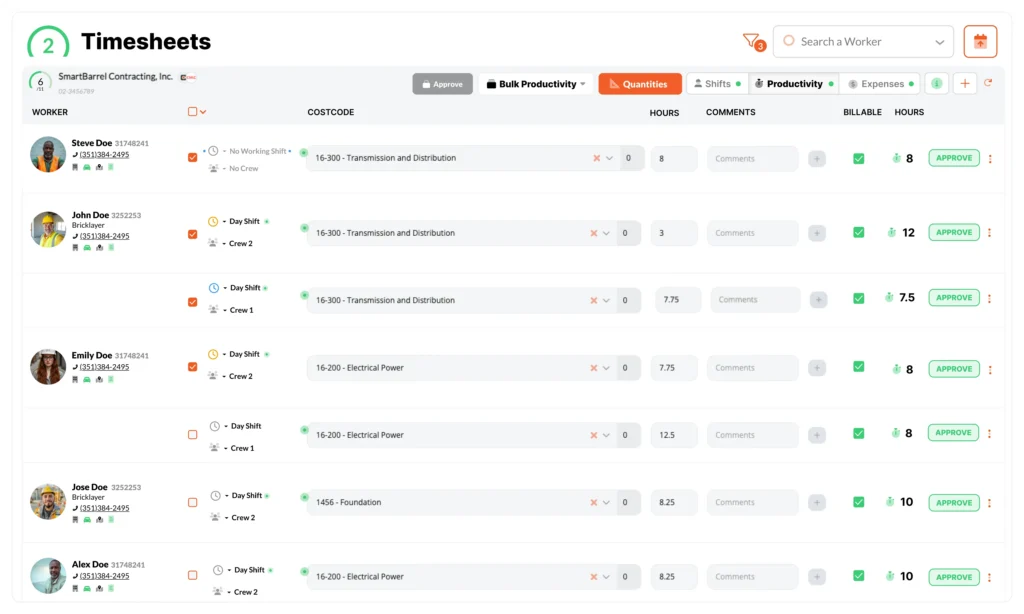

When every hour is verified at the jobsite, the labor records behind each form are ready long before filing season. See how SmartBarrel turns verified field time into clean, audit-ready labor data. Request a demo.
Common 1099 reporting mistakes in construction
Even careful businesses repeat the same errors. Awareness is the cheapest prevention.
- Treating employees as contractors, which invites back taxes and penalties.
- Missing or incorrect W-9 details, which leave names and TINs that do not match the IRS database.
- Failing to total payments across multiple invoices, so a contractor over the threshold gets missed.
- Missing IRS deadlines, or mailing paper returns when e-filing was required.
- Overlooking state rules that differ from federal reporting.
- Assuming the higher reporting threshold ends the need to track smaller payments.
Building a 1099 process that holds up to an audit
A defensible process is built year-round, not in the last week of January. Collect a W-9 from every contractor before the first payment so the legal name and TIN are on file from day one. Keep running records of reporting payments and total payments by payee and project, then run data validation on names and TINs against the IRS database to catch mismatches early. Separate the service portion from materials so each amount lands in the right box, then file the matching 1099 forms. Store invoices and contracts digitally so the backup is ready to file if an IRS review ever asks.
Handled this way, reporting on Form 1099 stops being a year-end fire drill and becomes a byproduct of records the business already keeps.
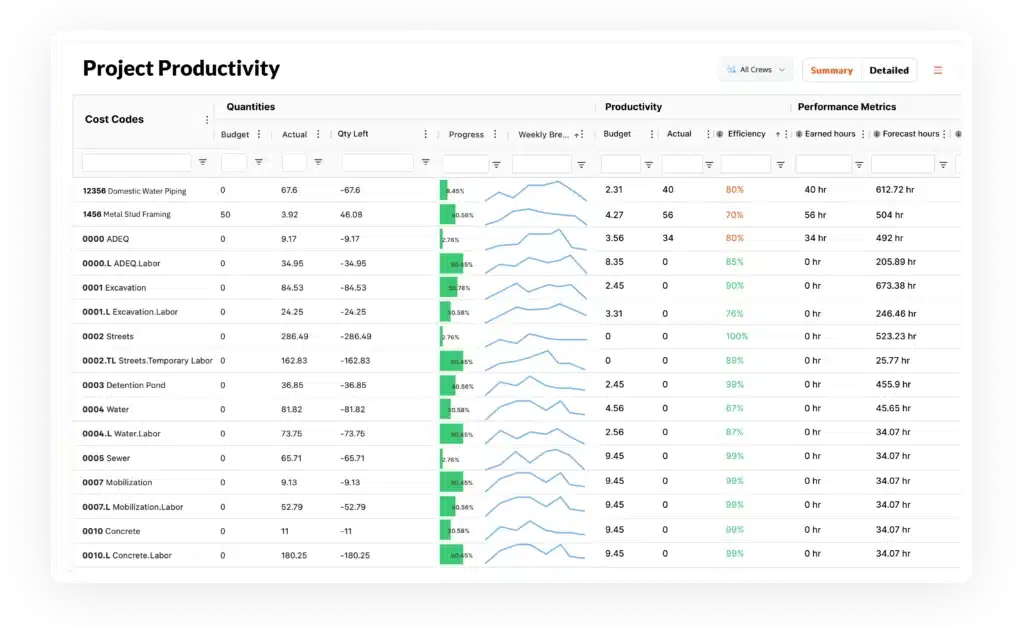

Book a SmartBarrel demo to see the most accurate time from the field.
Frequently Asked Questions
How do backup withholding rules apply when a subcontractor refuses a W-9?
If a contractor will not provide a W-9, the business must apply backup withholding and send a set percentage of the payment to the IRS. The backup withholding rules protect the payer when a TIN is missing or incorrect. Document each request for the W-9 in case the IRS asks why the business withheld.
What are the penalties for late or incorrect 1099 filing?
For information returns due in 2026, IRS penalties run $60 per form if corrected within 30 days, $130 if corrected by August 1, and $340 after that or if never filed. Intentional disregard carries a minimum penalty of $680 per form with no annual cap, and the IRS charges interest on unpaid penalties until paid. (see the IRS information return penalties page)
How long should construction businesses keep contractor payment records?
Keep contractor payment records and filed 1099 forms for at least four years after the tax is due or paid, whichever is later. Construction projects span years, so many contractors hold records longer to match project timelines and warranties. Organized records also make the next filing season far easier.