

Construction site security improves fastest when you combine physical deterrents with verified digital records of who was on site and when. Access control, jobsite cameras, drones, wearables, and biometric time tracking each close a different gap: theft prevention on one side, worker safety on the other. For specialty contractors and self-perform general contractors running their own crews, the highest-value starting point is usually access control tied to verified attendance, because it addresses both at once.
Technology is developed to innovate and simplify several spheres of human living and working, and the construction industry has not been exempt from this. Technologies in the past few decades have sprung up to not only streamline operations and make overseeing projects easier, but also improve construction site security to address prevalent on-site issues like theft and worker safety.
Accordingly, fewer than 25% of stolen materials on construction sites are ever recovered, and the Occupational Safety and Health Administration (OSHA) reports that one in ten construction site workers are injured every year. This points to an industry-wide issue, one that can only be solved through the use of advanced technology.
Here’s how you can use technology (including tools like the SmartBarrel device) to improve security, as well as some examples of what’s being commonly used today.
How Is Technology Used For Construction Site Security?
Security technology on a jobsite splits into two jobs that rarely overlap. The first is protecting assets: perimeter access control, surveillance, and equipment tracking that keep materials and machines from walking off site. The second is protecting people: PPE verification, training validation, and fall detection. The systems that deliver the most value tend to sit where those two jobs meet, because a verified record of site presence supports both a theft investigation and an emergency headcount.
When it comes to security, there are two aspects to consider: site theft and worker safety.
Preventing theft on construction sites involves ensuring that equipment and building materials are kept secure and safe from workers and trespassers who may steal them. With technology, you can more effectively protect your project’s resources through enhanced monitoring and tracking.
The practical measures to prevent construction site theft run from perimeter control to keeping a verified record of who was on site and when.
Similarly, technology can be used to enhance safety, a key concern on all construction sites. Technologies mitigate risk through features like personal protective equipment (PPE) verification and safety training validation.
Although the industry has been slow to adopt new technologies, the benefits of doing so have become much more apparent, as it’s one of the best methods to better guard projects and protect workers.
Check out some of the most common technologies used today and how they help with improving construction site security.
Technology | Primary security job | Best fit |
Access control and jobsite time clocks | Both theft and safety | Any site needing a verified record of who was present |
Drones | Theft and site surveillance | Large or open sites with wide perimeters |
VR simulators | Safety training only | Crews operating heavy machinery |
Mobile apps | Attendance visibility | Distributed crews and small or short-duration sites |
Wearables | Worker safety only | High-fall-risk and confined or hazardous work |
Physical and digital tools
The combination of physical and digital tools has made monitoring every operation on construction sites much easier.
Tools like the jobsite time clock SmartBarrel device ensure security by collecting data on the field, which is then viewable through an online dashboard. This allows users to verify that employees are abiding by all the necessary hazard-prevention measures, even remotely.
Some technologies also include access control to prevent unknown visitors from entering the construction site, enhancing security.
That combination works well for specialty contractors and self-perform general contractors who need one verified record covering both their own crew and site access.
Drones
This aerial vehicle has become a commonly used tool for security on many jobsites. Drones are used for surveying construction sites and inspecting structures.
Whether you’re considering using them to prevent theft or keep workers safe, these units can provide insight into what’s happening on site, from viewing safety incidents to stopping trespassers from stealing from your site.
Virtual reality simulators
More VR brands are breaking into the market, making this technology more accessible and affordable as the years go by.
Virtual reality simulators have been used in other industries previously to train soldiers and surgeons. The construction industry has recently been making use of this technology to train construction workers on how to safely operate machinery like cranes and excavators.
This tool can be used for safety training in a practical, hands-on way to help ensure construction jobsite security.
Mobile applications
Mobile applications can be used as a part of manpower, time, and safety tracking. Workers simply download an application on their phones to track key components of the job.
Some apps, like the SmartBarrel MobilePunch app, allow workers to punch in and out using geofence technology. This helps with overseeing who’s on site to effectively manage security.
Wearables
Safety wearables are a recent trend in the construction industry for improving security.
Wearables include gadgets like smart watches, which can detect falls and alert safety officers to speed up response times. Another example includes safety vests equipped with kinetic energy to power them, with an airbag collar that inflates when it detects a worker falling from a great height.
Hard hats may also be equipped with sensors and a GPS to track the location of workers, featuring a built-in LED light that works as a safety beacon and work light.
These wearables often monitor vital signs in the body, making them useful for jobsite security and worker safety as it lets you check for respiration, body temperature, and heart rate.
Improve security with the SmartBarrel device
The construction industry has developed in many ways in the past 100 years. Although technologies have been created and offer many benefits, they’re often overlooked when it comes to implementing them.
However, contractors that want to remain competitive will find themselves adapting to new methods and taking more concrete preventative measures, especially as construction site security becomes an increasing concern. Technology can meaningfully reduce theft and lower the risk of serious occupational injuries.
Invest in technologies like the SmartBarrel device, a plug-and-play box that’s magnetic, solar-powered, LTE-connected, and weatherproof. It’s built with rugged in mind, made to withstand a fall or two and last in the rough conditions of a construction site.
Our device is easy to set up and use, and is suitable for construction sites of all sizes, from small residential projects to high rise and commercial projects. Since it’s self-powered and there’s little to no intervention needed in maintaining the device, you won’t need any advanced infrastructure or IT department to oversee it.
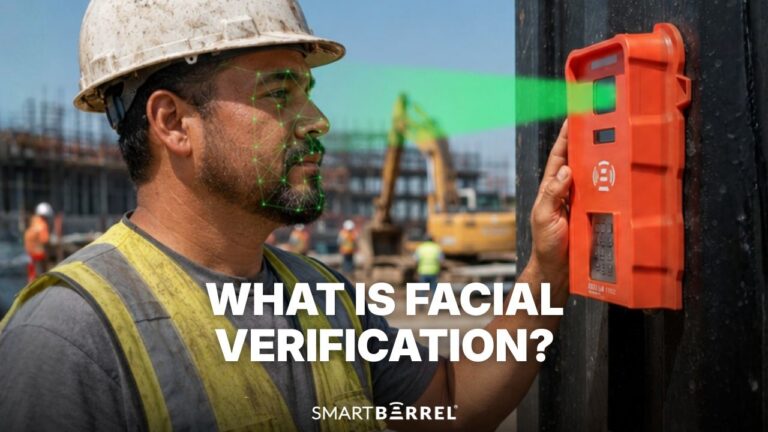
The device’s access control features let you restrict who is allowed on site. Workers check in through keypad input, RFID fob, or biometric facial verification. It is headache-free and fraud-free, which removes the possibility of buddy punching, and it helps you protect your jobsite.
The facial verification system also confirms that workers are wearing their required PPE, and the same system can track completion of required safety training.
Manpower tracking features also show exactly who is on site and when. You get real-time visibility into the jobsite from anywhere, through a dashboard that is easy to navigate. It is the most accurate time from the field, which is what makes the security record hold up.
Want to improve construction security? Book a demo with SmartBarrel today!