
Preventing construction hazards comes down to seven controls applied consistently: safety technology that documents conditions from the field, enforced PPE and training, clear signage, disciplined heavy equipment use, sanitation, access control, and a reliable record of who is on the jobsite at any moment. According to the Bureau of Labor Statistics’ Census of Fatal Occupational Injuries, construction remains one of the industries with the highest number of fatal injuries, with falls, struck-by incidents, hazardous chemicals, noise, and machinery among the leading causes. This guide is written for specialty contractors and self-perform GCs responsible for their own crews.
But safety incidents don’t have to be a regular occurrence. With the right tools and measures in place, contractors can prevent on-site construction hazards to ensure the health and safety of all workers.
The sections below cover each control, then explain how the SmartBarrel device supports safety tracking and access control on the jobsite.
Regular site inspections are the mechanism that turns those precautions into something you can verify rather than assume.
Hazard | Prevention control | How to verify it is working |
Falls and struck-by incidents | PPE enforcement, fall protection training, warning signage | Training records on file; PPE checked at check-in each day |
Heavy equipment | Licensed operators only, dedicated signaler, maintenance schedule | Operator certifications current; pre-shift inspection logged |
Chemical and biological exposure | Respiratory protection, sanitation facilities, waste removal | Exposure monitoring; safety data sheets accessible on site |
Unauthorized access and theft | Perimeter fencing, limited entry points, verified check-in | Live headcount matches the people physically on site |
Communication gaps in an emergency | Broadcast alerts, bilingual signage | Alert delivery confirmed to every worker checked in that day |
What Technology Helps Prevent Construction Hazards?
The most useful safety technology does three things: records observations from the field at the moment they happen, shows who is physically on site right now, and reaches every worker at once when conditions change. Tools that need a laptop or an end-of-day upload tend to get skipped, so field-first capture matters more than reporting features. Treat the technology as the record of your safety program rather than the program itself.
One of the more effective ways to reduce hazards on construction jobsites is to invest in technologies that offer safety features. Despite the industry’s hesitance to adopt new technologies, various tools and platforms can improve how the industry operates, including addressing one of its core issues: safety.
The right technology will allow you to document safety data and observations from the field to simplify the reporting process. Ease of access also makes reports more reliable, as managers will be less likely to delay reporting and later recall events inaccurately. Ideally, you’d also be able to track the number of safety incidents occurring on-site.
Look for technologies that offer worker tracking features, which allow you to see exactly who is present on a jobsite. A broadcasting feature can also be handy when you need to communicate alerts.
Technology can not only improve efficiency by automating tasks and reducing the need for overhead, but can greatly enhance safety.
How Do PPE Enforcement And Safety Training Reduce Hazards?
PPE and training reduce hazards only when they are verified, since issuing gear and scheduling a course do not by themselves change what happens at 6:30 a.m. on site. The practical standard is a record for each worker (what was issued, what training was completed, which certifications are current) that a supervisor can check without leaving the jobsite. When that record lives at the point of check-in, enforcement becomes routine instead of a periodic audit.
One standard method to prevent construction hazards is to give workers the correct personal protective equipment (PPE), such as hard hats, safety vests, eye protection, and industrial gloves. But providing PPE is only the first step. Its use must also be monitored and enforced. Ensure all workers are trained on proper use, care, and any limitations.
Safety training in general must also be provided on things such as fall prevention or working in enclosed spaces. Draft out safety plans, provide supervision, and verify that workers have completed their safety training. It’s important to ensure that workers have the right qualifications and certifications as well, particularly signalers and equipment operators.
To further prevent construction hazards, encourage workers to keep jobsites tidy and report unsafe conditions to supervisors.
What Signage Does A Construction Jobsite Need?
A jobsite typically needs four categories of signage: hazard warnings where equipment or vehicles operate, PPE requirements at entry points, directional signs for restricted areas and egress, and emergency information such as muster points and first-aid locations. Bilingual signs are worth the cost on any crew with non-native English speakers, since a sign a worker cannot read provides no protection. Durability matters as much as wording; a faded or damaged sign reads as optional.
Another standard way to prevent safety hazards on a construction site is to put up clear and easily-readable signage.
Not only does it help with maintaining facility compliance, but it can alert both workers and visitors to potential risks (and what steps they should take to avoid them, such as wearing hard hats or walking around fencing instead of within). Warning signs should be placed, particularly where vehicles and machinery are used.
If needed, consider putting up bilingual warning signs, especially if your construction firm has hired non-native English speakers or you’re working in an area that primarily speaks another language.
Signs should be weather resistant, resist fading from UV rays, temperature tolerant, and durable enough to withstand rough work environments.
How Do You Reduce Heavy Equipment Hazards On Site?
Heavy equipment incidents usually trace back to one of three gaps: an unqualified operator, a missing spotter, or a machine that skipped maintenance. Closing all three means keeping operator certifications current and on file, assigning a dedicated signaler whenever equipment moves near workers, and logging inspections before each shift. Rules about clothing and sight lines help, but the controls that prevent fatalities are qualification, supervision, and maintenance.
One of the most dangerous types of hazards in construction sites is using heavy equipment, since it places workers at a high risk for being seriously or fatally injured.
Heavy equipment should always be properly maintained, and only licensed and qualified workers should be allowed to operate them accompanied by a dedicated signaler. Ensure that operating manuals are readily available for workers to review if needed.
Advise workers to only proceed if they have a clear view of pathways, and to tie back long hair and avoid wearing baggy clothing that could get caught in mobile parts.
How Does Jobsite Sanitation Prevent Illness?
Sanitation prevents illness by limiting the time workers spend exposed to biological and chemical agents and by giving them the means to remove contaminants before eating, drinking, or going home. Running water, soap, sanitizer, and prompt waste removal are the baseline; respiratory protection is required wherever airborne exposure could exceed mandated limits. Because these hazards act slowly, they are easy to underweight against falls and equipment, which is why they belong in the same daily checklist.
Often overlooked, but still crucial to preventing construction hazards is sanitation. Diseases can be spread by prolonged exposure to bacteria, viruses, and asbestos. Employees who regularly work with biological and chemical agents are especially at risk too.
Employers should encourage workers to practice good personal hygiene on-site and follow sanitation protocols, but should also provide proper waste removal, soap and sanitizer, and running water at all times. Workers who deal with agents should be given respiratory protection to prevent exposure to harmful substances from going over the mandated safety limit.
How Does Access Control Improve Jobsite Safety?
Access control improves safety by making sure only trained, verified people are on site, and by giving you an accurate count of who is there when something goes wrong. Fencing and limited entry points handle the perimeter; verified check-in handles identity. For a specialty contractor, the practical value is knowing which of your workers are on which jobsite in real time, which supports both evacuation headcounts and T&M documentation.
Construction equipment theft is a significant annual cost for U.S. contractors, which is why access control is an important security measure and another way to reduce safety hazards on a construction jobsite.
Access control systems can be as simple as secure perimeter fencing with limited entry points, or as sophisticated as facial verification at check-in that confirms each worker’s identity against their own previous check-ins. Security patrols help on some sites, but verified check-in is often the more cost-effective control for confirming who is present.
Layering those controls is one of the more reliable ways to reduce construction site theft without slowing crews down at the gate.
Encourage workers to be wary of and report unfamiliar visitors or suspicious activities.
How Does Smartbarrel Support Safety Tracking And Access Control?
SmartBarrel supports jobsite safety through the same check-in that records time. Each worker verifies their identity with facial verification at the TimeClock 4.0 device or the Kiosk App, which gives supervisors a live headcount per jobsite, a safety SMS at check-out to capture incidents, and broadcast messaging to reach every worker on site at once. Because it uses built-in LTE and can run on electricity, solar, or a tool battery, the record keeps working on sites without Wi-Fi or power.
The SmartBarrel device is a magnetic, out of box unit that’s weatherproof, LTE-connected, and runs on electricity, solar, or a Milwaukee or DeWalt battery pack. It includes safety tracking and access control features that help reduce hazards on your construction jobsite.
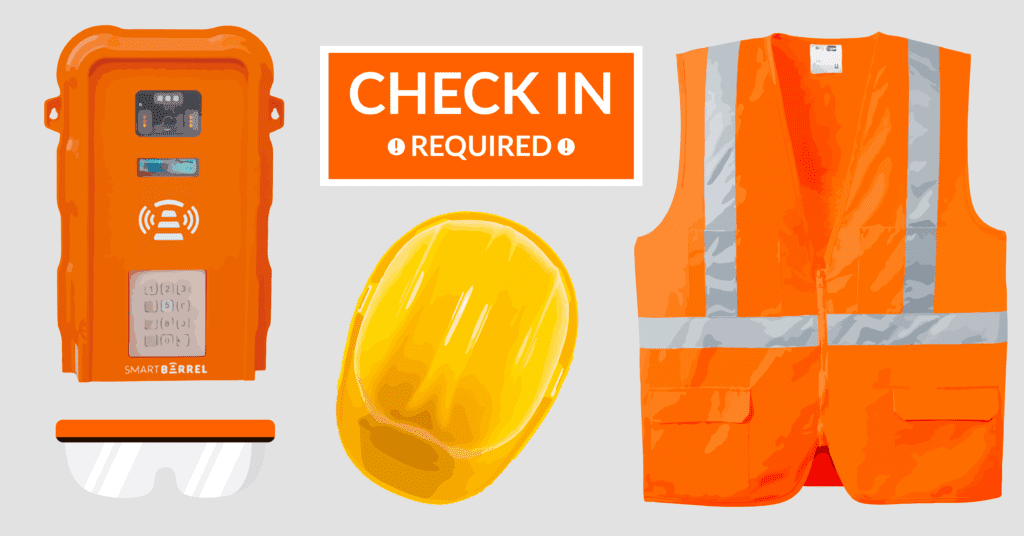
Our safety tracking feature combines many elements, including instant PPE verification. Rest assured as the SmartBarrel device scans for PPE including hard hats, safety glasses, and masks, all information is displayed on a connected dashboard to show whether workers are safety compliant or not so you never lose track of your jobsite.
Upon check-out each worker will also get an SMS sent to their device to ask whether there has been an incident on the job-site. The SMS communication is in both English & Spanish. All incidents are seen and easily reportable on the SmartBarrel dashboard and all records are stored in one centralized location for your convenience.
The SmartBarrel device and dashboard are designed to be intuitive and easy-to-use, so set-up is quick with little to no training required for new users. As a self-connected box, there’s also very little maintenance required.
Other safety tracking features include:
- Easy employee onboarding: Cut your admin time in half and streamline the onboarding process with automatically-generated badge IDs and the ability to easily collect emergency contact information and worker info through SMS.
- Message broadcasting capabilities: Make communication on the job site more efficient by effortlessly sending a message that goes to all employees/workers on the job or company-wide to notify of any safety issues, weather warnings, alerts, egress, and job site updates.
- Site Safety orientation tracking: Upon clocking in, each employee will get an SMS to their phone to ask if they completed the site safety orientation.
The SmartBarrel device also supports access control. Each worker checks in with facial verification, which serves both time tracking and site security. Once workers have checked in, you have a live list of everyone on the jobsite, which replaces manual headcounts, and only verified workers are counted as present.
SmartBarrel is built to make jobsites of 10 workers or 1,000 more productive, safe, and secure. Reduce risk on the jobsite and book a demo with SmartBarrel today.
Frequently Asked Questions
-
Does verified check-in slow crews down at the gate?
Not in practice. A returning worker's check-in at a jobsite device takes seconds: they step up, the camera verifies them against their own previous photos, and they are in. First-time registration takes about a minute and requires no pre-uploaded photos, because the system learns each worker from their own check-ins. Compared with a manual sign-in sheet or a guard checking IDs, verified check-in is usually the faster gate for crews of 20 or more.
-
How does knowing who is on site help in an emergency?
During an evacuation, the question that matters is whether everyone who checked in this morning is accounted for at the muster point. A live headcount per jobsite answers it immediately, and broadcast messaging lets the super send the evacuation or shelter instruction to every checked-in worker at the same time. Without a verified check-in record, that headcount depends on memory and paper at the moment those are least reliable.
-
What incident records do contractors have to keep?
Employers with more than 10 employees in most construction classifications must keep OSHA injury and illness records: the OSHA 300 log of work-related injuries and illnesses, a 301 incident report for each recordable case, and the 300A annual summary posted from February 1 through April 30 each year. Capturing incidents at check-out, when the worker is still on site and the details are fresh, makes those records easier to complete accurately. Confirm current requirements at osha.gov.