


The cost of employee absenteeism in construction looks straightforward on paper: one worker doesn’t show up, one worker’s wages aren’t paid for the day. One less pair of hands. Except that’s not how construction works.
On a jobsite with multiple trades working at once, crews are sequenced. One absent worker doesn’t just slow one task; it can stall the workers behind them, push equipment idle, and compress a schedule that has no room to give.
The real cost of absenteeism in construction multiplies outward. And for contractors running labor-intensive operations across multiple jobsites, those ripples add up well before anyone realizes there’s a problem.
Why Employee Absenteeism Hits Construction Harder Than Other Industries
Absenteeism in the workplace carries a multiplier effect that most industries don’t face. In an office environment, one absent employee means one person’s tasks get delayed or redistributed. In construction, the calculus is different. Crews work in interdependent sequences, and when one link breaks, the rest of the chain stalls:
- Forming crew falls short: concrete crew can’t proceed
- Concrete crew is short: MEP rough-in gets pushed
- Plumbing rough-in slips: inspections reschedule, the GC’s milestone moves
When a key worker is absent, even for a partial day, the trades behind them can’t proceed, equipment sits, and a superintendent is scrambling to re-sequence a day that was already planned to the hour.
Research on electrical construction projects found that productivity dropped by 24.4% when jobsite absence rates reached 6-10%. Not a 6-10% productivity drag: a 24.4% drop. That nonlinear relationship is what makes worker absenteeism in construction so costly and so easy to underestimate.
The costs of absenteeism increase faster than the absence rate itself. A site with 8% absenteeism doesn’t lose 8% productivity. It loses significantly more, because the remaining crew is absorbing disruption, covering gaps, and working around a schedule that’s already been compromised.
What Are The Direct Costs Of Absenteeism In Construction?
The obvious costs are the ones tied to the clock. When employees miss work, direct cost exposure includes the premium paid to backfill with overtime, the partial burden still accruing on the absent worker, and any temp labor premiums brought in to cover critical roles.
Average hourly earnings in construction reached $38.30/hour in 2024, according to the Bureau of Labor Statistics. With full labor burden (payroll taxes, workers’ compensation insurance, benefits), the actual cost per worker-hour for a specialty trade contractor typically runs $50-65/hour.
When a worker is absent, and another worker covers overtime at 1.5x their base rate plus full burden, a single day of absence can cost $600-800 in overtime premium alone, before factoring in what the absent worker’s benefit obligations still cost the company that day.
For contractors managing 150-500 workers across multiple jobsites, even five unplanned absences per week produce a material payroll variance. That number grows quickly when absent employees cluster in a single trade or on a critical-path project.
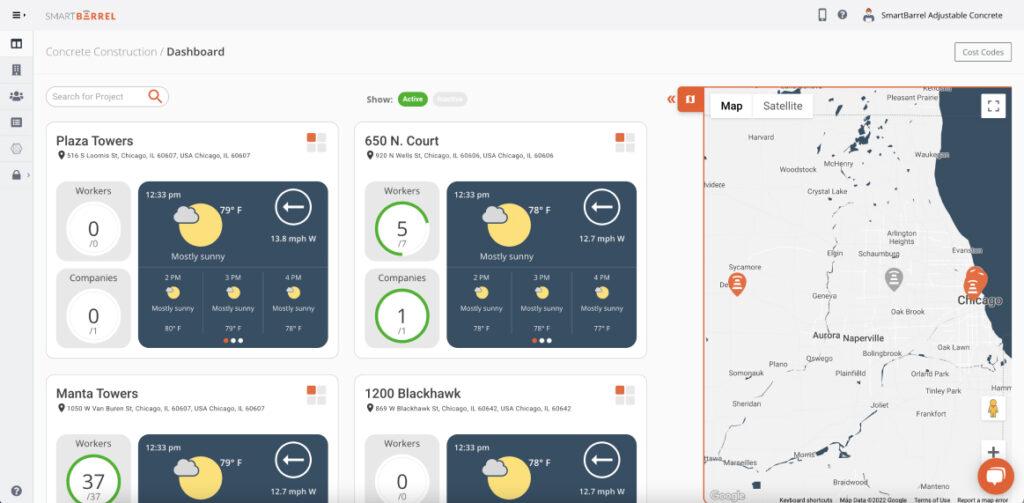
Absences on jobsites are often uncontrollable, but the response to them doesn’t have to be reactive. SmartBarrel’s Company Absentee Module gives office users and admins a real-time, company-wide view of absent workers across all active projects from a single screen, without having to open each project individually. When a worker doesn’t clock in, they appear immediately on the absentee list. From there, the team can create a shift, log PTO, mark a no-show, or stop tracking entirely, all from one centralized location.
For contractors running multiple jobsites, the module surfaces workers who are absent across more than one project on the same day, a pattern that’s easy to miss when attendance is managed project by project. Catching that mid-day instead of at Friday payroll is the difference between a manageable staffing gap and a schedule problem that’s already compounded.
What Are The Hidden Costs Of Worker Absenteeism in Construction?
Indirect costs are where the real damage accumulates. They’re harder to trace to a single line item, which is exactly why they go unaddressed for so long.
Schedule compression and lost productivity
When absent employees push tasks off schedule, the remaining crew absorbs their share of the workload, often under pressure that reduces efficiency. The same research on electrical construction projects that documented the 24.4% productivity drop found that absenteeism averaging 9.13% produced measurable productivity loss across entire projects, not just on the days workers were absent. That compression creates overtime demand that drives up cost further.
Supervision time
Every unscheduled absence requires a foreman or superintendent to re-sequence tasks, adjust crew assignments, and update daily logs. That’s time taken directly from leading crews and pushing projects forwardAt scale, across multiple projects, the cumulative administrative drag of managing attendance issues is significant.
Equipment and capital idle cost
A crane, a lift, or a specialty piece of equipment on a daily rental rate doesn’t stop billing because a crew member didn’t show. When absent employees hold up the work that requires that equipment, the idle cost is real and often untracked.
T&M billing exposure
On Time and Material projects, unverified attendance creates a direct billing risk. Hours that weren’t worked can still be reported through manual timesheet processes, not through deliberate fraud, but because paper-based and foreman-entered systems lack verification.

What Causes Absenteeism in Construction and What Can Be Addressed
Understanding why employees miss work in construction matters, because not every cause is the same and not every cause can be addressed the same way. Some absences are legitimate and protected: medical leave, jury duty, approved absences for family responsibilities.
Problems arise when there is an ongoing pattern of unscheduled absences, that builds across a crew over months, and the chronic absenteeism that quietly undermines project performance.
Health issues and injury
Construction is a physically demanding industry. The Bureau of Labor Statistics recorded 173,200 non-fatal injuries and illnesses in construction in 2023, a significant share of which caused days away from work. Health-related workplace absenteeism tied to injury is largely unavoidable, and it’s also a driver of the overtime burden described above, since replacements are needed for skilled workers on injury-related medical leave.
Mental health issues and substance use
Mental health in construction is an industry-wide challenge with direct consequences for worker well-being and attendance. Construction tradesworkers have the highest rate of substance use disorders of any occupation at 19%, nearly double the national average, and untreated substance use disorders cost employers an estimated $8,591/year per affected worker.
Mental health issues including anxiety and depression are associated with increased absenteeism, reduced performance, and higher safety risk. Addressing mental health as a factor in poor attendance, rather than treating it as a conduct problem, is increasingly recognized as both the right and the effective approach.
Workplace environment and employee engagement
Job dissatisfaction, workplace bullying, and a poor work environment drive voluntary absenteeism, pulling in workers who could come in but choose not to. Low employee engagement, a lack of recognition programs, and workers feeling disconnected from the company’s mission all contribute to the kind of disengagement that shows up as unexpected absences over time. These challenges go beyond any individual worker’s attendance record.
Absenteeism Formula: How to Calculate the Cost of Absence in Construction
The cost of a single absence is calculated by combining direct wage-hour losses, overtime or temp labor backfill costs, and a productivity loss factor applied to the remaining crew.
Cost Type | What It Captures | Worked Example |
Direct cost | Burdened hourly rate x hours missed by the absent worker | $55/hr x 8 hrs = $440 |
Backfill cost | Overtime premium rate x hours worked by the covering worker | $82.50/hr x 8 hrs = $660 |
Productivity drag | Estimated efficiency loss on remaining crew x burdened rate x hours | 15% drag x $55/hr x 9 workers x 8 hrs = $594 |
Equipment idle | Daily rental rate of any equipment that can’t be deployed | Varies by site |
Total (one absence) | ~$1,694 |
Applied across a 200-worker operation with even modest absenteeism rates, those figures compound quickly. An absenteeism rate of 5% means 10 workers absent on any given day. At roughly $1,650-1,700 per incident, that’s $16,500-17,000 in daily lost productivity exposure, or $82,500-85,000 per five-day week.
Absenteeism Data: Why Most Contractors Can’t See the Problem
Here’s the issue that makes absenteeism expensive beyond the obvious costs: most contractors don’t have reliable absenteeism data. They have timesheet data, which is not the same thing. The way hours get recorded on most jobsites creates a built-in visibility gap:
Paper sign-in sheets
Workers record their own arrival. There’s no verification, no timestamp, and no way to flag a two-hour late start after the fact.
Foreman-entered hours
A superintendent filling out timesheets at the end of the week is working from memory and observation, not a verified record. Partial-day absences get rounded or missed entirely.
Mobile apps tied to phone location
Verifying a phone’s location is not the same as verifying a worker’s presence on site. The data reflects what was reported, not what actually happened.
That gap between reported presence and verified presence is where chronic absenteeism hides. Partial-day absences, workers arriving two hours late or leaving two hours early, are virtually invisible in these systems.
Research on industrial construction absenteeism found that missing two or more hours is nearly as disruptive to crew workflow as a full-day absence. But that two-hour event rarely makes it into weekly timesheets as an absence. It gets rounded, estimated, or simply not tracked. Over 18 months across 100 workers, those two-hour gaps can compound into six- and seven-figure labor cost variances with no visible line item to explain them.
Getting accurate construction manpower tracking data starts with the check-in. When workers verify their own attendance biometrically, scanning their face at clock-in and clock-out, the system captures exactly who was on site and for how long. That verified attendance record is the foundation of reliable absenteeism data. Without it, contractors are managing the problem with estimates.

How to Address Absenteeism and Attendance Issues in Construction
Reducing absenteeism in construction requires addressing both what can be measured and what can be changed. The two aren’t separate problems.
Improve attendance visibility first
Attendance policies and performance management only work when attendance data is accurate. If foremen are entering hours after the fact, approved absences aren’t clearly separated from unscheduled absences, and partial-day attendance issues are invisible, there’s no reliable baseline for identifying patterns.
Real-time verified attendance data makes it possible to see which workers, crews, and jobsites have elevated absence rates, before those patterns become a project problem.
Build scheduling and staffing practices around attendance realities
Flexible scheduling, where project conditions allow, reduces absenteeism tied to personal days, family member obligations, and car trouble that would otherwise cause unplanned absences.
Allowing employees advance notice of scheduling changes, building reasonable accommodations into shift planning, and avoiding sustained overtime that drives burnout-related absenteeism all reduce the overall absence rate over time.
Address the underlying causes
Employee assistance programs that include mental health resources, substance use support, and access to counseling reduce health-related absenteeism. In an industry where workers feel the physical and psychological weight of the job more acutely than most, those programs improve employee well-being, and well-being outcomes show up directly in attendance.
Recognition programs and clear paths for employee experience growth improve employee engagement, and engaged workers feel connected to their team and their jobsite in ways that reduce the kind of job dissatisfaction-driven absenteeism that’s hardest to see coming.
The Problem Is Measurable. The Cost Isn’t Optional.
Contractors already know absenteeism is a problem. What most don’t have is visibility into how much it’s costing them, where it’s concentrated, and whether it’s getting worse. The instinct is to reach for an HR policy or a wellness initiative, and those matter. But before any of that works, there has to be accurate attendance data. You can’t manage what you can’t measure.
That’s what changes when workers verify their own attendance through biometric facial verification. Foremen start the day with a pre-populated, verified timesheet instead of a blank form. Supers can see real-time headcount across every jobsite. Payroll reflects actual time, not estimated time. And absenteeism patterns, partial-day absences, habitual lateness, site-specific gaps, become visible the moment it happens, not hours later.
See how SmartBarrel gives contractors verified, real-time attendance data across every jobsite. Request a demo.
Frequently Asked Questions
What is an acceptable absenteeism rate in construction?
Industry research suggests an absenteeism rate below 5% is generally considered manageable in construction. Hanna et al. found no measurable productivity loss on electrical construction projects when absence rates stayed in that range, but once rates climbed to 6-10%, productivity dropped by 24.4%. For most contractors, the more useful benchmark isn’t an industry average but their own verified baseline, which requires accurate attendance data to establish in the first place.
Can biometric time tracking reduce absenteeism?
Verified biometric attendance shifts accountability from the honor system to the record, making partial-day absences and habitual late starts visible data points rather than gaps that disappear into rounded timesheets. Contractors using verified attendance data can identify elevated absence rates by crew, site, or trade before those patterns compound into a schedule or cost problem. Visibility doesn’t eliminate absenteeism, but it’s the prerequisite for managing it.
How does absenteeism affect worker morale on a jobsite?
When workers are frequently absent, the employees who show up absorb the extra workload, creating fatigue and the kind of disengagement that leads to further absenteeism over time. Workers feel the impact directly: covering more ground, working longer hours, and watching schedules slip because of gaps they didn’t create. Improving attendance visibility and addressing absenteeism patterns early protects not just productivity but the work environment that reliable workers choose to stay in.


