

Time tracking belongs in overhead because, like trucks, phones, and insurance, a contractor cannot run jobs profitably without it. Unlike most overhead, it can pay for itself. Every rounded check-in, long lunch, or buddy punch is labor you pay for but do not receive, and a verified time tracking system recovers enough of those hours to cover its monthly cost on many jobs.
For some of us, however, time tracking solutions seem like an expense we can avoid by just doing things the same way we always have.
We evaluated and ranked the best construction time tracking software to help you cut through the marketing noise and find what actually works.
Technology and the construction industry do have a complicated relationship. But, in modern construction, time tracking with technology is the norm among the most successful builders, contractors, and developers. In other words, time tracking solutions should be considered an overhead expense, not a luxury.
In the construction contracting industry, accurately tracking labor is among the greatest challenges. We can track a crew’s time ourselves, ask the foreman to track it on top of running the work, or use a system that records the time we pay for. The first two put timekeeping on people who already have full-time jobs, so many contractors are turning to the third option.
Traditionally, we invest in advertising, insurance, tools, and all of the other overhead expenses we incur without much debate. However, when we have the opportunity to save money on labor, we can be apprehensive to invest because we just don’t understand it.
Today, we will discuss why time tracking solutions should be considered an overhead expense, just like building rent and fuel for the trucks. Time tracking solutions are one of the few investments we can make that actually offer a measurable return, so we owe it to ourselves to investigate the possibilities.
We will discuss why some contractors don’t see the value in time tracking solutions until it is too late, while others see the benefits early. We will discuss the various technologies used in modern time tracking solutions and why some applications may be better for some contractors than others.
What Is Construction Time Tracking Software?
Construction time tracking software records when each worker starts and stops work on a jobsite and sends those hours to payroll and job costing. The better systems also verify the punch, using facial verification to confirm who clocked in and geofencing to confirm they were on site, so the hours can be trusted without a supervisor checking every entry.
Time tracking software solutions take much of the work, and errors, out of calculating labor costs. Instead of using a mechanical time clock, these solutions record employee time using technologies such as geofencing, cellular connectivity, and artificial intelligence.
Some provide passcodes or fobs, and others provide kiosk and smartphone apps for ease of use. The most modern solutions use artificial intelligence to some degree and provide multiple ways to access the system.
|
Method |
How it confirms the punch |
Common limitation |
|---|---|---|
|
Paper timesheet |
It does not, hours are written down |
Filled in from memory, re-typed by the office |
|
Passcode or fob |
Something the worker knows or carries |
Codes and fobs can be shared |
|
Phone app with geofencing |
Confirms the device is on site |
Needs a charged personal phone and a signal |
|
Jobsite time clock with facial verification |
Confirms who punched and where |
Needs a device installed on site |
Like utility and phone bills, the solution would become an overhead expense we could control. Better yet, it would resolve enough time tracking errors to literally pay for itself, using funds that would have otherwise gone undetected and wasted.
Why Should Time Tracking Solutions Be an Overhead Expense?
Time tracking should be an overhead expense because it supports every job at once and does not belong to any single project. It also behaves differently from most overhead: its cost is fixed and predictable, while the labor it protects is variable.
The most successful contractors have realized that accurate time keeping is the best way to manage expenses and profitability. We might scoff at spending a few hundred dollars on a time tracking solution, but might consider two workers consistently checking in late or time theft just a cost of doing business. Time is literally money, and uncontrolled costs accumulate.
Consider a crew arriving at a project at different times, each arriving ten minutes early to ten minutes late. However, the foreman is responsible for clocking everyone in, and they don’t want to penalize the early arrivals, so they clock the whole crew in ten minutes early. The extra time may not seem that significant until the end of the week when a surprise awaits the payroll department.
In this case, an easy-to-use time tracking solution would have tracked the actual time spent on a job, not rounded up or down to the next time increment.
Or, consider the same crew taking a 45-minute lunch instead of a 30-minute lunch without clocking in and out. If we’re paying the crew $175.00 per hour with an agreed-upon 30-minute lunch, we just lost $44.00.
If this goes on for a week, we’ll pay over $200.00 in labor we didn’t actually receive. The problem grows with buddy punching, where one worker clocks in another, and with handwritten timesheets that a foreman fills out at the end of a long shift on top of running the crew.
|
Scenario |
Extra paid time |
Cost at a $175/hour crew rate |
|---|---|---|
|
15-minute long lunch, one day |
0.25 hours |
$43.75 |
|
Same long lunch, five-day week |
1.25 hours |
$218.75 |
|
Same long lunch, 50-week year |
62.5 hours |
$10,937.50 |
The solution then is to use a time tracking solution that is accurate, helps prevent fraud, and is robust enough to allow a single manager to manage the time of multiple employees. The obstacle some buyers encounter is the upfront capital investment or the paid training their employees will require to operate the system.
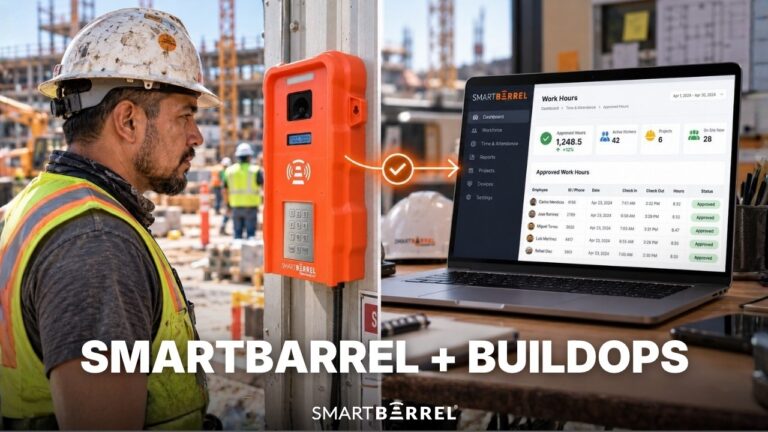
SmartBarrel was built by a specialty contractor for this exact problem. Workers check in and out on the SmartBarrel TimeClock 4.0 or the Kiosk App, each punch is confirmed with facial verification, and the foreman reviews hours and assigns cost codes in the dashboard instead of writing timesheets.
Get Control of Your Time Tracking
How Does Construction Time Tracking Work?
A worker checks in at the jobsite on a time clock, kiosk, or phone. The system confirms who they are and where they are, records the time, and makes the hours available in a dashboard. A foreman or admin reviews the hours, assigns cost codes, and approves them, and the approved hours sync to payroll or the ERP without being typed in again.
Some use the employee’s phone and employ a technique called geo-fencing, while others assign a key fob or passcode for each employee that they use at the physical time clock onsite.
The most advanced systems use facial verification and artificial intelligence to confirm each punch. For example, the SmartBarrel AI-powered jobsite time clock uses facial verification and runs on its own, with built-in LTE and the option of solar or battery power, so it needs no IT setup.
The system uses AI self-learning to compare each new punch with that worker’s previous photos. There is no photoshoot or pre-upload, so after the first check-in, workers simply punch in and out. Facial verification confirms identity at the moment of the punch; it does not identify strangers. That makes shared passcodes, lost fobs, and buddy punching far less of a problem.
How Is Time Tracking Different From Other Overhead Expenses?
Time tracking is different because its return can be counted: the hours you stop paying for that no one worked. That makes it one of the few overhead lines you can test on a single jobsite and judge by the numbers.
If you could be guaranteed a certain number of new, qualified clients by investing in an advertising campaign, you could make an educated decision, right? You could do the math and determine that every dollar you spend in advertising will be returned to you in qualified clients, guaranteed.
However, advertising doesn’t work like that, and neither does insurance or many of the other overhead expenses we routinely approve every day. We don’t usually negotiate with the security guy or wonder if paying for public utilities is a good investment.
Buddy punching, malicious intent, or just sloppiness can cause a variety of timekeeping inconsistencies, which eventually cost your company money.
What To Look For In A Cost-Effective Time Tracking System
When we calculate the cost of the materials for a project, we include all of the elements that will be an expense for the job. We calculate the materials as accurately as possible, keep consumables to a minimum, and stick to the plan we’ve designed.
However, because labor costs account for a large percentage of most jobs, accurately accounting for labor time is critical to profitability. In fact, small inaccuracies are amplified when the project is large, has many employees, and uses sloppy time-keeping methods.
The best time tracking systems for construction meet four tests:
- Verified accuracy: each punch confirms who and where, with facial verification and geofencing
- Field adoption: workers only check in and out, with no app download or login to remember
- Durability: hardware that handles weather and runs without site Wi-Fi
- Fast recovery: a broken component can be replaced in minutes
Companies like SmartBarrel shine in this area because they keep it simple yet effective. The system is leased to the user, so no large capital investments are required. It also requires no expensive installation. Just find a spot near power, plug the kiosk in, and away you go.
Frequently Asked Questions
-
Should time tracking software be booked as overhead or as a job cost?
Most contractors book it as overhead (general and administrative expense), because the system serves every job at once. Some allocate the cost to jobs as an indirect cost, especially on cost-plus or T&M work where the owner may reimburse it. Ask your CPA which method fits your contracts and your accounting system.
-
How do you calculate the payback period of a time tracking system?
Divide the monthly cost of the system by the labor you expect to recover each month. A conservative example: a worker paid $20 an hour who rounds 15 minutes twice a week costs $10 a week, or about $40 a month. Multiply that by your field headcount and compare it to the monthly fee. If recovered labor is higher, the system pays for itself within the month.
-
Does time tracking software replace the foreman’s timekeeping role?
It changes the role more than it removes it. Workers check themselves in and out, and the foreman reviews hours and assigns cost codes in the dashboard instead of writing timesheets. Accountability moves to the crew, because a missed punch means the worker’s own time needs fixing, and the foreman gets that time back for running the work.
Want to see what verified time would recover on your jobs? Book a free SmartBarrel demo and bring your crew size and hourly rates, and we’ll walk through the math with you.