

Construction daily reporting captures the day-to-day activities that determine whether a project stays on schedule and on budget. It’s a critical part of the job, and some contractors struggle to do it effectively.
When handled ineffectively, it might look like this: The reports go out. The boxes get checked. And then a billing dispute shows up six weeks later, or a general contractor questions labor hours on a T&M job, and suddenly the end-of-day form half-filled out from memory is the only documentation available.
That’s the real cost of treating daily reports as administrative busywork. Not the time it takes to complete, the exposure you carry when the data inside those reports isn’t accurate or complete.
This guide covers what belongs in a construction daily report, how to draft one efficiently, best practices for consistent construction daily reporting across job sites, and where most construction companies lose accuracy.
If you want the full picture of SmartBarrel’s construction daily log software, this page breaks down how you never have to start from scratch, what pieces of data get captured automatically and how foremen speed up reporting.
What a Construction Daily Report Actually is (and What it Isn’t)
A daily construction report is the official written record of everything that happened on a construction site on a given date. The report date anchors the whole document; who was there, what work was performed, what equipment ran, what materials arrived, what went wrong, and what conditions the crew worked in. The foreman or site supervisor fills it out and shares it with the project managers, the GC, or owner depending on the project structure.
It isn’t an informal project status update or a check-in text.
A construction daily log is a legal document. These records matter for billing disputes, delay claims, safety incident investigations, and questions about time records months down the line.
Theft and trespassing claims land in that same category, and the daily log is often the only place a contractor can show who had authorized access that day.
Verbal agreements get forgotten. Emails go missing. The day’s events become a dispute six months later, and reports are the only paper trail you have. The daily report is what stands. It plays a significant role in protecting contractors when things go sideways.
The terms daily progress report (DPR), construction daily log, and construction daily report are often used interchangeably.The label matters less than the consistency and accuracy of what’s inside. What matters is that daily reports exist, that they’re complete, and that they’re submitted on time.
Why Construction Daily Reports Matter More Than Most Contractors Realize
Most construction project managers understand that daily reports matter in theory. Fewer treat them as a strategic tool for construction project management. According to research by Autodesk and FMI, construction teams spend over 14 hours per week on non-productive activities, including conflict resolution, rework, and chasing down project information that should have been documented in real time.
Poor data and miscommunication account for 48% of all rework in U.S. construction, adding up to more than $31 billion annually.
That’s not an abstract construction industry problem. It’s what happens on individual construction projects when daily reports are inconsistent, incomplete, or pieced together from memory. Daily reports play a major role in overall project operations that goes beyond paperwork.
Here’s the practical impact of daily reports:
- Track progress and surface problems early: Project managers get real visibility into project progress and crew deployment without constant check-ins. Schedule issues show up in daily reports before they turn into costly delays.
- Support delay claims and protect project schedules: Reports document the cause of delays; weather conditions, late material deliveries, equipment failures, so you can defend schedule changes and submit claims with a historical record behind them.
- Reduce risk on T&M billing: Verified hours and tasks completed, documented in daily construction logs, give you billing proof that clients can’t easily dispute. This is effective project management applied to cash flow.
- Serve as a communication tool across internal teams: When project managers, foremen, field crews, and back-office teams all reference the same daily reports, you reduce risk from miscommunication and create a shared source of truth.
- Protect you legally: A well-documented daily report with signatures, site documentation and field notes, with detailed information has resolved legal issues that would otherwise have ended in litigation. This is one of the core legal purposes construction reports serve.
The contractors that treat daily reports seriously tend to run tighter jobs. Their reports hold up when it counts. Those reports matter, and those reports win disputes. Construction daily reporting is one of the simplest forms of risk management available to a specialty contractor.
What to Include in a Construction Daily Report
Here’s what belongs in every construction daily report, and why each element earns its spot:
Component | What to capture | Why it matters |
Project name and report date | Project name, location, each date, report number, prepared by | Establishes the documented trail; no ambiguity about what construction site, when |
On-site personnel | Headcount by crew, trade, and subcontractor including site visitors | Labor tracking, payroll accuracy, and crew accountability; safety management depends on knowing exactly who is on site |
Hours worked | Individual hours per worker with cost code assignments | The foundation of accurate job costing and billing; guesswork here inflates labor costs and creates downstream reporting errors |
Work performed | Specific tasks completed, location on site, and completion status | Connects time entries to actual progress; critical for billing, project schedules, and decision making |
Equipment usage | Equipment type, operator, and hours of operation | Supports equipment billing, maintenance scheduling, and resource utilization analysis |
Construction materials | Materials used or received, quantities, and any shortfalls | Inventory management and early warning on supply issues that could delay work |
Material deliveries | What arrived, what didn’t, and what’s still outstanding | Missed material deliveries are a leading cause of project delays; document them in the day’s report |
Weather conditions | Temperature, precipitation, wind, and any impact on work | Weather delays are legitimate for claims, but only if documented the same day they happen |
Safety incidents and safety observations | Any accidents, near misses, hazards observed, toolbox talks | Non-negotiable for OSHA compliance, safety management, and liability protection |
Site visitors | Anyone on the construction site who isn’t part of the regular crew | Safety compliance and access accountability; part of effective project management |
QC inspections | Inspections performed, results, and follow-up required | Quality documentation that supports warranty claims and dispute resolution |
Delays | What caused delays, how long, and what crew was affected | Required for delay claims and change orders; undocumented delays become your liability |
Progress photos | Visual documentation of completed work, weather conditions, or issues | Text alone rarely wins disputes; progress photos are the difference in legal use |
Next day plan | What’s scheduled tomorrow and what needs to be ready | Prevents surprises, keeps crews prepared, supports task management across the project |
Signatures | Foreman or site lead signature on every report | Makes the construction report official, attributable, and legally defensible |
A note on documentation and safety observations: Many foremen skip both when they’re rushed. This is the most common gap that comes back to hurt firms during disputes.
Photos take 30 seconds. Safety observations logged daily build the documented safety culture that protects companies during OSHA audits and incident investigations.
Findings from construction site inspections belong in that same daily record, so hazards and corrections stay traceable to a specific date and crew.
How to Make an Effective Construction Daily Report
The mechanics of drafting a construction report are a crucial starting point. A clear process makes the difference between daily reports that get done consistently and daily reports that get rushed or skipped when the day runs long.
Start with what’s already captured
The biggest efficiency gain in construction daily reporting comes from not starting from scratch.
If your crew is checking in through a biometric time clock or time clock app, your headcount and hours worked are already logged. Weather pulls automatically based on job site location. Construction materials received log at point of delivery.
These fields should never require manual entry, and if they do, that’s a process worth revisiting for any construction project manager running multiple sites.
Structure the report in order of certainty
Fill in the project details, the date, and personnel sections first; these are facts you know at the start of the day. Work performed, equipment usage, and construction materials should be logged throughout the day as tasks completed accumulate, not reconstructed from memory at the end of a shift.
Incidents and observations get noted as they happen. The next day plan and summary sections close out the day’s report.
Choose a format that travels with the foreman
Paper forms work on simple, single job site operations with a reliable office handoff. They break down the moment you’re managing multiple construction projects, dealing with disputes that require searchable records, or trying to give internal teams and project managers easy access to data in real time.
A daily log software eliminates the end-of-day memory problem and gets reports submitted before crews leave the construction site.
The best solutions pre-populate from your time tracking data so the foreman is reviewing and adding context, not building daily construction logs from scratch after a ten-hour shift. Cloud storage means project managers and your back office can access it from anywhere without chasing paper.
Book a SmartBarrel Demo – see how daily reports build themselves from verified field data.
Best Practices for Consistent Construction Daily Reporting
Most problems with daily reports aren’t about format. They’re about discipline and process. These practices close the gap between what gets documented and what actually happened on the construction site:
Same time, every day
Daily reports submitted the following morning are less accurate than those submitted at the end of shift.
Set a standard: teams submit reports before crews leave the site. Every day. No exceptions. Teams submit reports on the day – not the morning after.
The foreman who submits a report two days late is working from memory. It is unreliable for the details that matter most; exact headcount, delay duration, specific tasks completed by trade, and accurate weather.
Assign ownership clearly
One person owns the daily log per site, typically the foreman or site supervisors. One person makes sure those reports go out. On multi-trade construction projects, subcontractors should submit their own daily construction logs that roll up into the general project record. Ambiguity about who’s responsible for project reporting is how gaps form.
Name the person. Hold them to it. Project managers should review and approve daily reports within 24 hours.
Standardize the format across all jobsites
If each foreman is using a different template across construction projects, or no template at all, you lose the ability to compare data, track progress or compile meaningful daily construction logs for ownership or operations.
One construction report format, used consistently, is worth more than five custom formats that nobody fills out completely. This is where a standardized daily log software pays for itself quickly for contractors managing multiple projects.
Document delays and weather as they happen
A delay claim that shows up in a construction daily log written three days after the delay occurred is far weaker than one logged the same day with verified weather, crew impact, and a note on what downstream work was affected.
For projects dealing with weather-related delays, same-day documentation is the difference between a defensible claim and a disputed one. Timing is credibility.
Use the daily construction log for decision making, not just compliance
The log isn’t just a compliance exercise. PMs who review daily reports consistently use them for real decision making: moving crews between sites, adjusting the schedule before delays compound, flagging resource utilization issues early.
Streamlining workflows starts with treating daily reports as a management tool, not just a paper trail. Workflow automation and letting the daily report app handle data capture frees up time for higher-level decisions.
Comparing how the leading construction daily report apps capture, format, and share that data is a practical way to choose a system your foremen will actually keep up with.
The Part Most Contractors Get Wrong: Where Construction Daily Reporting Errors Actually Start
Here’s the thing nobody talks about when they write guides to construction daily reporting: the form isn’t the problem. The data going into the form is.
A foreman who manually tracks headcount throughout the day and reconstructs it at the end of the day is guessing. A timesheet built from rounded hours; ten workers down for eight hours each when half of them left early or started late, is not exactly accurate documentation.
That’s what goes into the construction daily report. And then those reports go to the GC, the owner, or your payroll team, and they’re treated as fact.
This is the core problem that SmartBarrel’s verified time tracking for specialty contractors solves. When workers check in and out with biometric facial verification, the headcount and hours worked in your construction daily log aren’t estimates. They’re verified records. The difference between those two things, especially on a T&M construction project or during a labor dispute, is substantial.
Dynamic Systems Inc (DSI) illustrates this clearly. After implementing SmartBarrel, DSI identified $2.6 million in overreported labor costs. That wasn’t fraud in every case, it was the accumulated result of foreman-reconstructed timesheets and rounded hours entering a construction daily reporting process. hey treated approximations as accurate data. The construction report format was fine buthe input was the problem. Accurate reporting requires accurate data at the source.
Fix the data source, and your daily reports become documents you can actually stand behind; for billing, for legal protection, and for the kind of oversight that actually reduces risk.
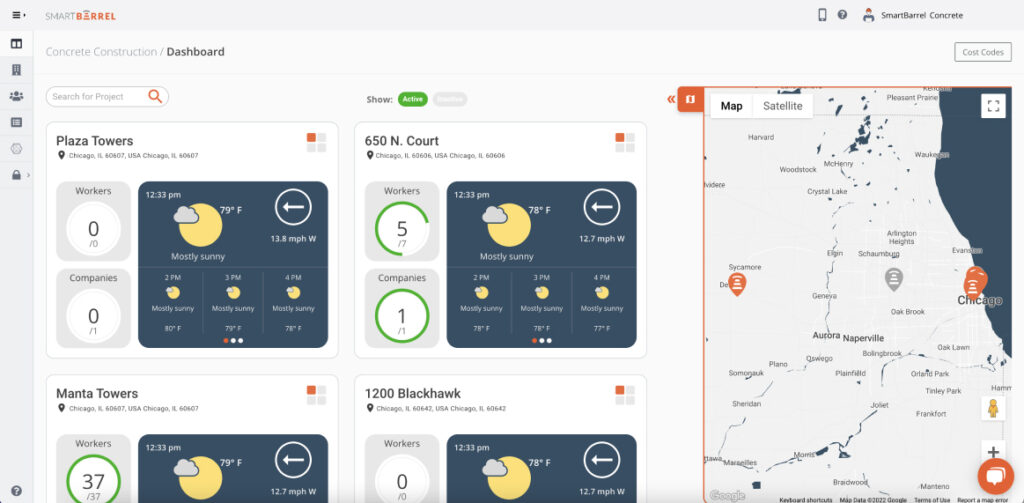
See how SmartBarrel eliminates manual data entry in daily reports.
How to Automate Daily Reporting Tasks in Construction for Effective Project Management
Automating daily reporting tasks in construction doesn’t mean replacing the foreman’s judgment. It means removing the parts of the process that don’t require judgment, such as work hours, cost codes and weather.
Workflow automation in construction daily reporting works because most of the data in a daily report is already being generated by site activity. Workers check in. Weather happens. Materials get delivered. Equipment usage accumulates.
The question is whether that data gets captured accurately in real time or reconstructed from memory at the end of a shift. Here’s what automation looks like in practice for construction firms:
What gets captured automatically:
- Headcount and hours: Workers use the daily report app or TimeClock to check in and out. The system records verified times. That data flows directly into the daily log without manual entry.
- Weather: Site weather pulls automatically based on location and the date. No more foremen trying to remember the weather at 5pm.
- Material deliveries: Logged at point of receipt. Material deliveries show up in the day’s report automatically rather than relying on foreman recall at end of shift.
- Cost codes: Hours can be assigned to cost codes automatically or with a single tap in the daily report app, so payroll costs are organized for job costing from the moment data is captured.
What foremen and PMs add:
- Work summaries: A brief summary of work completed, location on the construction site, and completion status.
- Site photos: Attached directly through the daily report app or mobile devices on site.
- Incidents and observations: Logged through the app or via SMS at punch-out for site safety compliance.
- Delays: Noted with cause and estimated impact on project schedules.
When daily logs are pre-populated with verified data, the foreman reviews, adds context to the day’s events, and submits. That’s a fifteen-minute task at the end of shift instead of an hour of reconstruction, and the resulting daily reports are accurate documents you can use for effective decision-making.
How SmartBarrel Builds Daily Logs From Verified Field Data
SmartBarrel uses existing data points – like verified hours and weather conditions – to automatically populate daily logs before you start building it. This gives contractors a head start using accurate data that doesn’t need to be recalled, estimated, or manually transferred into your reports later.
Here’s how the construction daily process flows:
- Workers check in: They check in by typing their phone number and taking a picture with the SmartBarrel TimeClock. Built-in LTE handles connectivity across remote sites. The system self-learns each worker; no photoshoot is necessary. Mobile devices and a foreman’s tablet handle smaller job sites or mobile crews.
- Field data flows in real time: Verified headcount, individual hours, and cost code data hit the SmartBarrel dashboard instantly. PMs can see who’s on site right now without calling the foreman. This is site data you can use for immediate management decisions – not data you receive the following morning.
- The daily log pre-populates: Workforce data, cost codes and weather are already in the daily report when the foreman opens it. They add work summaries, site photos, field observations, incidents, and any delay documentation from the shift.
- Reports are submitted and shared automatically: PMs, GCs, or owners receive daily reports based on configured preferences. For construction project management teams using Procore, the Procore integration pushes verified time and log data directly into Procore timesheets and daily logs – no duplicate entry, no additional project management software steps required. That same connection is covered in more depth on SmartBarrel’s Procore time tracking integration page, including how the two-way sync keeps cost codes, phases, and jobs aligned between Procore and the field.
The result is construction daily reporting that doesn’t depend on memory. Cloud storage means daily reports are searchable, accessible to the team, and ready if disputes arise months later. The PM team can create reports across all jobsites from a single dashboard, and field data flows from the site into payroll and ERP systems without manual transfer.
Prism Electric, an electrical contractor managing multiple construction projects across Texas, shifted from rounded timecards and manual daily construction logs to SmartBarrel’s automated system.
Their leadership had been asking: how accurate was our construction daily reporting? How much time was spent on specific codes?
SmartBarrel gave them detailed information backed by verified data instead of foreman estimates, and that accuracy changed how they ran every subsequent project.
Common Construction Daily Reporting Mistakes That Can Be Costly
These are the patterns that show up repeatedly across construction companies and the specific reason each one creates problems for project oversight:
Mistake | Why it costs you |
Filling out the day’s report from memory at end of shift | Details blur after any shift. Headcounts get rounded, weather gets forgotten, observations get skipped. The daily log reflects what you think happened, not what did. |
Vague descriptions of work summary | ‘Framing continued’ tells nobody anything useful. Project leads need specifics: which section, which workers, what stage of completion. Vague daily reports fail during billing disputes and project schedule reviews. |
Skipping photos | Photos are the only evidence type that’s hard to dispute. And with construction projects constantly progressing, a real-time photo is easily missed. Photos serve as essential legal documentation when a construction project goes to dispute. |
Submitting daily reports late | A construction report filed the next morning is worth less than one filed at the end of shift. Late daily reports also delay decisions for project leads trying to monitor progress and adjust project timeline. |
Using inconsistent formats across job sites | Reports from different foremen can’t be aggregated or compared. Construction companies running multiple projects need one standard construction report format that makes project information comparable across sites. |
Leaving out delays or incidents | The instinct to protect the record creates bigger problems later. Undocumented delays become your liability. Unreported incident logs create OSHA exposure. If it happened, the day’s report needs to include it. |
Treating hours as estimates | Rounded or reconstructed hours corrupt every downstream document: daily logs, timesheets, job cost reports, billing and payroll. Accurate records require accurate data at the point of capture, not approximations added hours later. |
FAQs About Construction Daily Reports
What is a daily construction report and why is it used?
A daily construction report is the official record of a construction project’s job site activity for a given day. It covers who was on the site, tasks completed, equipment use, materials received, weather, hazard logs, safety observations, and anything else that affected the schedule.
Construction companies use the daily construction report for project management, billing documentation, safety compliance, and as an audit trail for legal use. The short version: it’s the document that proves what happened on your job site on any given day, to anyone who asks.
What is the impact of daily reporting on site safety and liability?
Construction daily reports play a central role in site safety and legal protection. Consistent documentation of safety incidents, hazard notes, toolbox talks, and site visitors creates the documented safety culture that protects construction firms during OSHA audits and incident investigations.
For construction project managers, the OSHA recordkeeping requirements for sites make this a compliance necessity, not just a documentation tool. From a liability standpoint, dated and signed records that include detailed field observations can determine whether an incident results in a citation, a lawsuit, or a defensible record. Companies most exposed in safety disputes are often those with inconsistent or missing documentation – not necessarily those with the worst safety practices.
Who should complete and review daily reports on a construction site?
The foreman or site supervisoris responsible for completing the construction daily log and submitting reports before crews leave the site. On multi-trade construction projects, each subcontractor should maintain their own logs that roll up into the project record maintained by the GC or prime contractor. Construction project managers review and approve daily reports within 24 hours.
The construction manager for the overall project is responsible for ensuring that daily logs from all subcontractors are received, reviewed, and stored, either in the cloud or a project management software system so that project information is accessible to teams and decisions can happen based on accurate field data.
How often should daily progress reports be submitted and stored?
Automated time tracking changes construction daily reporting by solving the data reconstruction problem at the source. When workers check in and out using biometric facial verification rather than paper sign-ins or manual entries in a daily report app, the time on site in your construction daily log are verified records, not estimates.
Project managers get accurate daily reports that pre-populate with accurate data; weather, headcount, time logged, cost code assignments, and foremen add work notes, site photos, and field notes from the shift.
The process goes from an hour of end-of-day reconstruction to a fifteen-minute review. And the daily reports that come out of that process are accurate enough to support billing, generate reports that serve legal purposes, and stand up to scrutiny in ways that paper-based daily reports simply can’t.
Stop Letting Daily Reports be a Liability
Every hour your workers work is either documented accurately in daily reports or it isn’t. There’s no middle ground when a billing dispute shows up. Reports don’t lie, but incomplete reports do. Inconsistent construction daily reporting is one of the most preventable sources of risk for any contractor, and one that contractors fix when they stop treating reports as paperwork and start treating them as data. Reports are the record. Protect them.
SmartBarrel gives you verified field information from the construction site that feeds directly into construction daily logs, so what you submit reflects what actually happened, not what someone remembered at the end of a long shift. PMs get easy access to daily reports across every job site, and your team stops chasing project data, and every construction report is backed by biometrically verified data. The workflow doesn’t get simpler. It gets accurate.
One job site or fifty. Same accuracy. Successful projects are built on that discipline. That’s what construction daily reporting should look like.
Book your SmartBarrel demo – See accurate construction daily reporting from day one.