

With all the recent talk about artificial intelligence and leveraging construction data, you may be wondering exactly what the fuss is all about. Is it worth it to jump on the bandwagon? If your goals are saving money, increasing efficiency, more accurate estimates, and increased profits, then the answer is yes. This article explains what AI can do for construction companies, but most importantly, where to start if you want to jump on the train.
What Can AI Do In Construction?
AI in construction means software that mimics human thinking to predict outcomes, plan and schedule work, flag safety hazards, and analyze designs, using past job data to do it:
- Predictive analytics using past experience and job data to predict outcomes
- Making complex decisions based on that analysis
- Project planning and scheduling (including analysis and identification of potential problems)
- Robotics and 3D printing
- Building information modeling (BIM) to analyze designs
- Identifying potential safety hazards
- Productivity and analytics and recommendations
In 2022, 92% of construction companies said they were using or planned to use AI in their business, yet overall the industry is one of the slowest to adopt new technologies. This may be due to the fragmentation and complexity of the industry, or the effects of the aging of the construction workforce.
Whatever the cause, getting construction companies to adopt AI and other technologies has been a struggle, despite the inherent advantages:
- Higher quality construction
- Improved safety
- Increased productivity
- Cost savings
Why Does AI Need Accurate Construction Data?
AI bases every prediction on the data it’s given, so inaccurate inputs produce unreliable outputs. In construction, where margins are thin, bad data can cost a company up to 30% or more of its revenue.
AI provides the most advantages in its ability to analyze project data and use that analysis to predict future outcomes. This is similar to relying on experienced project managers, supervisors, and estimators for their insights into a project. In the same way, they rely on their experience to tell them when problems may arise so they can address them before they occur. AI can be used to perform a similar analysis. The process is called machine learning, and the more data available for analysis, the more refined its predictions will be in current situations.
If you’ve heard the phrase “garbage in, garbage out,” you understand how machine learning works – similar to this – there is a phrase forming with companies starting to use AI – “garbage in, bad insights out”. AI can only base its analysis on the data provided, so if it isn’t accurate, the predictions that come from it will be wrong. This can have a tremendous impact on a business, especially in the construction industry, where margins are thin and competition is tight. The cost of incorrect data can be up to 30% or more of a company’s revenue.
AI-powered time tracking addresses this directly by replacing manual hour entry with verified biometric records, giving the system clean labor data to work with from day one.
To save a company from these extra costs, gathering and inputting accurate construction data is the key. Only in this way can you guarantee that your AI predictions will be correct. For most construction companies, the accuracy of the following data points is extremely important:
- Material costs
- Labor hours
- Equipment usage time
- Total job costs
- Safety incidents
- Schedule delays
Inaccuracies in tracking any of these could lead to incorrect assumptions when using AI, which means you could be making the wrong decisions for your company.
Why Are Accurate Labor Hours So Important?
Labor costs can represent 50-60% of a construction project budget. For subcontractors and service contractors, these percentages may be even higher, as worker wages for these contractors are often based solely on the number of hours worked. If labor hours aren’t tracked accurately, the costs to a contractor could be exponentially more than just wages and benefits.
|
When labor hours are tracked inaccurately, it can hurt |
When labor hours are tracked accurately, it can improve |
|
Taxes owed |
Payroll processing time |
|
Project costs |
Labor costs, through fewer overpayments |
|
Workers compensation and general liability insurance costs |
Insurance audits |
|
Estimates |
Estimate accuracy and competitiveness |
|
Bottom-line profits |
Bottom-line profits |
|
Future project profitability |
Future project profitability |
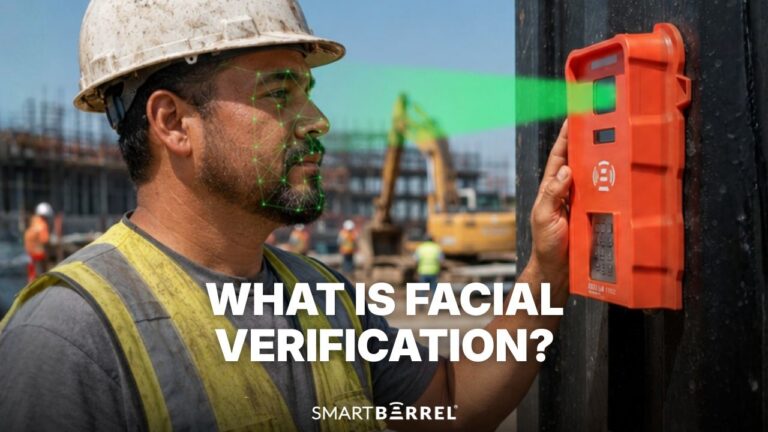
SmartBarrel offers an easy to implement, easy to use, field-friendly process for collecting construction labor hour data and ensuring that it’s accurate. Using biometric facial verification, the system ensures that workers are on site when they say they are on site. This reduces workarounds such as timecard tampering and asking others to punch in/out (buddy punching), as well as technology issues like phones or apps not working. In addition, its intuitive design means that there’s very little training required.
SmartBarrel’s time tracking solution includes a device that is built for the field, has its own LTE connection, and can be powered by electricity or solar power. It uses AI-powered facial verification to verify worker times and has a dashboard that allows supervisors to review time and assign cost codes. Time data can then be exported to a number of construction accounting programs to allow for quick payroll processing.
This could save your company more than $4,285 per worker and 800+ data entry hours per year. The system makes timekeeping error-proof, which ensures more accurate job costing and reduced pay disputes.The next step to more accurate time tracking and job costing is scheduling a demo with our team. The system pays for itself within the first month and set-up is easy and fast. You can’t afford not to contact us!
Frequently Asked Questions
Is the biometric data from facial verification private and secure?
Facial verification works by confirming presence, so it compares a new photo against a worker’s own previous photos rather than matching faces against any outside database. Because it can’t identify a stranger, it captures far less than a recognition system would. For specifics on how data is stored and how long it’s kept, it’s worth confirming the details with the vendor during a demo.
Can verified labor data feed into AI, BI, and analytics tools?
Yes. Once labor hours are captured and verified at the source, that data can flow into payroll and accounting systems and into analytics tools like Power BI for job costing and reporting. Clean inputs are what make the tools that rely on that data, including AI-driven analysis, more reliable.
How do you start collecting accurate data if you still use paper or manual timesheets?
The practical first step is replacing manual hour entry with a verified capture method at check-in, so the data is clean before it ever reaches payroll or reporting. Workers check in and out, supervisors review the hours and assign cost codes, and that verified record becomes the basis for everything after it. Starting there keeps you from feeding old inaccuracies into new tools.