

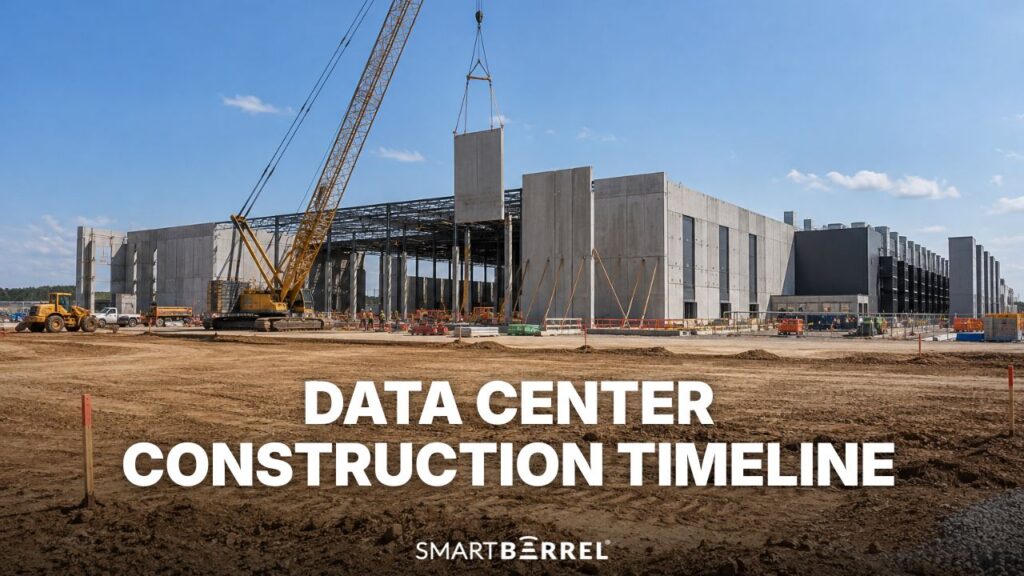
A full data center construction timeline typically runs three to six years from site selection to commissioning, with vertical construction accounting for roughly 12 to 36 months of that span. Coverage tends to lead with data center construction timeline years and stop there, which suits developers and owners.
For the specialty contractors and self-perform GCs whose crews build these facilities, the total matters less than what is left after permitting, design, and equipment procurement have eaten the float. Whatever remains is the window the labor plan has to fit inside.
What The Full Data Center Construction Timeline Looks Like, Phase By Phase
Data center development moves through five phases, each with its own duration range and risk profile.
Phase | Typical duration | What happens |
Site selection and demand analysis | 6 to 12 months | Power availability, grid capacity, fiber, water, and utility access weighed against local regulations |
Permitting and zoning approvals | 6 to 18 months | Government agencies review environmental regulations, land use, transmission lines |
Data center design and preconstruction | 9 to 18 months | Construction documents, redundant systems, cooling infrastructure, power density targets |
Vertical construction | 12 to 36 months | Shell construction, infrastructure systems, fit-out of multiple buildings |
Commissioning and energization | 3 to 9 months | Integrated systems testing, utility interconnection, and handover |
Treat these as typical ranges, not fixed figures. Duration varies with market, scale, and utility infrastructure, and the ranges have been widening.
On fast-track jobs the phases overlap. A greenfield data center can break ground while long lead equipment is still sitting in fabrication, and that overlap is where pressure on project schedules starts.
How Long Does The Construction Process Take, From Shell Construction To Commissioning?
Vertical construction on a single building typically runs 12 to 24 months, with larger campuses extending toward 36 months across multiple buildings. Broken into typical data center construction timeline months, the work falls into four stages:
- Sitework and foundations: grading, underground, slab
- Shell construction and envelope, enough steel and skin to get the building dried in
- Rough-in and fit-out, where electrical systems, power distribution, and cooling systems go in alongside each other
- Integrated systems testing, where every system gets proven together before handover
The back half carries most of the labor. Power distribution equipment, UPS systems, and backup generators arrive alongside advanced HVAC systems and computer room air handlers, with fire protection, security systems, and monitoring systems threaded through the same window. All of it has to be proven before commissioning closes out.
Hyperscale Data Centers Vs. Enterprise Data Centers: How Data Center Design Shapes The Build
Build duration tracks power capacity more than square footage. A 5 MW enterprise facility and a 200 MW campus can occupy similar footprints and still differ by two years in delivery.
Most of that difference plays out in the data center construction phases that follow the shell, when electrical and mechanical rough-in push headcount to its peak.
Cost tracks capacity too. JLL’s 2026 Global Data Center Outlook forecasts average global shell-and-core cost at $11.3 million per MW for 2026, up from $10.7 million in 2025, with tenant fit-out billed separately.
Behind that per-megawatt figure, a full data center construction cost breakdown spans electrical, cooling, shell, land, and a labor line that rarely arrives with a fixed price.
Build type | Construction duration | Typical crew on site | Redundancy |
Edge | 6 to 12 months | 20 to 60 workers, short trade overlap | N+1 |
Enterprise | 12 to 24 months | 100 to 300 workers, single shift | Tier III common |
Hyperscale | 18 to 36 months per campus | 500 to 2,000+ across pads and shifts | 2N on critical systems |
A hyperscale data center construction timeline runs longer at the campus level and shorter at the building level, which surprises people. Repeatable data center design, prefabricated skids, and phased handover let one building energize while the next is still in shell. The campus program takes years even when each building on it does not.
Those crew counts are not hypothetical. Apache Industrial solved buddy badging across 6,000 field employees, and Newtron Group runs hundreds of workers on its data center projects. That is the scale a campus reaches once trades stack across shifts.
Why Does Critical Equipment Keep Compressing The Back End Of Data Center Development?
Long lead power equipment is the single largest source of schedule risk, and almost none of it sits within a contractor’s control.
JLL’s 2026 Global Data Center Outlook reports that average global equipment lead times have reached 33 weeks, a 50% increase over pre-2020 levels, and that more than half of projects in 2025 experienced construction delays of three months or more, even with developers preordering materials as much as 24 months in advance. Average grid connection lead times now exceed four years in primary markets.
A transformer slips, a utility provider pushes energization, zoning approvals drag, and the completion date holds anyway. The tenant commitment was made against that date and the owner is not moving it. What moves instead is everything downstream.
The scope stays the same while the calendar shrinks, so crew density rises, second shifts get added, and trades that were sequenced to follow each other end up working the same areas at once.

How Do Owners And Contractors Compress A Data Center Build?
Most of the levers sit at the front end, before a crew mobilizes. Freezing design early against OEM data lets procurement book factory slots while drawings are still in progress, the difference between a 33-week lead time running parallel with construction and running after it. JLL projects annual sales of modular systems and micro data centers reaching $48 billion by 2030 as the industry leans on that approach.
Prefabrication does the same for labor. Skid-mounted power equipment and modular cooling shift hours into controlled shops, taking work off the critical path without adding bodies to a congested site.
Phased handover is the third lever. Energizing building one while building two is still in shell gives the owner revenue earlier and the trades a staggered ramp instead of one compressed peak.
Which Trades Are On The Clock During Each Construction Phase?
Every trade experiences a different version of this timeline, and the ones with the longest continuous presence carry the most exposure when it tightens.
Sitework, Concrete, And Steel: First In, First Out
These crews mobilize first and demobilize early, usually before critical infrastructure deliveries start driving the schedule.
Electrical Contractors: The Longest Run On Critical Infrastructure
Electrical carries the longest tail of any trade. Crews mobilize with the underground work and stay through switchgear, power distribution units, busway, and final terminations. Electrical is a substantial share of total build cost, and it feeds straight into commissioning.
Mechanical And Controls: Cooling Infrastructure That Gates Commissioning
These contractors land in the middle and stay late. Liquid cooling, chilled water, computer room air handlers, and building controls all feed integrated systems testing, so a slip in their scope pushes the energization date with it.
Fire Safety, Physical Security, And Low-Voltage: The Tightest Window
These crews thread between other trades in already congested areas, usually with the least float on site.
What A Compressed Data Center Project Does To Labor Cost Control
Once a job compresses, labor data becomes a project controls problem, which is a large part of why time tracking gets so hard at scale on data center projects. Weekly reconciliation works well enough on a normal job.
On a job running 600 workers across three shifts and four buildings, hours rekeyed into the ERP three to five days late arrive too late to act on, and project managers forecast against numbers that describe last week.
Cost coding is where this shows up first. Labor hours reaching payroll without a job-specific cost code or craft classification break earned-versus-burned reporting at the moment it matters most. Contractors lose the ability to track real time costs by building, level, or phase. Certified payroll submissions turn into reconstruction work, and union payroll reporting inherits the same gaps.

Your labor hours shouldn’t land three days after the decision. See how verified check-ins put same-day hours in front of your PMs, cost-coded and ready for the ERP. Get a Demo
How Construction Teams Protect The Schedule With Verified Field Data
Contractors who hold their labor position on compressed jobs fix this at the source. Capturing hours at check-in, with biometric facial verification confirming who is on site, removes the rekeying step and hands foremen a pre-populated timesheet instead of a data entry task. Cost codes and classifications get assigned in the field the same day. That is what the most accurate time from the field buys on a compressed schedule.
It is the model behind time tracking for data center construction, where verified hours flow into the ERP and construction productivity tracking runs on real numbers instead of estimates.
The Newtron Group, a union electrical and instrumentation contractor with more than 1,000 employees, moved off paper timecards for that reason. As documented in their case study, the union electrical contractor rolled out across six data center projects in three weeks, cut payroll processing time by 20%, and reduced manual data entry by 25%.


Frequently asked questions
Does modular construction shorten the timeline for building a data center?
Yes, though the savings land in a specific place. Prefabricated power skids, modular cooling, and factory-built electrical rooms move labor off the critical path, compressing fit-out more than the overall schedule. Permitting and equipment procurement are unchanged.
How far in advance should a specialty contractor commit crews to a data center project?
Further out than most other work. ABC’s Construction Backlog Indicator for June 2026 put contractors with data center work at 11.0 months of backlog against 8.5 months for those without, so commitments often get made before a firm mobilization date exists. Committing against design freeze and equipment release gives a more reliable anchor than the original schedule.
Do data center construction timelines differ by region?
Considerably. Permitting speed, local regulations, and grid capacity vary enough that identical facilities can differ by a year or more between markets. Northern Virginia, Columbus, Phoenix, Atlanta, and Dallas each carry different interconnection queues and different depth of trade labor.
Planning labor around a timeline you do not control
Demand for data centers continues to outpace the workforce available to build them. Associated Builders and Contractors estimates the industry needs 349,000 net new workers in 2026, rising to 456,000 in 2027, with AI data centers named among the drivers.
Transformer lead times, grid capacity, and permitting queues sit outside a contractor’s hands. The hours their own crews work do not. Getting those hours accurate and coded the same day keeps a labor plan adjustable while there is still schedule left to adjust.
Building on a compressed data center schedule? Get the most accurate time from the field, from the gate to payroll. Simple enough for the crew. Built for a campus running thousands. Request a Demo