

Confidence. It can take you a long way. Not only in the construction industry but in life itself.
Automated time tracking helps contractors earn more on every project in five ways: more accurate bids built on real labor history, real-time labor tracking that catches overspend early, integrations that remove manual re-entry, cost code visibility into actual labor costs, and faster jobsite communication that cuts downtime. Each one starts from the same input, verified hours captured at check-in, which is why the accuracy of that first step decides how much the other four are worth.
Explore these five ways an accurate, innovative, and no-nonsense approach to construction time management can give you the confidence to control your job site and make more money for your company.
|
Way to earn more |
What changes |
Where the data comes from |
|
1. More accurate bids |
Estimates priced on real production rates by cost code |
Verified hours from past jobs |
|
2. Real-time labor tracking |
Overspend caught during the week, not at payroll |
Live check-in and check-out data |
|
3. Operational efficiency |
Manual re-entry removed between field and office |
Integrations with ERP and project management (Procore, CMiC, Viewpoint Vista) |
|
4. Actual labor cost visibility |
Budget vs. actual hours by cost code, updated daily |
Cost codes assigned on the timesheet |
|
5. Reduced downtime |
Schedule and site changes reach the whole crew fast |
SMS broadcast to workers checked in that day |
1. How does automated time tracking create more accurate bids?
Bids get more accurate when the labor history behind them reflects hours verified at check-in rather than reconstructed at week’s end. A contractor who knows the true hours per cost code on the last three similar jobs can price the next one against real production rates instead of a blended guess. The gain shows up as fewer surprises mid-project, since the estimate and the field were built from the same data.
Imagine bidding for a large contract with extreme confidence, knowing your labor costs inside and out. That is how companies like Axcon Corporation, Inc. consistently win more bids. When you know the actual labor costs for your projects, you will have the confidence to create more competitive bids.
SmartBarrel offers detailed job costing information instantly. This can make it easier to provide more accurate bids on your future projects, which leads to more projects being awarded to your team. The ability to create accurate bids using historical production tracking and labor tracking is a no-brainer.
2. How does real-time labor tracking protect project margins?
Real-time tracking changes when you find out about labor overspend: during the week it happens instead of when payroll closes. A superintendent who can see budgeted versus actual hours by Wednesday can shift crew, adjust scope, or document a change order before the overage compounds. The margin protection comes from the timing of the information.
When you have accurate time-tracking visibility into projects, you can make sure you are not overspending on labor costs, which increases your overall project profitability. Get on your way to quickly predicting project completion dates and resource requirements and win repeat business. No more paying for work that didn’t happen.
“SmartBarrel has brought about a positive culture change at Axcon. Supervisors now have real-time data on employee hours, enabling them to make informed decisions and drive productivity.” – Axcon Corporation, Inc.
Get Control of Your Time Tracking
3. How do integrations improve operational efficiency?
Integrations remove the re-keying step between field time and the office systems that use it. When coded hours flow from check-in into an ERP or project management platform such as Procore, CMiC, or Viewpoint Vista, payroll and job costing run on the same record the field created, so there is nothing to reconcile at the end of the pay period. The efficiency shows up as shorter payroll cycles and fewer correction rounds.
Software integrations help contractors streamline their operations, improve efficiency, and use data from both platforms to win more jobs and increase their profitability. Seamless data shared between SmartBarrel and ERPs and Project Management software like CMiC and Procore help contractors avoid delays by reducing manual data entry, removing the human error element, and helping to accelerate project timelines, helping directly impact your company’s bottom line. Watch your project timelines shrink in real-time.
Accurate job costing starts with accurate time capture. When hours are coded correctly at clock-in and flow directly into the ERP, the financial picture at the end of a project reflects what actually happened in the field.
For CMiC shops, the CMiC integration carries those coded hours into eTime so job costing runs on verified field data rather than estimates.
That data trail starts at the construction timesheet app, before the numbers ever reach payroll or job costing.
Learn how much time you could save if your systems talk to each other efficiently.
4. How do you see actual labor costs by cost code?
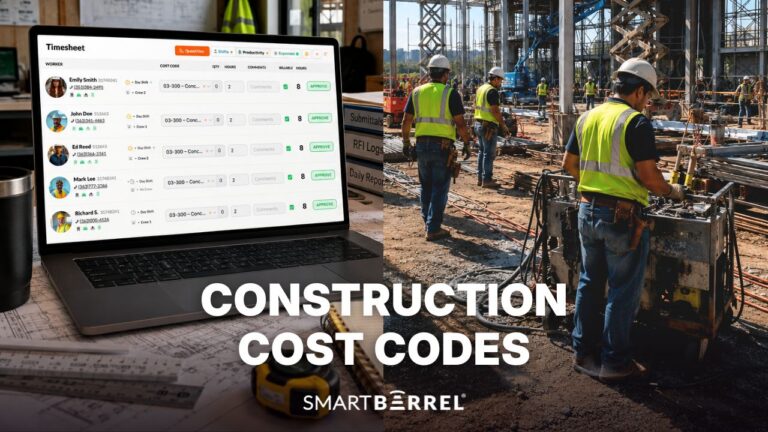
Actual labor cost visibility comes from attaching a cost code to hours at the point they are captured, then comparing those hours against the budget for that code as the job runs. A foreman assigning or splitting cost codes on a pre-populated timesheet takes seconds; the payoff is a budget-versus-actual view that updates daily instead of monthly. Contractors typically start with the two or three codes that carry the most labor and expand from there.
Without visibility into labor costs, decisions get made on estimates. SmartBarrel provides a view into actual labor costs so you can make decisions backed by data. Cost codes and phase codes can be assigned to shifts, so you can see budgeted versus actual hours by cost code, spot where you are making or losing money, and act on it during the job instead of after. Keeping cost codes aligned with actual productivity is what makes that view reliable.
From there, the real win is measuring output against those hours. This breakdown of construction productivity tracking shows the core metrics and tools.
5. How does faster jobsite communication reduce downtime?
Downtime on a jobsite is often a communication lag: a crew waiting on an instruction, a delivery, or a weather call that someone in the office already knows about. Broadcast messaging by SMS reaches every worker who checked in that day, without an app or a group chat to maintain, so a schedule change or a site closure reaches the crew in minutes. The saving is measured in crew-hours not spent waiting.
The financial impact of downtime can harm your project’s health and team morale. Every hour your team isn’t aligned can cost you money. Keep projects on schedule with SMS Broadcast Messaging to allow you to communicate with your on-site workers instantly. Reduce downtime with real-time communication and get your project completed quicker. Don’t let timely delays that could be fixed with a quick text message eat into your profits. Get moving and get on the same page today!
Before you waste money on another failed solution, check out our comprehensive guide to the best construction time tracking systems available today.
When the industry calls for cutthroat decision-making, future-forward contractors look for solutions, not just a product. In our business, every minute wasted is money lost. Miscommunications, clouded visibility, inefficient operations, outdated labor tracking with pen and paper, and inaccurate bids are draining your profits and costing your business. SmartBarrel not only helps you save money but also increases profits.
Swapping manual entry for an on-site clock-in device removes the guesswork that quietly inflates those numbers before they ever reach payroll.
Book your quick demo and start realizing the benefits of how smart timekeeping can help you make money.
Frequently Asked Questions
-
Does automated time tracking replace job costing or ERP software?
No. It feeds them. Job costing and ERP platforms are only as accurate as the hours entered into them, and automated time tracking replaces the manual entry step with a verified record captured at check-in. The integration carries coded hours into the system you already use, so the outcome is cleaner data in your existing stack rather than another platform to manage.
-
How quickly does automated time tracking pay for itself?
For most contractors the payback is measured in weeks. Conservative math: a worker paid $20 per hour who rounds time by 15 minutes twice a week costs roughly $10 per week, or about $40 per month, in unearned pay, before payroll taxes and burden. Across a 50-person crew that monthly gap is typically larger than the cost of the system, which is why SmartBarrel positions payback within the first month. Industry research suggests the annual figure can reach $4,285 or more per worker once time theft and admin hours are counted.
-
Can automated time tracking help win T&M billing disputes?
Yes, and this is often the fastest return. On time and material work the GC or owner is paying your fully burdened rate, so they will ask for proof that each billed hour happened on site. A facial verification photo with a timestamp and a geofence record answers that question in a way a foreman-signed sheet cannot, which shortens disputes and reduces the hours a contractor ends up absorbing.